kizewamono
生世話物
きぜわものthe rawest, most realistic of kabuki's domestic plays
INSTANT ANSWER
Kizewamono are the most sharply realistic of kabuki's domestic plays, depicting the raw life and lower depths of the Edo townsman's world.
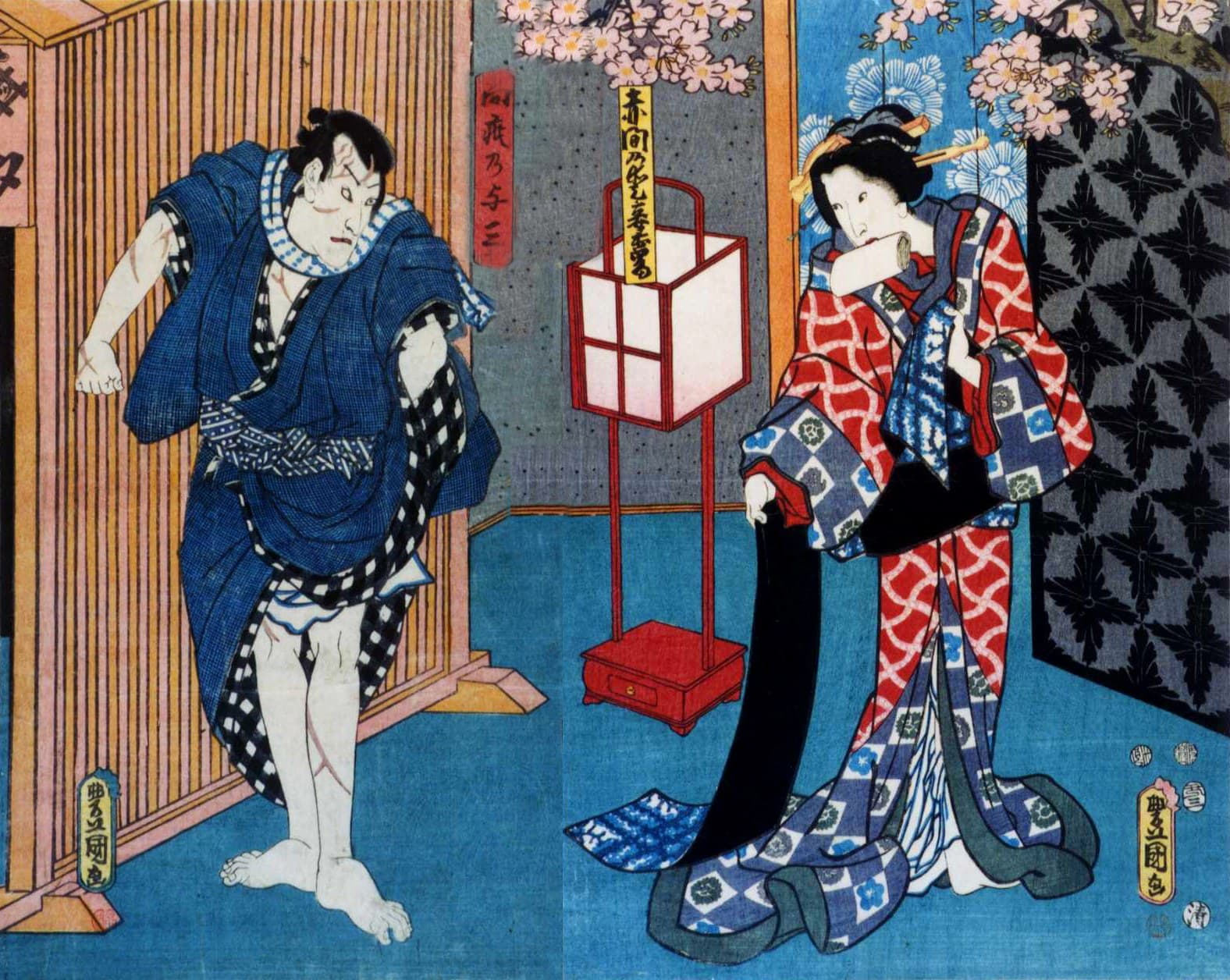
Kizewamono are the domestic plays (sewamono) of exceptional realism. The prefix ki is taken to mean "pure" or "raw": these works transcribe onto the stage, without ornament, the customs of society's lower depths and the darker workings of human nature.
The genre is said to have developed in Edo kabuki from the Bunka-Bunsei era (1804–30) onward, with Tsuruya Nanboku IV as its representative author—his Tōkaidō Yotsuya Kaidan, unsparing in Iemon's villainy and Oiwa's tragedy, its masterpiece. In the final Edo years Kawatake Mokuami is said to have written many kizewa plays for Ichikawa Kodanji IV.
In the final Edo years the kizewa line of realism joined with Kawatake Mokuami's musical dialogue to reach a summit all its own. In Sannin Kichisa Kuruwa no Hatsugai, said to have premiered in 1860, the thief Ojō Kichisa—a man in a young woman's furisode—sings out the famous lines in 7-5 meter at the riverbank by Sumida, "The moon hazy, the whitebait fires dim in the spring sky..." Portraying lives lived in the city's shadows, the language flows like music: one destination of the domestic play.
Aragoto's perfected stylization and kizewa's raw reality form kabuki's two poles. That Ichikawa Danjūrō VII is said to have created the role of Tamiya Iemon at the premiere of Tōkaidō Yotsuya Kaidan shows the house of aragoto leaving its mark on the theatre of realism as well.
Plays Where You Can See It
- Tōkaidō Yotsuya KaidanThe Ghost Story of Yotsuya (Tōkaidō Yotsuya Kaidan)The masterless samurai Tamiya Iemon, weary of his wife Oiwa, chooses advancement and a marriage into the wealthy family next door.View play
- Sannin Kichisa Tomoe no ShiranamiThe Three Kichisas (Sannin Kichisa Tomoe no Shiranami)Ojō Kichisa in a young woman's robes, Obō Kichisa the masterless samurai, Oshō Kichisa the former priest: three thieves who share a name meet on the bank of the Sumida.View play
Read this next
These words meet on the same stage. Knowing one makes the next easier to see.
- 世話物sewamonoSewamono are plays of ordinary townspeople in the Edo period—dramas of love, duty, and scandal drawn close to real life.Read
- 怪談物kaidan-monoKaidan-mono are kabuki's ghost plays, traditionally staged in summer; Tsuruya Nanboku's Tōkaidō Yotsuya Kaidan stands as the genre's masterpiece.Read
- 白浪物shiranami-monoShiranami-mono are kabuki's "thief plays"—dramas with charismatic robbers as their heroes, which flourished at the end of the Edo period, above all in the work of Kawatake Mokuami.Read
- 時代物jidaimonoJidaimono are kabuki's history plays, set in the worlds of samurai and nobles, staged with grand, highly stylized acting.Read
Sources & Supervision
- Author
- KABUKI Universe Editorial Team
- Supervision
- Ichikawa Danjūrō
- Published
- Aug 16, 2026
- Updated
- Sep 9, 2026
Supervision means Ichikawa Danjūrō has reviewed this page's intent and key points. The text is the editorial team's writing, not Ichikawa Danjūrō's own statements. Editorial responsibility rests with the team, which corrects any error. Read the editorial policy