mie
見得
みえthe dramatic frozen pose
INSTANT ANSWER
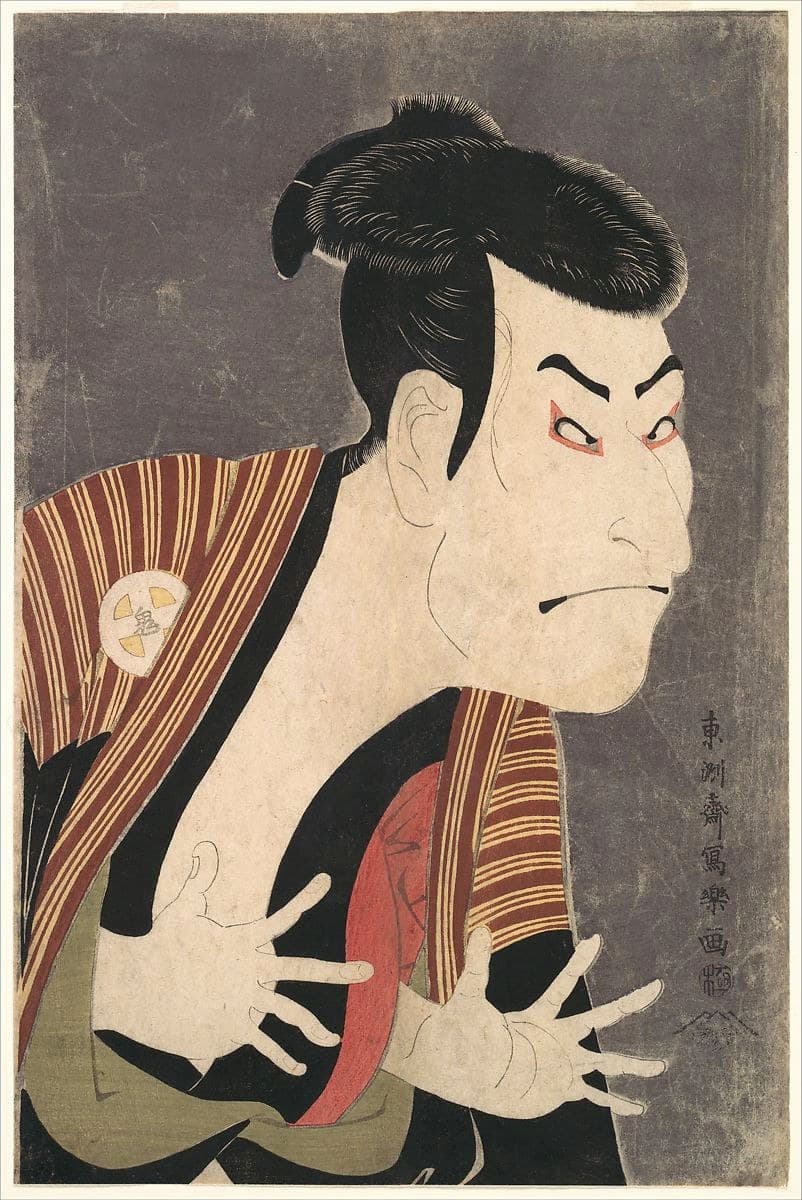
A mie is the stylized pose in which an actor freezes at a moment of peak emotion, punctuated by the sharp crack of wooden clappers.
A mie is the moment when an actor suddenly stops at an emotional peak—rotating the head, opening the eyes wide, and holding a sculptural pose. The sharp "battari" of the tsuke clappers lands at the same instant, and the whole stage resolves into a single picture. It is often compared to a cinematic close-up.
Many mie are tied to specific plays and roles—the Genroku mie in Shibaraku, the pillar-wrapping mie in Narukami. It is also the classic moment for spectators to call out an actor's house name, when the whole theatre breathes as one.
A single play can hold a whole sequence of mie. In Kanjinchō, Benkei, Togashi, and Yoshitsune lock into the three-figure "heaven-earth-man" mie; Benkei ends his reading of the subscription scroll with the "Fudō mie," modeled on the guardian deity Fudō Myōō; the mountain-ascetic catechism closes with a Genroku mie; and the "stone-throwing mie" follows. Simply watching for the mie is one of the easiest ways for a first-time viewer to follow the drama's pulse.
The phrase mie o kiru—"to cut a mie"—has entered everyday Japanese: striking a showy, self-assured attitude is "cutting a mie," and making a grand, confident declaration is "cutting a great mie" (ōmie o kiru). Offstage as well as on, the gesture lives on in the language.
Alongside the mie, the Ichikawa Sōke hands down a special crossed-eyed glare called the nirami. Being "glared at" by Danjūrō is popularly said to drive away evil and bring a year of good health, and it is performed on landmark occasions such as name-succession celebrations.
Video & Voice
市川團十郎が語る歌舞伎の”見得” | 生き方の美学
Jun 15, 2025
歌舞伎の「見得」の意味と種類、生き方の美学としての見得を團十郎が解説。
FROM THE OFFICIAL CHANNEL
KABUKU. / Ichikawa Danjūrō.Films where this word appears
市川團十郎が語る歌舞伎の”見得” | 生き方の美学
Jun 15, 2025
The meaning and varieties of mie, framed as an aesthetics of living — why stillness reads as strength.
Plays Where You Can See It
- ShibarakuShibaraku — Just a Moment!The tyrant Kiyohara no Takehira has seized power and is about to execute a group of innocents who refuse to bow to him.Kabuki JūhachibanView play
- KanjinchōKanjinchō — The Subscription ScrollMinamoto no Yoshitsune, estranged from his powerful brother, flees north disguised as a mountain ascetic with his loyal retainer Benkei and a handful of men.Kabuki JūhachibanView play
- NarukamiNarukami — The Thunder GodThe holy priest Narukami, wronged by the imperial court, has sealed the rain-bringing dragon god beneath a waterfall, plunging the land into drought.Kabuki JūhachibanView play
Read this next
These words meet on the same stage. Knowing one makes the next easier to see.
- ツケtsukeTsuke are the sharp beats of wooden clappers struck against a board at the side of the stage, accenting footsteps and landing exactly on the frozen mie poses.Read
- 荒事aragotoAragoto is the bold, larger-than-life acting style—said to have been created by Ichikawa Danjūrō I—in which heroes express superhuman power through striking makeup, oversized costumes, and dramatic poses.Read
- 六方roppōRoppō is a bravura stylized walk with sweeping arms and stamping feet—most famous as Benkei's "flying roppō" exit down the hanamichi in Kanjinchō.Read
- 隈取kumadoriKumadori is kabuki's distinctive makeup of bold colored lines that reveals a character's nature—red for heroic passion, blue for villainy or the supernatural.Read
Sources & Supervision
- Author
- KABUKI Universe Editorial Team
- Supervision
- Ichikawa Danjūrō
- Published
- Aug 15, 2026
- Updated
- Sep 9, 2026
Supervision means Ichikawa Danjūrō has reviewed this page's intent and key points. The text is the editorial team's writing, not Ichikawa Danjūrō's own statements. Editorial responsibility rests with the team, which corrects any error. Read the editorial policy