Q&A
Costume, Makeup & Wigs
How are a role's face and wig decided?
ANSWER
It starts from the character's core nature: makeup follows the house's kata and precedent, while the wig is fitted at a katsura-awase session and dressed to the role's rank and age.
The Short Version
- The starting point is the character's shōne: a grasp of what sort of person this fundamentally is.
- Actors apply their own makeup; stylised faces such as kumadori are largely fixed by play and role.
- For the wig there is a katsura-awase fitting: the metal base is shaped to the head, then the tokoyama dresses it.
- Face and wig are not separate decisions but two outcomes of a single reading of the character.
See it in a picture
Beni-guma (red)
Justice, youth, overflowing strength
Ai-guma (indigo)
Villainy, vengeful spirits, cold power
Cha-guma (brown)
Demons and creatures beyond the human
The order begins with shōne, the character's core nature. What sort of person is this at bottom — strong or brittle, on the side of righteousness or nursing a grievance? Until that is settled, neither face nor wig can be. Put the other way: every choice in the koshirae is derived from that single point.
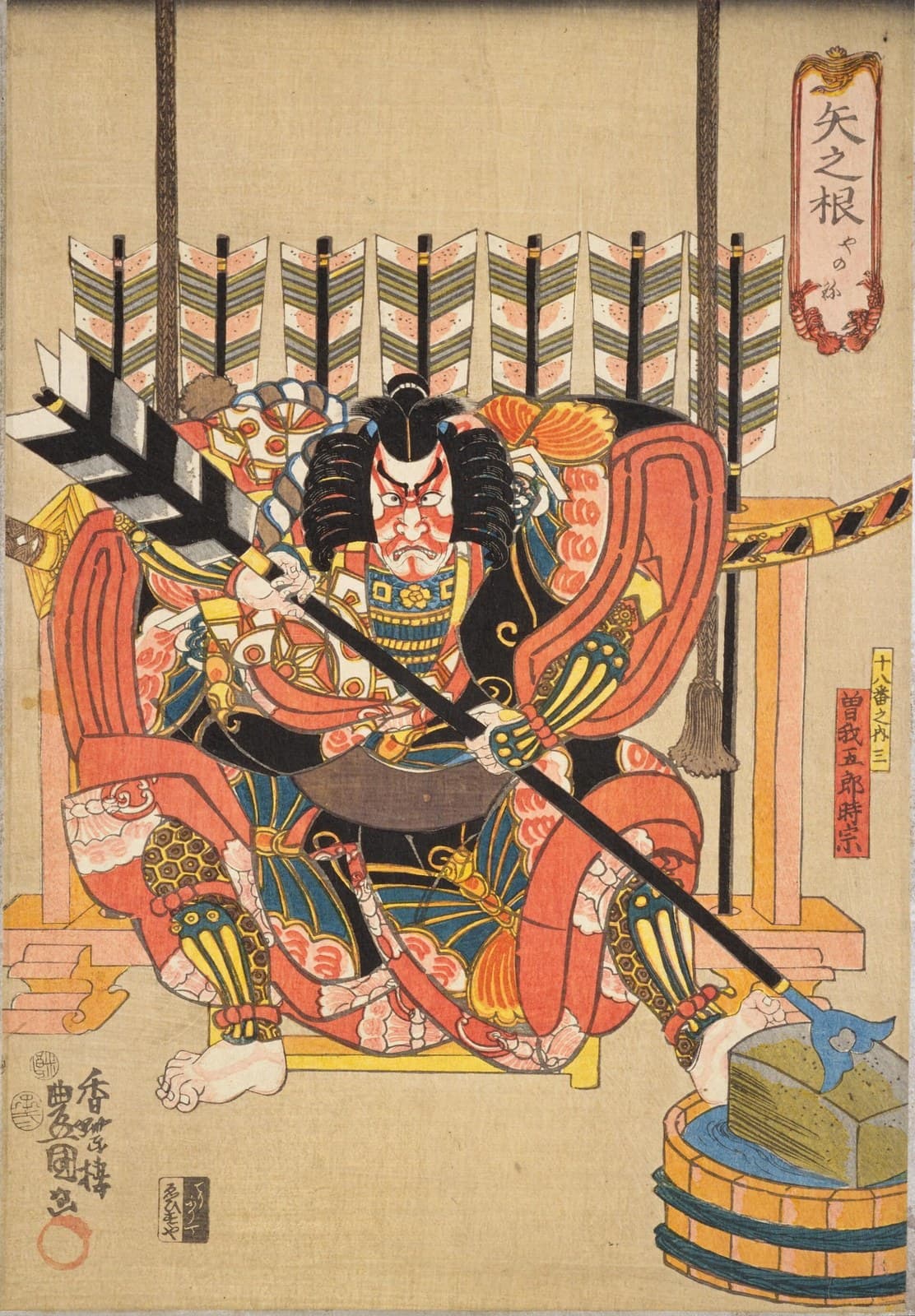
As for makeup, kabuki actors apply their own. At the dressing-room mirror they lay on the white and draw the lines. Stylised faces such as kumadori are largely fixed by play and role — suji-guma for the aragoto hero, indigo for the court villain. But the weight of a stroke, the way it is swept, the degree of blurring carry each house's kata, and into that comes an adjustment to the actor's own bone structure. Copying a father's face exactly may not sit on one's own. So a young actor works from his forebear's face while searching for the strokes that hold on his.
For the wig there is a fitting called katsura-awase before the run. The base built by the katsura-shi is set on the actor's head and its tension adjusted. If the fit is wrong the wig shifts under violent movement, and hours of wearing bring headaches. Once the base is settled, the tokoyama dresses it into the role's coiffure — samurai or townsman, young or old, kempt or dishevelled, all declared by the shape of the topknot and the precision of the dressing. And crucially, face and wig are not decided separately. Both derive from the same reading of the shōne, which is why they always answer one another.
Words Used Above
- Shōne
- A character's fundamental nature — the point from which both koshirae and acting derive.
- Katsura-awase
- The pre-run fitting at which the metal base is shaped to the actor's head and its tension set.
- Kugeaku
- The grand villain in courtier's dress, given an uncanny air by indigo kumadori.
Words in This Answer
- 隈取kumadoriKumadori is kabuki's distinctive makeup of bold colored lines that reveals a character's nature—red for heroic passion, blue for villainy or the supernatural.
- 鬘katsuraKatsura are kabuki's wigs, whose fixed styles signal a character's status, age, and occupation at a glance.
- 床山tokoyamaTokoyama are the craftspeople who dress, style, and maintain kabuki wigs, giving each role its finished head of hair.
More in This Category
Sources & Method
This answer rests on widely shared, established knowledge of kabuki. Matters transmitted as custom are marked "it is said," and assertion is avoided.
- Author
- KABUKI Universe Editorial Team
- Supervision
- Ichikawa Danjūrō
- Published
- Aug 25, 2026
- Updated
- Sep 9, 2026
Supervision means Ichikawa Danjūrō has reviewed this page's intent and key points. The text is the editorial team's writing, not Ichikawa Danjūrō's own statements. Editorial responsibility rests with the team, which corrects any error. Read the editorial policy