Q&A
Costume, Makeup & Wigs
Are there family schools and traditions in stage makeup?
ANSWER
Yes. Even for the same role, the strokes and shades of kumadori carry each house's kata, handed down from parent to child by word and practice.
The Short Version
- Kumadori is said to have been created by Danjūrō I and is inseparable from the Ichikawa art.
- Even in the same role, the weight, sweep and blur of the strokes carry each house's transmission.
- Because actors paint their own faces, the differences are transmitted as daily dressing-room practice.
- One inherits by copying a forebear's face and then finding the strokes that fit one's own bones.
See it in a picture
Beni-guma (red)
Justice, youth, overflowing strength
Ai-guma (indigo)
Villainy, vengeful spirits, cold power
Cha-guma (brown)
Demons and creatures beyond the human
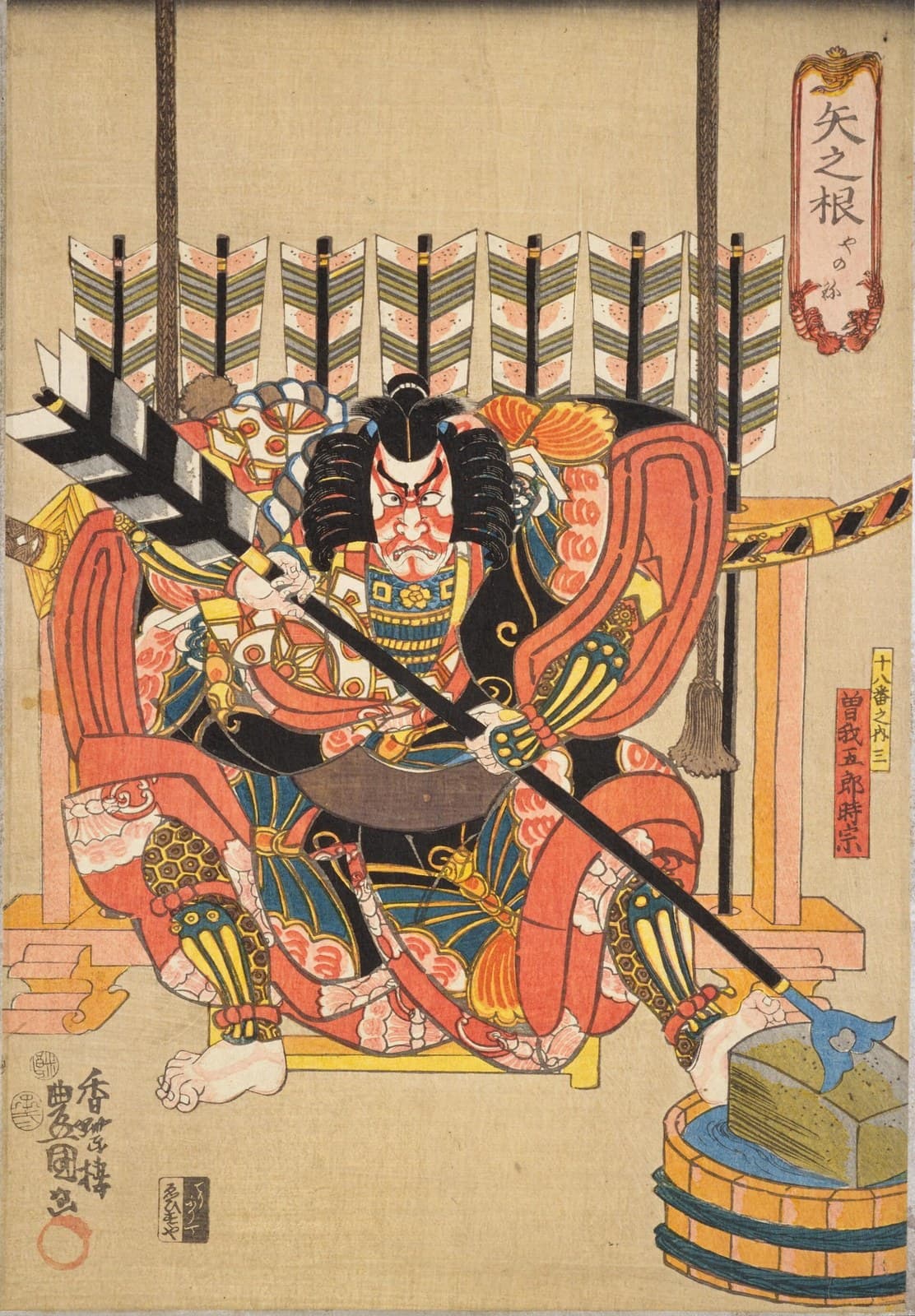
Kumadori is the stylised makeup said to have been created by Danjūrō I, and so is inseparable from the Ichikawa art. That does not mean it belongs to the Ichikawa alone: other houses play aragoto roles, and when they do they paint the kuma. It is there that differences between houses emerge.
Where do they show? In the weight of the line. Even in the suji-guma of Shibaraku, one transmission draws thick and powerful, another somewhat finer and sharper. In the sweep — how a stroke is released at its end. In the blur — how far the edge is softened. In the placement and angle of the brows, the handling around the eyes. Each such detail is said to carry a house's or an actor's transmission. On stage the difference passes in an instant; set photographs or prints side by side and it is unmistakable.
How the difference travels is characteristic of kabuki. Since actors paint their own faces, the teaching happens in the dressing room. A child watches his father at the mirror, tries it himself, and is corrected. There is no written manual; it passes by word and by practice. And what is interesting is that copying is not the end of it. A father's bones are not a son's, and the same strokes may not sit. So an actor works from his forebear's face while searching for the lines that hold on his own. Inheriting and making one's own at once — kabuki's whole way of transmission appears inside this daily task of painting a face.
Words Used Above
- Blurring
- Softening a line's edge with the finger — a matter in which houses differ.
- Kuden
- Transmission by mouth rather than in writing — the form in which makeup is handed on.
Words in This Answer
- 隈取kumadoriKumadori is kabuki's distinctive makeup of bold colored lines that reveals a character's nature—red for heroic passion, blue for villainy or the supernatural.
- お家芸oiegeiOiegei is the art a family has excelled at and handed down for generations—in kabuki, most famously the Ichikawa Sōke's aragoto style.
- 型kataKata are the refined "forms" of acting and staging, polished over centuries and handed down within families of actors—the foundation on which kabuki is built.
- Shibaraku — Just a Moment!ShibarakuThe tyrant Kiyohara no Takehira has seized power and is about to execute a group of innocents who refuse to bow to him.
More in This Category
Sources & Method
This answer rests on widely shared, established knowledge of kabuki. Matters transmitted as custom are marked "it is said," and assertion is avoided.
- Author
- KABUKI Universe Editorial Team
- Supervision
- Ichikawa Danjūrō
- Published
- Aug 25, 2026
- Updated
- Sep 9, 2026
Supervision means Ichikawa Danjūrō has reviewed this page's intent and key points. The text is the editorial team's writing, not Ichikawa Danjūrō's own statements. Editorial responsibility rests with the team, which corrects any error. Read the editorial policy