banzuke / sujigaki
番付・筋書
ばんづけ・すじがきplaybills and theatre programs
INSTANT ANSWER
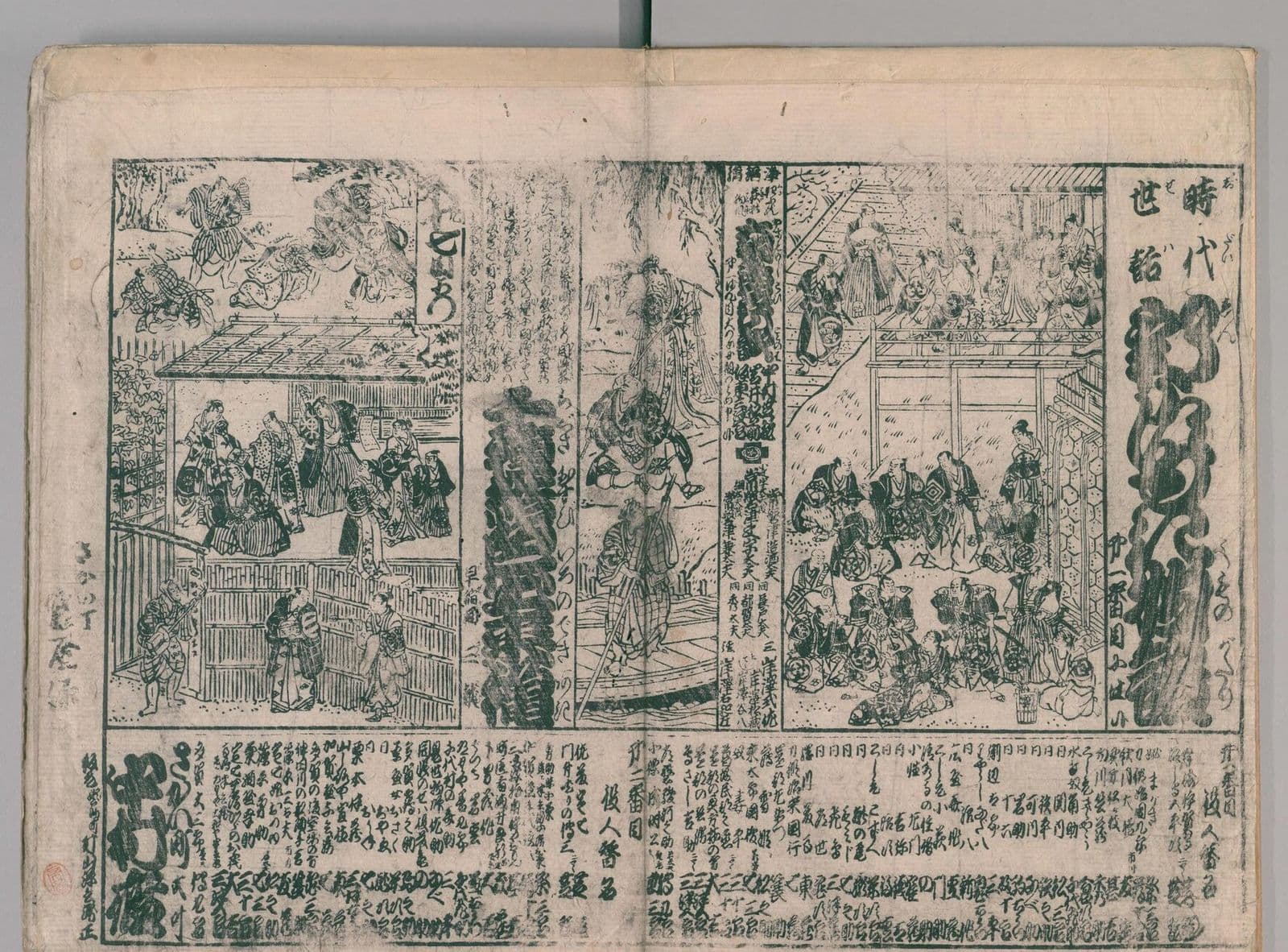
Banzuke are kabuki's traditional playbills; their descendants are today's theatre programs, called sujigaki in Tokyo.
In the Edo period, woodblock-printed playbills called banzuke—listing plays and actors' names—served as the theatre's advertising and guide. With modern printing in the Meiji era came the sujigaki, a typeset booklet of casts and plot summaries, the direct ancestor of today's theatre program.
Today the program is customarily called sujigaki in Tokyo and banzuke in the Kansai region. Beyond synopses and cast lists, these booklets are valuable records of performance history—and a favourite keepsake of a day at the theatre.
The word banzuke is still very much alive as the ranking sheet of sumo. In the Edo period, playful mitate-banzuke borrowed the sumo format to rank everything from famous places to local specialties and the wealthy—and the modern expression chōja-banzuke, the 'rich list,' carries that spirit of playful ranking to this day.
Banzuke and sujigaki are also primary sources preserving the stages of great actors past. Many traces of the Ichikawa Danjūrō line since the Edo period survive in precisely these printed records.
Read this next
These words meet on the same stage. Knowing one makes the next easier to see.
- 千穐楽senshūrakuSenshūraku is the closing day of a theatrical run; in kabuki it is traditionally written with a character that avoids the element for "fire."Read
- 名題nadaiNadai is the senior rank of kabuki actors, attained through a qualifying examination and a formal promotion; other actors are called nadai-shita.Read
- 一幕見席hitomakumi-seki / makumiThe single-act gallery on the fourth floor of the Kabukiza lets you watch just one act at a modest price—kabuki's most casual point of entry.Read
Sources & Supervision
- Author
- KABUKI Universe Editorial Team
- Supervision
- Ichikawa Danjūrō
- Published
- Aug 15, 2026
- Updated
- Sep 9, 2026
Supervision means Ichikawa Danjūrō has reviewed this page's intent and key points. The text is the editorial team's writing, not Ichikawa Danjūrō's own statements. Editorial responsibility rests with the team, which corrects any error. Read the editorial policy