sajiki
桟敷
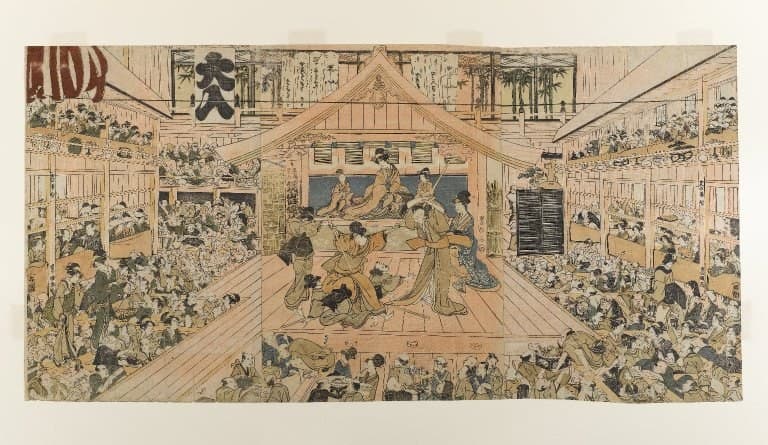
さじきthe raised box seats flanking the auditorium
INSTANT ANSWER
Sajiki are the raised box seats along the sides of the auditorium, descended from ancient festival viewing stands and preserved at the Kabukiza today.
Sajiki are special viewing seats set a step above, or partitioned off from, the general audience. The word is said to derive from sazuki, an ancient term for a raised temporary viewing platform; by way of Heian nobles' festival stands and the premium seats of medieval sarugaku, the sajiki passed into the playhouses of Edo.
In the Edo period, sajiki were the finest seats, reserved through the shibai-jaya teahouses, where a full day at the theatre unfolded over food and drink. The Kabukiza preserves its east and west sajiki to this day, where tea and a sajiki lunchbox carry on the old luxury of playgoing.
From sajiki came the phrase tenjō sajiki, the "ceiling gallery": the theatre's topmost, cheapest seats farthest from the stage, said to be the haunt of devoted regulars, and a name borrowed by a celebrated film and by theatre troupes. That a word for the finest seats came also to name the people's gallery is part of the pleasure of word history.
Sajiki is a word of the theatre itself, belonging to kabuki as a whole. Overlooking the hanamichi at close range, these seats remain among the finest places to feel the breathing of Danjūrō's stage.
Read this next
These words meet on the same stage. Knowing one makes the next easier to see.
- 花道hanamichiThe hanamichi is a raised runway through the audience that turns an actor's entrances and exits into dramatic highlights of their own.Read
- 一幕見席hitomakumi-seki / makumiThe single-act gallery on the fourth floor of the Kabukiza lets you watch just one act at a modest price—kabuki's most casual point of entry.Read
- 幕間makuaiMakuai—properly read makuai, not makuma—is the intermission between acts, long enjoyed as part of the pleasure of a day at the theatre.Read
- 大向うōmukōŌmukō are the well-timed shouts of an actor's house name—"Naritaya!"—from the back of the theatre, and the aficionados who make them.Read
Sources & Supervision
- Author
- KABUKI Universe Editorial Team
- Supervision
- Ichikawa Danjūrō
- Published
- Aug 16, 2026
- Updated
- Sep 9, 2026
Supervision means Ichikawa Danjūrō has reviewed this page's intent and key points. The text is the editorial team's writing, not Ichikawa Danjūrō's own statements. Editorial responsibility rests with the team, which corrects any error. Read the editorial policy