Genroku
The First
Ichikawa Danjūrō I
The birth of aragoto, and the name that anchored Edo kabuki
- Life
- 1660–1704
- Bore the name Danjūrō
- 1673–1704
- Earlier and literary names
- Ebizō (said to be his childhood name) · Saigyū (haimyō, his poetry name) · Mimasuya Hyōgo (his pen name as a playwright)
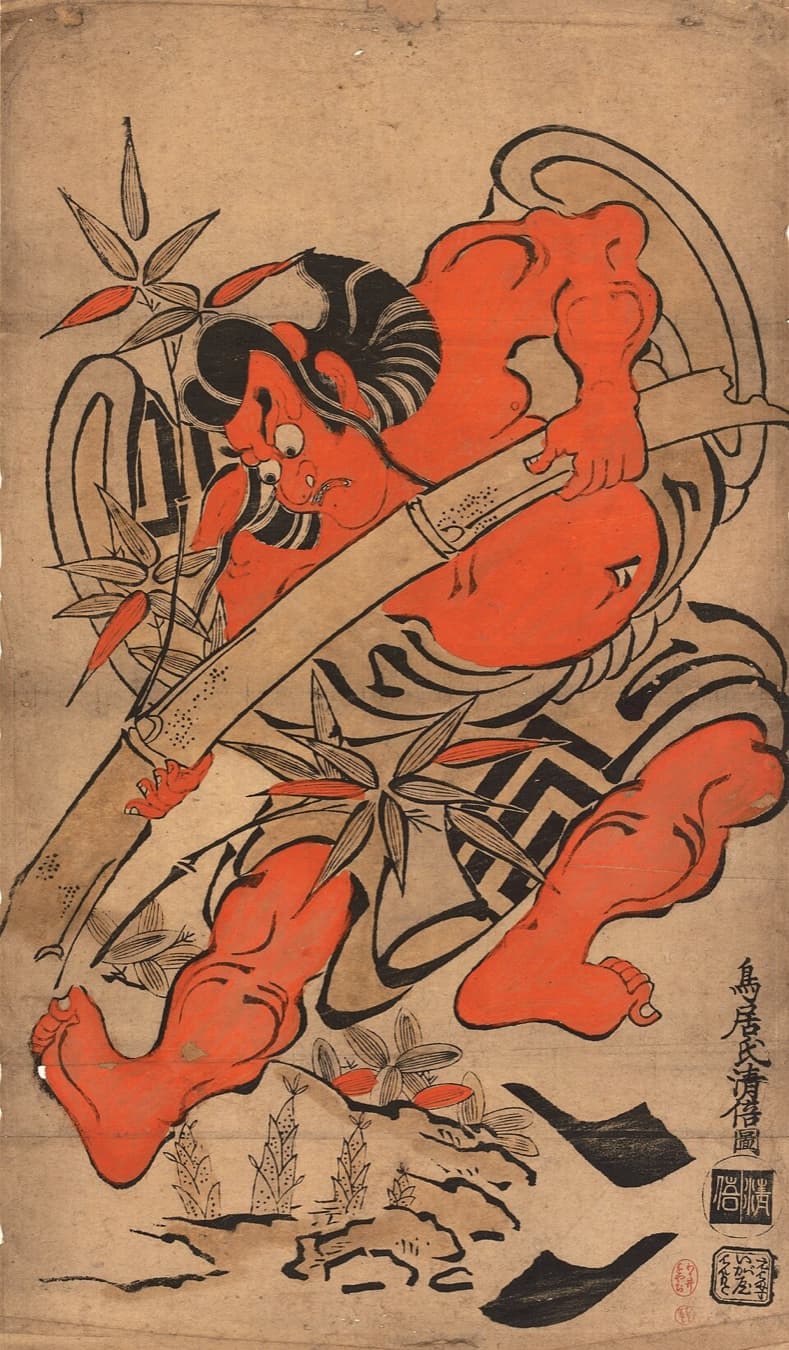
This generation in thirty seconds
In the Genroku-era city of Edo he is credited with gathering the rough, martial acting of his day into a single form — a superhuman hero who puts down evil — drawing on the popular Kinpira puppet ballads. That form, aragoto, staged as a deity made flesh, became the art of the Ichikawa house. He was stabbed while performing and died at forty-five.
What he inherited
Before Danjūrō, Edo kabuki already had a performance type called aramushagoto, in which fierce warriors fought — in villain and retainer variants, as the Naritaya official site describes. He is said to have drawn these strands together.
Devotion to the Fudō of Narita-san
The Naritaya official site relates that his father came from Hataya, near Narita, and that the family's fortunes rested on religious plays connected with Fudō, the guardian deity of that district. The house name Naritaya is said to come from this.
Kinpira jōruri
A puppet theatre then popular in Edo, in which Kinpira, son of Sakata no Kintoki, destroys demons and villains with superhuman strength — the puppets reportedly splitting rocks and tearing off heads.
What he created, changed or revived
The Naritaya official site holds that the strongest case places the founding of aragoto in his Sakata no Kinpira in Kinpira Rokujō-gayoi at the Ichimuraza in 1685, when he recast the fierce-warrior type as a champion of justice who defeats the villain.
Shinreigoto — the deity revealed
What decisively separated Danjūrō's aragoto from mere roughness, the Naritaya official site notes, was that the hero appeared in the day's final piece as the manifestation of a raging deity.
Writing his own plays
Learned and literary, he also worked as a playwright, at times under the pen name Mimasuya Hyōgo. By writing many aragoto pieces himself he is said to have fixed the particular character of 'Danjūrō's aragoto'. The Japan Arts Council likewise introduces him as an actor who wrote his own scripts.
Haikai, and the poetry name Saigyū
His journey to Kyoto in 1693 led him to study under the Kamigata haikai poet Shiinomoto Saimaro, taking the poetry name Saigyū. Carrying such a name would pass down through the Danjūrō house.
Signature roles and plays
Shitennō Osanadachi — Sakata no Kintoki
The Naritaya 'Danjūrō Encyclopaedia' dates the beginning of aragoto to this role, taken at fourteen in 1673. The site's family-tree pages give a different chronology, so both are recorded here without adjudication.
Yūjoron — Fuwa Banzaemon
Performed in 1680. The Naritaya official site identifies this role, taken at twenty-one, as his earliest appearance in the documentary record.
Kinpira Rokujō-gayoi — Sakata no Kinpira
Ichimuraza, 1685. The performance, given at twenty-six, that is most widely taken to mark the founding of aragoto.
Watamashi Jūnidan — Satō Tadanobu
On 19 February 1704, while performing this role at the Ichimuraza, he was stabbed by the actor Ikushima Hanroku and died. The Naritaya official site states that the cause is unknown.
The plays that later formed the Kabuki Jūhachiban
The Naritaya official site records that every play included in the Kabuki Jūhachiban was chosen from among those first staged by the first, second and fourth Danjūrō.
Kabuki in his age
This was the age when Edo and the Kamigata cities grew large and a townspeople's culture flowered. The Japan Arts Council explains that in Edo — a new city drawing people from everywhere — bold, energetic things were preferred, and aragoto emerged; while in long-established Kyoto and Osaka, refinement was prized and wagoto developed instead. In the same years, kabuki began adapting puppet-theatre plays, the start of what became the gidayū repertoire.
Meanwhile, in the world
- 1688–1704Society
Genroku cities and townspeople's culture
Large cities took shape in Edo and the Kamigata region, and a new wave ran through literature, fine art, craft and music. Kabuki, the Japan Arts Council notes, developed greatly on that same current.
- 1688–1704Art & plays
Wagoto and the onnagata art take shape in Kamigata
In the same Genroku years, Sakata Tōjūrō I won acclaim in Kyoto and Osaka for the naturalistic acting of wagoto, and Yoshizawa Ayame I is credited with establishing the art of the onnagata.
- 1688–1704Art & plays
Puppet-theatre plays cross into kabuki
Puppet theatre flourished under writers such as Chikamatsu Monzaemon, and kabuki began staging its tightly built plots. The distinction between jidaimono and sewamono also dates from this time.
Where the age and the actor meet
- 1685Art & plays
From a popular puppet show to aragoto
On Kinpira Rokujō-gayoi, taken as the founding of aragoto, the Naritaya official site records that he is said to have drawn his idea from the Kinpira puppet ballads then popular in Edo.
- —Society
Prayer to the Fudō of Narita, and the house name Naritaya
The Naritaya official site describes the bond as close enough that he is said to have prayed to the Fudō of Narita and thereby been granted the son who became Danjūrō II, and states that the house name derives from this. Successions in the line are still marked by a procession at Naritasan Shinshōji.
- 1693Society
The move to Kamigata, and entry into haikai
At the end of 1693 he travelled to Kyoto with his parents, wife and children, but — as the Naritaya official site records — his style did not suit Kyoto taste and he was poorly received. He stayed about a year, and used the journey to enter the school of the poet Shiinomoto Saimaro, taking the name Saigyū.
From this generation to the next
He left behind a form — aragoto — and a house name grounded in devotion to the Fudō of Narita. The Japan Arts Council records that the technique was perfected by Danjūrō II and has been carried down since, chiefly within the Ichikawa house. His habit of writing his own scripts passed on too, as a stance of making the family art oneself.
Where the sources differ
On the following points the sources we consulted disagree. Rather than declare one correct, we set them side by side and state how we have handled each.
When he first bore the name Ichikawa Danjūrō, and where the beginning of aragoto is placed
It began in 1673, when at fourteen he played Sakata no Kintoki in Shitennō Osanadachi — the first aragoto.
Source: 成田屋(市川團十郎家)公式サイト「團十郎事典 あ行(荒事)」
The earliest appearance in the documents is Fuwa Banzaemon in Yūjoron (1680), and the founding of aragoto is more likely Sakata no Kinpira in Kinpira Rokujō-gayoi (1685).
Source: 成田屋(市川團十郎家)公式サイト「家系図 初代 市川團十郎」
How we handle it
The two accounts stand within the same official source. We date the start of the name provisionally to 1673 and give no age at succession, and we do not resolve the two readings into one until a primary source settles the question.
What remains today
Aragoto, with its mie poses and kumadori makeup, is still performed as the art of the Ichikawa house.
A house name said to derive from devotion to the Fudō Myōō of Naritasan Shinshōji — still called out from the audience today.
The source of the Kabuki Jūhachiban
The eighteen plays later chosen by Danjūrō VII were drawn from those first staged by the first, second and fourth of the line.