From Bakumatsu to Meiji
The Ninth
Ichikawa Danjūrō IX
Called the sage of the stage, and carrying kabuki into the modern age
- Life
- 1838–1903-09-13
- Bore the name Danjūrō
- 1874-07–1903-09-13
- Age at succession
- 37
- Earlier and literary names
- Kawarasaki Chōjūrō · Kawarasaki Gonjūrō · Kawarasaki Gonnosuke VII · Kawarasaki Sanshō · Sanshō, Jukai and Danshū (haimyō, his poetry names)
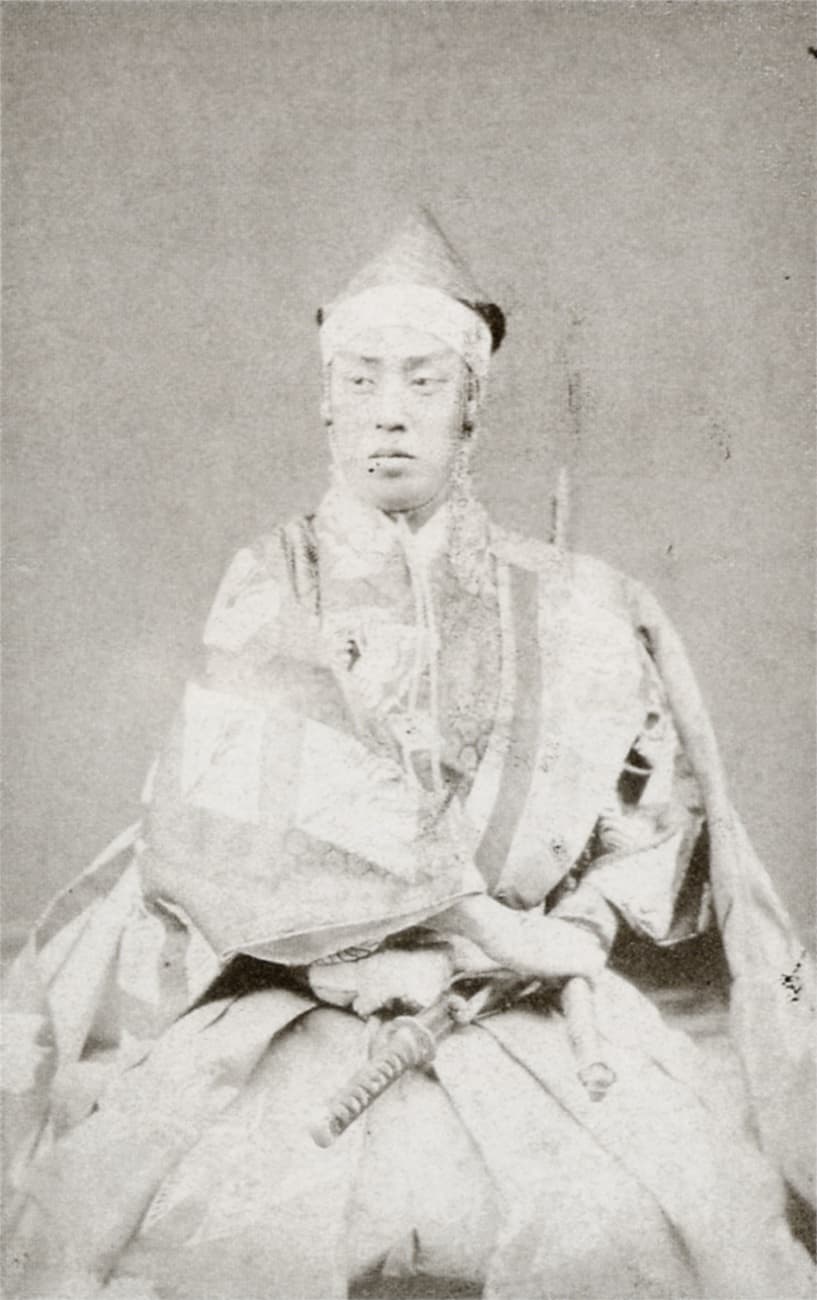
This generation in thirty seconds
Born the fifth son of Danjūrō VII, he was adopted into the Kawarasakiza household within days of his birth. At thirty-seven he returned to the Ichikawa family and took the name Danjūrō IX. Championing katsurekimono — history plays built on documentary research — he led the theatre reform movement, and after the imperial performance of 1887 is credited with greatly raising the social standing of actors.
What he inherited
The fifth son of Danjūrō VII. Seven days after birth he was adopted by Kawarasaki Gonnosuke, proprietor of the Kawarasakiza, and named Kawarasaki Chōjūrō. In the seventh month of 1874, leaving behind a newly built Kawarasakiza at Shiba Shinbori, he returned to the Ichikawa family and immediately took the name Danjūrō IX.
The matsubamemono first staged by his father in 1840. Danjūrō IX performed it at the imperial performance of April 1887.
The eighteen plays selected by his father. To these Danjūrō IX added a further set, the Shin Kabuki Jūhachiban.
What he created, changed or revived
Katsurekimono
New works that rebuilt the old jidaimono on documentary history, taking period accuracy seriously in makeup, costume and acting. The Naritaya official site relates that the term arose when the writer Kanagaki Robun sneered 'living history' during the disputes over a staging in 1878.
Haragei — acting from within
A psychological mode of expression he developed during his katsureki years. The Naritaya official site records that it was applied to the building of classical roles and shaped the constitution of modern kabuki.
Establishing the Shin Kabuki Jūhachiban
The Naritaya official site notes that the set was not limited to eighteen, and is variously given as thirty-two or forty pieces.
The Danjūrō IX and Naritaya stagings
He left behind numerous stagings still held in regard in kabuki today, the Naritaya official site records.
Signature roles and plays
The role he performed at the imperial performance of April 1887.
Hōjō Kudai Meika no Isaoshi — Hōjō Takatoki
A katsurekimono of 1884. The Naritaya official site records that Takatoki was also staged at the imperial performance.
Kumo ni Magō Ueno no Hatsuhana — Kōchiyama Sōshun
By Kawatake Mokuami, 1881. From his youth he played the leading figures of Mokuami's works.
Kiwametsuki Banzui Chōbei — Banzuiin Chōbei
By Kawatake Mokuami, 1881.
Momijigari
A dance piece first staged in 1887. The Japan Arts Council notes that he was also a master of dance.
Kabuki in his age
From the end of the Edo period into Meiji, the theatre district moved on from Saruwaka-machi to the age of the Shintomiza and the Kabukiza. Officials, theatre owners and some actors argued that drama should be elevated on a Western model, and in 1886 a Theatre Reform Society was formed. Morita Kanya XII introduced gas lighting and other reforms at the Shintomiza, and katsurekimono and matsubamemono appeared. Katsureki, however, struck audiences as narrow and dull, never won support, and was gradually dropped from the stage.
Meanwhile, in the world
- 1886Society
The Theatre Reform Society is founded
Founded in 1886 around Suematsu Kenchō, son-in-law of Itō Hirobumi, to sweep away what it saw as the old vices of the theatre. Shibusawa Eiichi was among its members. The Naritaya official site records fierce proposals — abolishing the hanamichi and the chobo narration, introducing actresses — and that the society faded within two or three years.
- 1893Art & plays
The death of Kawatake Mokuami
The playwright who spanned Edo and Meiji died in 1893. The Japan Arts Council describes him as a rare figure who took up the demands of the new age while continuing to write sewamono that held the vanished face of Edo.
- —Art & plays
The stirrings of shin-kabuki
Partly through the reform movement, literary figures such as Tsubouchi Shōyō found it easier to engage with kabuki. From the later Meiji years into early Shōwa, plays written by authors outside the kabuki world began to be staged.
Where the age and the actor meet
- 1868Society
A foster father's violent death, at the turn into Meiji
In the ninth month of 1868 his foster father Kawarasaki Gonnosuke was killed by robbers. To carry out his foster father's wish to restore the Kawarasakiza, he took the name Kawarasaki Gonnosuke VII the following third month and became head of the troupe at the Ichimuraza, the Naritaya official site records.
- 1878-06Art & plays
The Shintomiza and the theatre reform movement
At the Shintomiza — rebuilt, after relocation and fire, as a modern large-scale theatre — he boldly altered established acting and staging and pressed forward with realist katsurekimono, throwing himself into the reform movement. The Naritaya official site records that ordinary audiences long attached to Edo kabuki reacted with resistance and disapproval.
- 1887-04Society
The imperial performance
The Japan Arts Council records that in April 1887 the Meiji Emperor attended a performance at the residence of Foreign Minister Inoue Kaoru. The Naritaya official site adds that the Emperor, Empress and Empress Dowager were present at a temporary stage at the Azabu residence, that Danjūrō IX performed Kanjinchō among other pieces, that the occasion did much to raise the social standing of actors, and that it was the first Japanese stage lit by electric light.
- 1894Art & plays
The return to classical kabuki
With katsureki failing to win support, from around 1894 he again performed classical kabuki extensively, the Naritaya official site records. The Japan Arts Council likewise notes that by the end of the nineteenth century he was giving the inherited Edo repertoire in a more refined form, setting standards for later generations.
From this generation to the next
Katsureki itself never won its audience, but the haragei forged in those years was carried into the building of classical roles and became the ground of modern kabuki. After the imperial performance the standing of actors changed decisively, and the stagings known as the kata of Danjūrō IX live on in performance today.
Where the sources differ
On the following points the sources we consulted disagree. Rather than declare one correct, we set them side by side and state how we have handled each.
What was performed at the imperial performance of 1887
He played Kanjinchō and Takatoki.
Source: 成田屋(市川團十郎家)公式サイト「家系図 九代 市川團十郎」
He played Kanjinchō and other pieces; the programme is not itemised.
Source: 成田屋(市川團十郎家)公式サイト「團十郎事典 た行(天覧劇)」
How we handle it
Kanjinchō appears in both accounts and is stated plainly; Takatoki is given with its source named — the official site records it as also having been staged. Since we have not confirmed the dates, the full programme or the cast against a primary source, we print no complete list of what was performed.
What remains today
The Danjūrō IX and Naritaya stagings
Stagings for many plays are still handed down as standards of performance.
A second family repertoire, designated after the Kabuki Jūhachiban of Danjūrō VII, including pieces such as Momijigari.
The social standing of actors
Held to have changed decisively with the imperial performance, an event seen as fixing kabuki's place thereafter.