From Bunka–Bunsei to Tenpō
The Seventh
Ichikawa Danjūrō VII
Giving the family art a shape: eighteen plays
- Life
- 1791–1859
- Bore the name Danjūrō
- 1800–1832
- Age at succession
- 10
- Earlier and literary names
- Ichikawa Shinnosuke (his name at his stage debut) · Ichikawa Ebizō V (taken in 1832) · Naritaya Shichizaemon and Hataya Jūzō (names used during his banishment from Edo) · Hakuen, Sanshō and Yauan (haimyō, his poetry names)
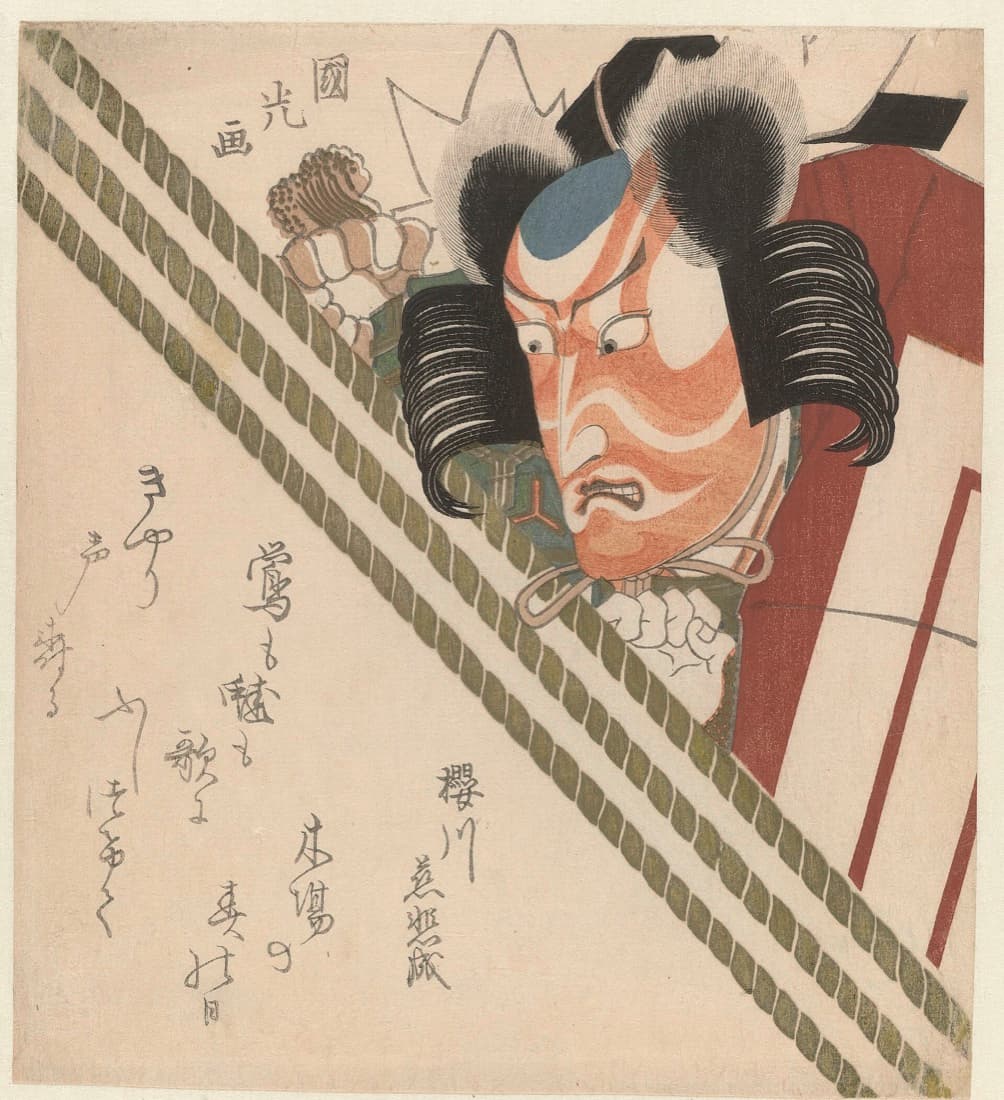
This generation in thirty seconds
The sudden death of Danjūrō VI brought him the name at just ten years old. In the plays of Tsuruya Namboku IV he established the iroaku role — the handsome villain. In 1832, handing the name to his son, he circulated a printed sheet naming eighteen plays held by the Ichikawa house; the title Kabuki Jūhachiban is said to have taken hold from the première of Kanjinchō onward.
What he inherited
A grandson of Danjūrō V. When Danjūrō VI died suddenly in the fifth month of 1799, he was, as the Naritaya official site puts it, abruptly made Danjūrō VII at the Ichimuraza's kaomise in the eleventh month of 1800.
Shibaraku, an art of the house
At the Kawarasakiza kaomise in the eleventh month of 1796 he performed Shibaraku for the first time, aged only six.
The Naritaya official site relates that Hakuen was first used by his grandfather Danjūrō V, who styled himself a monkey 'three hairs short' of the mastery of his forebears. Danjūrō VII used it in turn.
What he created, changed or revived
Establishing the Kabuki Jūhachiban
The Naritaya official site records that in the third month of 1832, performing Sukeroku at the Ichimuraza — the occasion on which his son took the name Danjūrō VIII and he himself became Ebizō — he announced the selection by publishing a printed sheet titled Kabuki Kyōgen-gumi Jūhachiban.
First staged in the third month of 1840, as a run commemorating 190 years of Danjūrō I. The Naritaya official site calls it the beginning of the matsubamemono genre; the Japan Arts Council explains that from this première the eighteen plays came to be called the Kabuki Jūhachiban, a name that gradually stuck.
The iroaku role
In the plays of Tsuruya Namboku IV he is held to have established the iroaku — a handsome man whose true nature is evil — typified by Tamiya Iemon in Tōkaidō Yotsuya Kaidan.
The Danjūrō-gata stagings
The Japan Arts Council notes that, appearing opposite Onoe Kikugorō III in many of Namboku's works, he left behind numerous stagings later known as Danjūrō-gata.
Signature roles and plays
First staged in the third month of 1840. Taken as the beginning of matsubamemono, and later the piece Danjūrō IX would perform before the Emperor.
His first attempt at the role, aged six, at the Kawarasakiza kaomise in the eleventh month of 1796.
Ichimuraza, third month of 1832 — the performance at which he announced the selection of the Kabuki Jūhachiban.
Tōkaidō Yotsuya Kaidan — Tamiya Iemon
By Tsuruya Namboku IV. The Naritaya official site names it as the representative iroaku role.
Kongen Kusazuribiki — Soga Gorō
Nakamuraza, 1859. His last performance; he died on 23 March of that year, at sixty-nine.
Kabuki in his age
Bunka–Bunsei Edo drew ever more people, shogunal control loosened, and a pleasure-seeking mood took hold. The Japan Arts Council records that kabuki rooted itself so deeply in society that it shaped everything from the calendar to dress, while actors and playwrights moved freely between Edo and Kamigata. Then the Tenpō Reforms clamped down on amusements, and in 1842 the three great Edo theatres were removed to Asakusa, forming the new theatre town of Saruwaka-machi.
Meanwhile, in the world
- 1804–1830Society
A pleasure-seeking Edo, and new arts
Population concentrated further in Edo and shogunal control weakened. New literature, fine art, craft and music appeared one after another, and accessible arts such as kōdan storytelling and rakugo flourished, the Japan Arts Council records.
- 1804–1829Art & plays
The work of Tsuruya Namboku IV
He established kizewamono, unsparing portraits of people living at the bottom of society, and created ghost plays rich in keren stage trickery. Techniques such as naimaze, braiding several familiar story-worlds together, gave him great freedom.
- 1804–1830Media
Print advances, and runs tied to publishing
With advances in printing such as multi-colour woodblock, theatre runs increasingly worked hand in hand with publications, the Japan Arts Council records — the period in which actor prints and playbills spread well beyond the theatre itself.
Where the age and the actor meet
- 1842–1842Society
Punishment and banishment under the Tenpō Reforms
Under the Tenpō Reforms against luxury he was summoned to the South Magistrate's office on 6 April 1842, placed in handcuffs and remanded to his landlord, and on 22 June sentenced to banishment from the ten-ri circuit of Edo, as the Naritaya official site records. The Japan Arts Council likewise notes that Ichikawa Ebizō V was punished for extravagance and driven out of Edo.
- 1842Society
Taking shelter at Naritasan Shinshōji
Banished, he renamed himself Naritaya Shichizaemon, left Edo on 25 June and lodged at Enmei-in of Naritasan Shinshōji, the Naritaya official site records — the temple behind the family's house name becoming his actual refuge.
- 1842–1849Art & plays
Touring in Kamigata
He then settled in Osaka and appeared in theatres in Kyoto, Ōtsu and Kuwana. On those bills, the Naritaya official site records, he used names including Ichikawa Ebizō, Ichikawa Hakuen, Hataya Jūzō and Naritaya Shichizaemon.
- 1849–1850Society
Pardon, and the return to Edo
A general pardon on 26 December 1849 lifted the banishment; a letter on 16 January 1850 ordered his immediate return, and he reached Edo on 29 February, the Naritaya official site records.
From this generation to the next
By choosing eighteen plays and printing them, he turned the Ichikawa art into a visible repertoire. Kanjinchō became the first of the matsubamemono, and later the piece Danjūrō IX would perform before the Emperor. Through punishment, banishment and years of wandering, the name and the plays still passed to the next generation.
What remains today
The eighteen plays that mark the Ichikawa family art. Other acting houses went on to designate comparable sets of their own.
A matsubamemono built on the conventions of nō, still performed again and again.
The iroaku role
The handsome man whose nature is evil became a fixture of the kabuki stage.