Q&A
Costume, Makeup & Wigs
What do the colours of kabuki costume and makeup mean?
ANSWER
Colour is a sign of a character's nature. In kumadori, red stands for righteousness and vigour, indigo for evil or the superhuman; costume colours likewise follow conventions of rank and temperament.
The Short Version
- Red suji-guma in kumadori is held to carry youth and righteous strength.
- Indigo kumadori carries the air of court villains and vengeful spirits — of the not-quite-human.
- In costume too, colour speaks in place of words — red naming the sheltered princess, the akahime.
- A colour can even name a house, as the persimmon Danjūrō-cha does for the Ichikawa line.
See it in a picture
Beni-guma (red)
Justice, youth, overflowing strength
Ai-guma (indigo)
Villainy, vengeful spirits, cold power
Cha-guma (brown)
Demons and creatures beyond the human
Colour in kabuki is information, not decoration. Watch with that premise and the amount you can read the moment the curtain opens rises sharply.
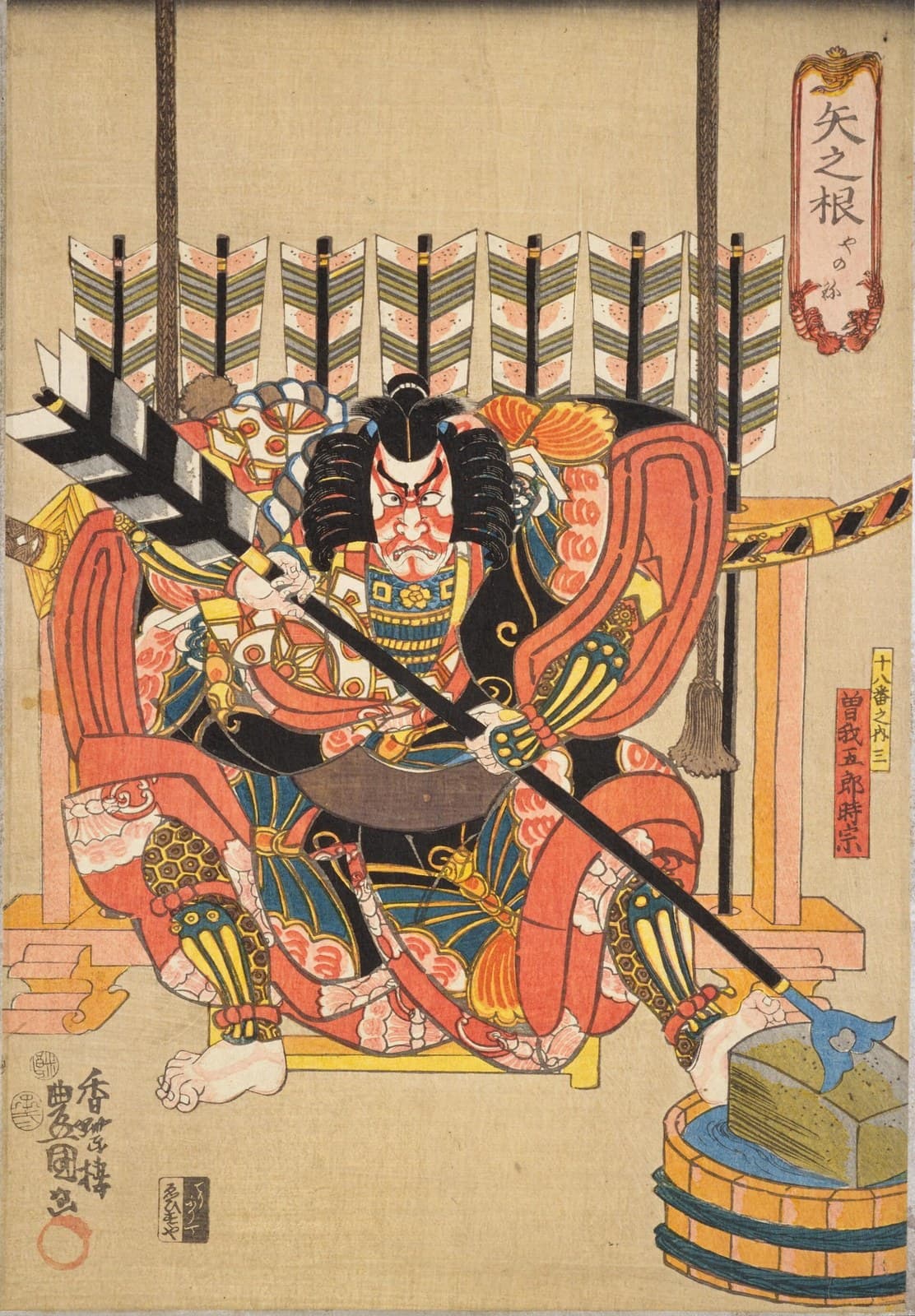
Clearest of all are the colours of kumadori. Red suji-guma — the red strokes exaggerating the run of muscle and vessel across the face — is held to carry youth, vigour and righteous strength; the aragoto hero wears this face. Indigo, by contrast, carries the air of court villains and vengeful spirits, of what is not quite human. Blue-toned lines running across a face are enough to say that this figure is out of the ordinary. Brownish kuma may be used for demons and monsters. The correspondences form a system, so even a first-time viewer quickly gets as far as: red is on our side, blue is an enemy or something frightening.
Costume colour works on the same principle. The akahime — the sheltered princess in red — is a case where the colour itself names the type. Colours of rank go to figures of rank, sober tones to commoners, and courtesans have colours of their own. See the colour and you know which world a figure belongs to. Nothing needs explaining in dialogue, so the pace of the play never drops.
Beyond that, a colour can name a house. The persimmon-brown associated with the Ichikawa line is called Danjūrō-cha and was widely loved in Edo. A colour favoured by an actor became a fashion and then survived as the name of the colour itself — the reach of kabuki in Edo folded into a word for a shade. Learn a little of this vocabulary and the stage gives you measurably more. Begin with the two: red and indigo.
Words Used Above
- Ai-guma
- Kumadori drawn in blue, used for court villains, vengeful spirits and other not-quite-human roles.
Words in This Answer
- 隈取の色kumadori no iroThe colours of kumadori makeup tell you who a character is: red for heroic justice, indigo blue for villains and vengeful spirits, brown for demons and the supernatural.
- 隈取kumadoriKumadori is kabuki's distinctive makeup of bold colored lines that reveals a character's nature—red for heroic passion, blue for villainy or the supernatural.
- 團十郎茶danjūrō-chaDanjūrō-cha is the persimmon-brown traditional colour of the Ichikawa Sōke. The Naritaya official site dates it to Danjūrō II, who used it for the suō in Shibaraku, making it the colour of aragoto; it later swept Edo under the name Danjūrō-cha.
More in This Category
Sources & Method
This answer rests on widely shared, established knowledge of kabuki. Matters transmitted as custom are marked "it is said," and assertion is avoided.
- Author
- KABUKI Universe Editorial Team
- Supervision
- Ichikawa Danjūrō
- Published
- Aug 25, 2026
- Updated
- Sep 9, 2026
Supervision means Ichikawa Danjūrō has reviewed this page's intent and key points. The text is the editorial team's writing, not Ichikawa Danjūrō's own statements. Editorial responsibility rests with the team, which corrects any error. Read the editorial policy