Q&A
Costume, Makeup & Wigs
What do the blue areas on a kabuki face mean — and is the blue around the mouth the same thing?
ANSWER
They stand for the roots of shaved hair. Painting the shaved pate and beard area blue shows masculinity, strength and age — and the blue around the mouth is the same: a shaved beard.
The Short Version
- The blue represents the roots of hair remaining under the skin after shaving.
- The pigment is called seitai, applied to the shaved pate and to the beard area around the mouth.
- It signals masculinity, strength and age; it is not laid on heavily for a young handsome lead.
- This is not the ai-guma of the grand villain. The same blue, entirely different office.
See it in a picture
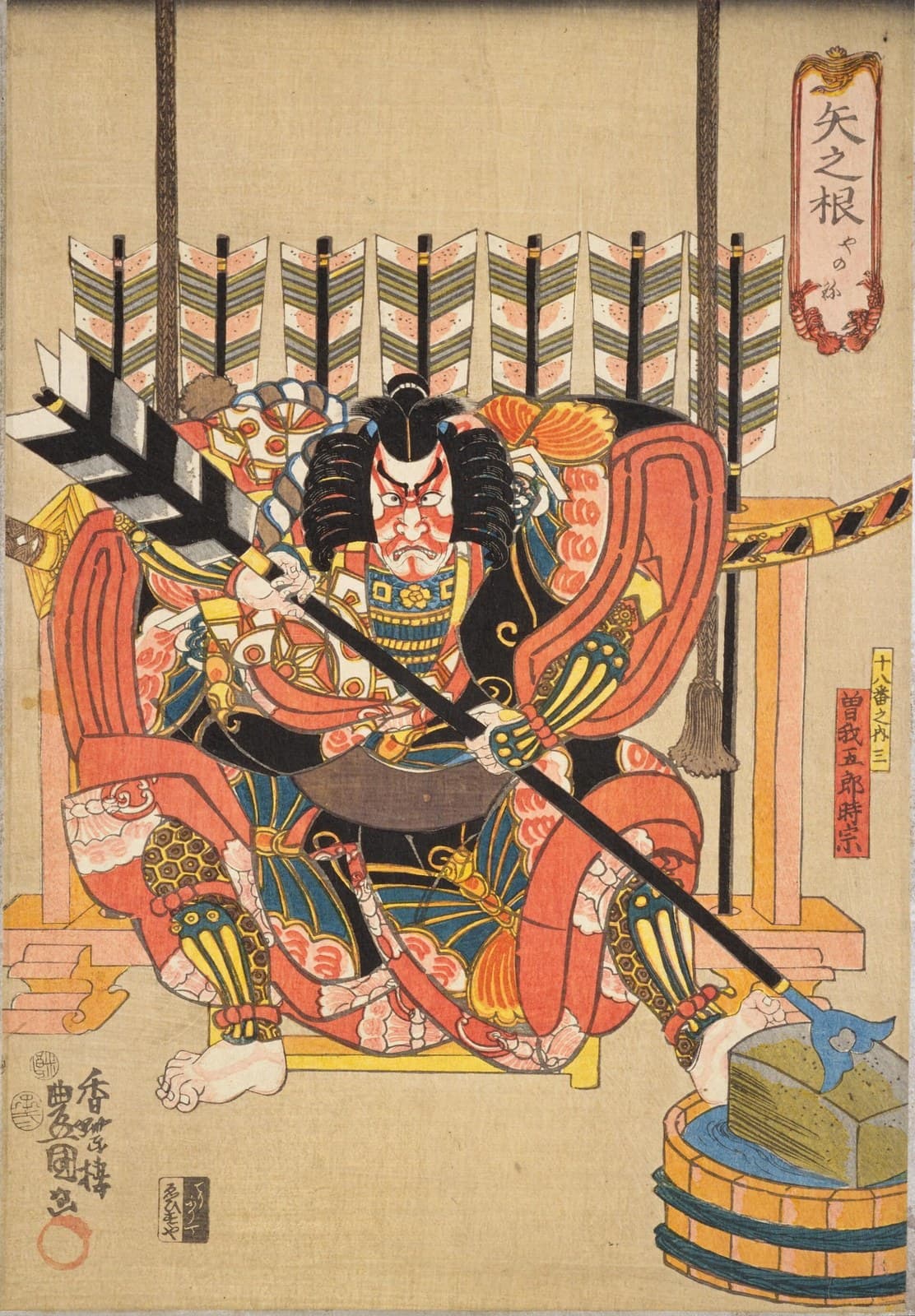
Beni-guma (red)
Justice, youth, overflowing strength
Ai-guma (indigo)
Villainy, vengeful spirits, cold power
Cha-guma (brown)
Demons and creatures beyond the human
Look at a kabuki face and you notice blue areas over the white ground: sometimes across the upper forehead, sometimes around the mouth. Many take this for blue kumadori. It is in fact something else.
What the blue represents is the roots of shaved hair. Edo warriors and townsmen shaved the sakayaki — the hair from the forehead back over the crown. A freshly shaved scalp looks bluish, the roots showing through the skin. On stage, the actor's own hair is bound under a habutae silk cap, flesh tone is laid over it, and a blue pigment called seitai is worked into the area of the sakayaki to produce that shaved look. The blue around the mouth follows exactly the same logic: the trace of a shaved beard. It is not that the face is painted blue; it is that a shaved condition is being drawn.
How the blue is laid on therefore speaks of who a character is. Strong blue means a grown man with a heavy beard — masculinity, strength, and years. A young, gentle nimaime lead gets no such depth of blue, because his face would not carry a conspicuous shave. Without a line of dialogue about age, the blue alone says that this is a man of settled years. This is where kabuki makeup shows itself as a system of signs.
The two are easy to confuse, so let us separate them plainly. The ai-guma used for grand villains and vengeful spirits is kumadori: blue lines drawn along the muscles of the face, signifying what is not quite human. The blue described here is not a line but a ground laid across an area, and what it depicts is a real matter of grooming — a shave. The same pigment, wholly different offices. When you see blue on stage, ask whether it is a line or a field.
Words Used Above
- Sakayaki
- The Edo male style in which the hair from forehead to crown is shaved.
- Seitai
- The blue pigment of stage makeup, used to render a shaved surface.
- Habutae
- The thin silk that binds the actor's own hair before the wig goes on.
Words in This Answer
- 隈取kumadoriKumadori is kabuki's distinctive makeup of bold colored lines that reveals a character's nature—red for heroic passion, blue for villainy or the supernatural.
- 隈取の色kumadori no iroThe colours of kumadori makeup tell you who a character is: red for heroic justice, indigo blue for villains and vengeful spirits, brown for demons and the supernatural.
- 鬘katsuraKatsura are kabuki's wigs, whose fixed styles signal a character's status, age, and occupation at a glance.
- 二枚目nimaimeNimaime, "the second billboard"—where the handsome lover's name was posted outside Edo-period playhouses—is now everyday Japanese for a good-looking man.
More in This Category
Sources & Method
- Author
- KABUKI Universe Editorial Team
- Supervision
- Ichikawa Danjūrō
- Published
- Aug 25, 2026
- Updated
- Sep 9, 2026
Supervision means Ichikawa Danjūrō has reviewed this page's intent and key points. The text is the editorial team's writing, not Ichikawa Danjūrō's own statements. Editorial responsibility rests with the team, which corrects any error. Read the editorial policy