Q&A
The Ichikawa Sōke
What defines the Ichikawa Sōke's aragoto — and is the weight of the costume part of it?
ANSWER
Its core is an aesthetic of exaggerated force: kumadori, the kuruma-bin wig, vastly oversized costume, the mie and roppō. The sheer size and weight of the ensemble is itself the expression of superhuman power.
The Short Version
- Aragoto — begun by Danjūrō I in 1673 and brought to maturity in Genroku-era Edo, as tradition holds — is the style that stages more-than-human strength.
- Red suji-guma lines, the jutting kuruma-bin wig and a costume too vast for an ordinary body compose the figure.
- To move grandly under that size and weight is itself the proof of the power.
- With heroes charged with divine force, it is held to raise "strength" to something near religious exaltation.
See it in a picture
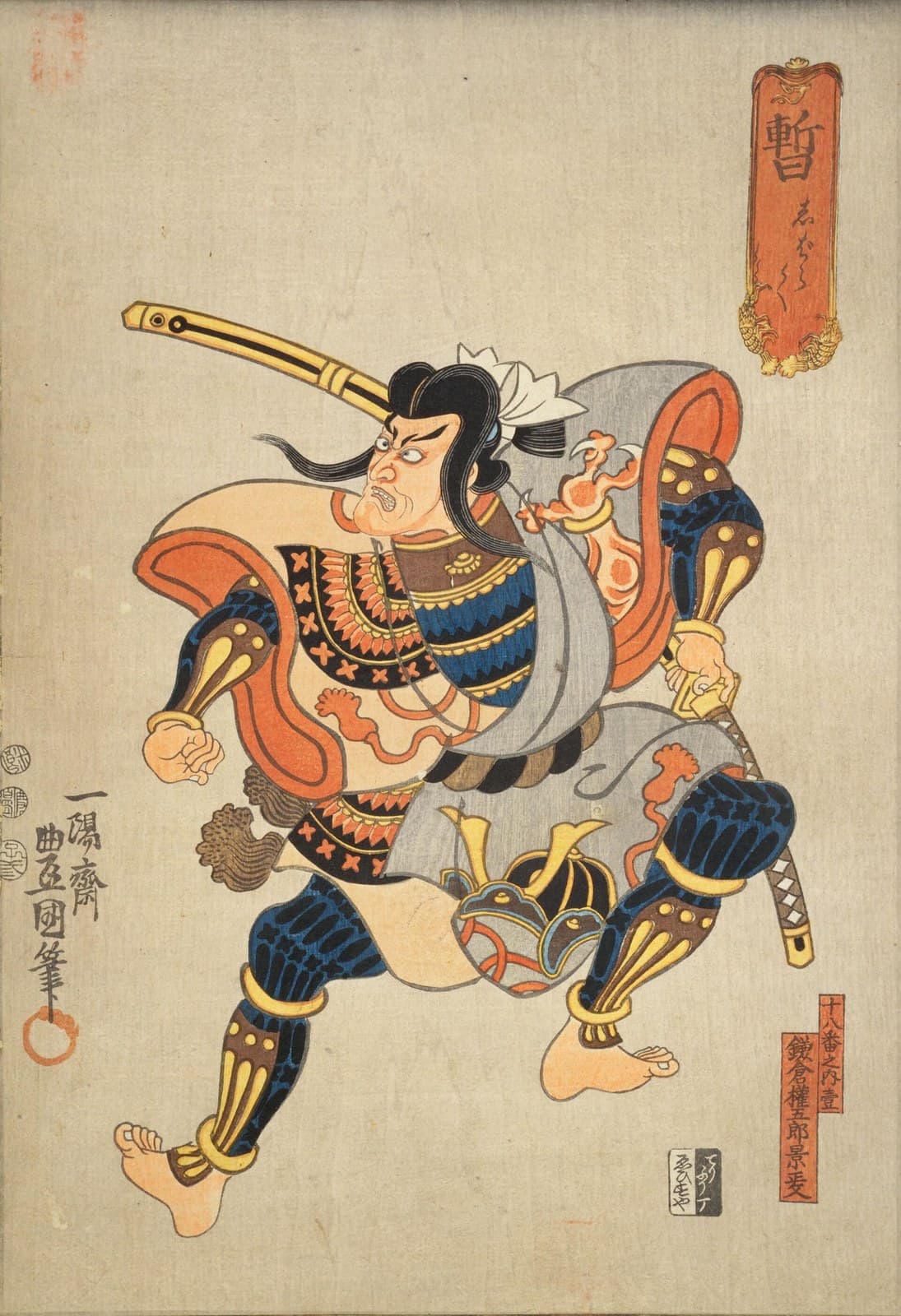
Beni-guma (red)
Justice, youth, overflowing strength
Ai-guma (indigo)
Villainy, vengeful spirits, cold power
Cha-guma (brown)
Demons and creatures beyond the human
Aragoto — literally "rough business" — is the style held to have been begun by Danjūrō I in 1673 and brought to maturity in the Genroku era. It aims to raise onto the stage a strength beyond human measure. It stands opposite wagoto, the delicately amorous style refined in the Kamigata region, and has long been placed as the art most characteristic of Edo's temperament.
Begin with what the eye sees. First the kumadori: a makeup that exaggerates the lines of muscle and vessel across the face, in aragoto drawn in red — the colour held to signify righteousness and power. Then the wig: the kuruma-bin, its side locks flaring outward, makes the very silhouette of the head other than human. And the costume: the suō of Shibaraku is cut vastly beyond any ordinary body, the three-square Ichikawa crest stamped large across it.
The weight the question asks about is indeed part of it — but the point is not that the actor moves despite the weight. It is that he moves while showing the weight. Wearing that outsized rig, he settles his hips, carries his body slowly and hugely, and freezes into a mie. The sequence is itself the proof of power. The same holds for the great strides of a roppō down the hanamichi: movement that displays bulk and mass is the substance of the style.
There is also a devotional colour to aragoto. Its heroes often carry a childlike innocence while being charged with the power of gods and buddhas to drive off evil. The Ichikawa family's long association with the deity Fudō Myōō at Naritasan Shinshōji is held to be connected to this character. Not a mere display of strength but an exaltation before the power that expels evil — that, it is thought, is why aragoto has gone on being performed for more than three centuries.
Words Used Above
Words in This Answer
- 荒事aragotoAragoto is the bold, larger-than-life acting style—said to have been created by Ichikawa Danjūrō I—in which heroes express superhuman power through striking makeup, oversized costumes, and dramatic poses.
- 隈取kumadoriKumadori is kabuki's distinctive makeup of bold colored lines that reveals a character's nature—red for heroic passion, blue for villainy or the supernatural.
- 六方roppōRoppō is a bravura stylized walk with sweeping arms and stamping feet—most famous as Benkei's "flying roppō" exit down the hanamichi in Kanjinchō.
- 市川宗家Ichikawa SōkeIchikawa Sōke is the customary name for Naritaya, the head family of the Ichikawa Danjūrō lineage — the house that has inherited aragoto, the Kabuki Jūhachiban, and the Danjūrō name.
- Shibaraku — Just a Moment!ShibarakuThe tyrant Kiyohara no Takehira has seized power and is about to execute a group of innocents who refuse to bow to him.
- Sukeroku, Flower of Edo (Sukeroku Yukari no Edo Zakura)Sukeroku Yukari no Edo ZakuraIn the Yoshiwara pleasure quarter of Edo, the dashing street knight Sukeroku—lover of the great courtesan Agemaki—picks fights night after night.
More in This Category
Sources & Method
This answer rests on widely shared, established knowledge of kabuki. Matters transmitted as custom are marked "it is said," and assertion is avoided.
- Author
- KABUKI Universe Editorial Team
- Supervision
- Ichikawa Danjūrō
- Published
- Aug 25, 2026
- Updated
- Sep 9, 2026
Supervision means Ichikawa Danjūrō has reviewed this page's intent and key points. The text is the editorial team's writing, not Ichikawa Danjūrō's own statements. Editorial responsibility rests with the team, which corrects any error. Read the editorial policy