Q&A
Performances & Services
Are there TV commercials for kabuki?
ANSWER
Yes. Shochiku and the theatres run spots announcing productions, and actors' appearances in corporate advertising also carry kabuki to a wide public.
The Short Version
- Spots announcing a specific production do air, though whether you see one depends on the region and the run.
- The centre of gravity has shifted from television toward official sites, video trailers and social media.
- Actors also appear in corporate advertising, which introduces kabuki's faces to people who have never entered a theatre.
See it in a picture
Danjūrō-cha (persimmon)
The Ichikawa family colour
Vermilion
The heat of kabuki
Turquoise
The colour Danjūrō XIII loves
There are two layers to kabuki publicity. One is the announcement of a run itself — this month, this theatre, these plays. The other is indirect: an actor appears in a company's advertising, and kabuki comes into view as a by-product. The answer to "is there a TV commercial" depends on which of the two you mean.
Production spots do air, but not uniformly across the country: how a run is promoted varies with the theatre's region and the scale of the engagement. In recent years the centre of announcement has moved toward trailers on official sites, video channels and social media, so someone watching only broadcast television may reasonably conclude there are no commercials. To follow productions reliably, the theatre's and Shochiku's official pages — and the actors' own feeds — are the faster route.
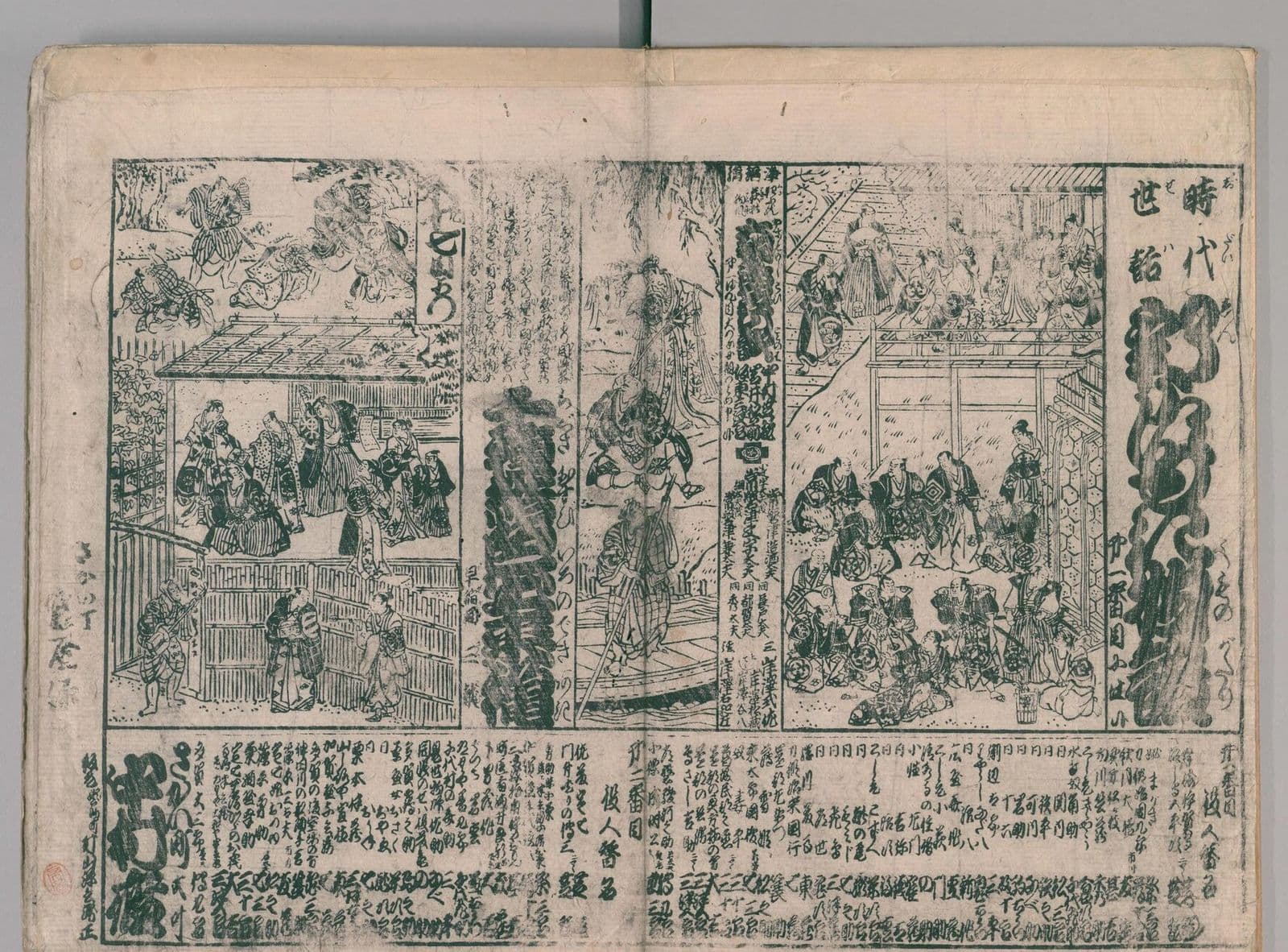
The second layer — actors in advertising — is in fact an old story. In Edo, actor prints served as the pin-ups and posters of their day, and the names, favourite colours and patterns of popular actors were used to sell cosmetics, trinkets and sweets. That a colour name like Danjūrō-cha survives to this day is a trace of exactly that. Modern corporate commercials sit on the same long line. Someone who has never seen a play learns an actor's face and name first, and comes to the theatre from there — a route that is travelled often.
Words Used Above
- Shochiku
- The company that produces kabuki, planning and staging the runs at the Kabukiza and other theatres.
- A run (kōgyō)
- A fixed period during which the same programme is played. At the Kabukiza these are normally organised by the month.
- Actor prints
- Woodblock prints of actors, produced in quantity in Edo — the posters and pin-ups of their day.
Words in This Answer
- 番付・筋書banzuke / sujigakiBanzuke are kabuki's traditional playbills; their descendants are today's theatre programs, called sujigaki in Tokyo.
- 千両役者senryō yakushaA senryō yakusha is an actor whose popularity commanded a yearly salary of a thousand ryō—Ichikawa Danjūrō II is counted among the first to earn the title.
- 團十郎茶danjūrō-chaDanjūrō-cha is the persimmon-brown traditional colour of the Ichikawa Sōke. The Naritaya official site dates it to Danjūrō II, who used it for the suō in Shibaraku, making it the colour of aragoto; it later swept Edo under the name Danjūrō-cha.
More in This Category
Sources & Method
This answer rests on widely shared, established knowledge of kabuki. Matters transmitted as custom are marked "it is said," and assertion is avoided.
- Author
- KABUKI Universe Editorial Team
- Supervision
- Ichikawa Danjūrō
- Published
- Aug 25, 2026
- Updated
- Sep 9, 2026
Supervision means Ichikawa Danjūrō has reviewed this page's intent and key points. The text is the editorial team's writing, not Ichikawa Danjūrō's own statements. Editorial responsibility rests with the team, which corrects any error. Read the editorial policy