Q&A
Costume, Makeup & Wigs
In Kamahige, why is Kagekiyo's kumadori red above and blue below?
ANSWER
In kumadori, red carries vigour and righteous strength, indigo resentment and the uncanny; the two together are usually explained as showing Kagekiyo's double nature.
The Short Version
- Kagekiyo is the warrior who survives the fall of the Heike still burning with hatred of the Genji.
- By the grammar of kuma colours, red shows the power seething within, indigo an obsession beyond the ordinary.
- Two colours on one face read as that torn nature made visible.
- The details, however, vary with production and house kata; there is no single definitive account.
See it in a picture
Beni-guma (red)
Justice, youth, overflowing strength
Ai-guma (indigo)
Villainy, vengeful spirits, cold power
Cha-guma (brown)
Demons and creatures beyond the human
Begin with the man. Aku Shichibyōe Kagekiyo was a warrior in the service of the Heike. After the fall of the Heike he went on nursing his hatred of the Genji — a figure who recurs through noh, kabuki and jōruri. He is no simple villain: he carries at once the nobility of one who kept faith to the end and the terror of one possessed by an obsession.
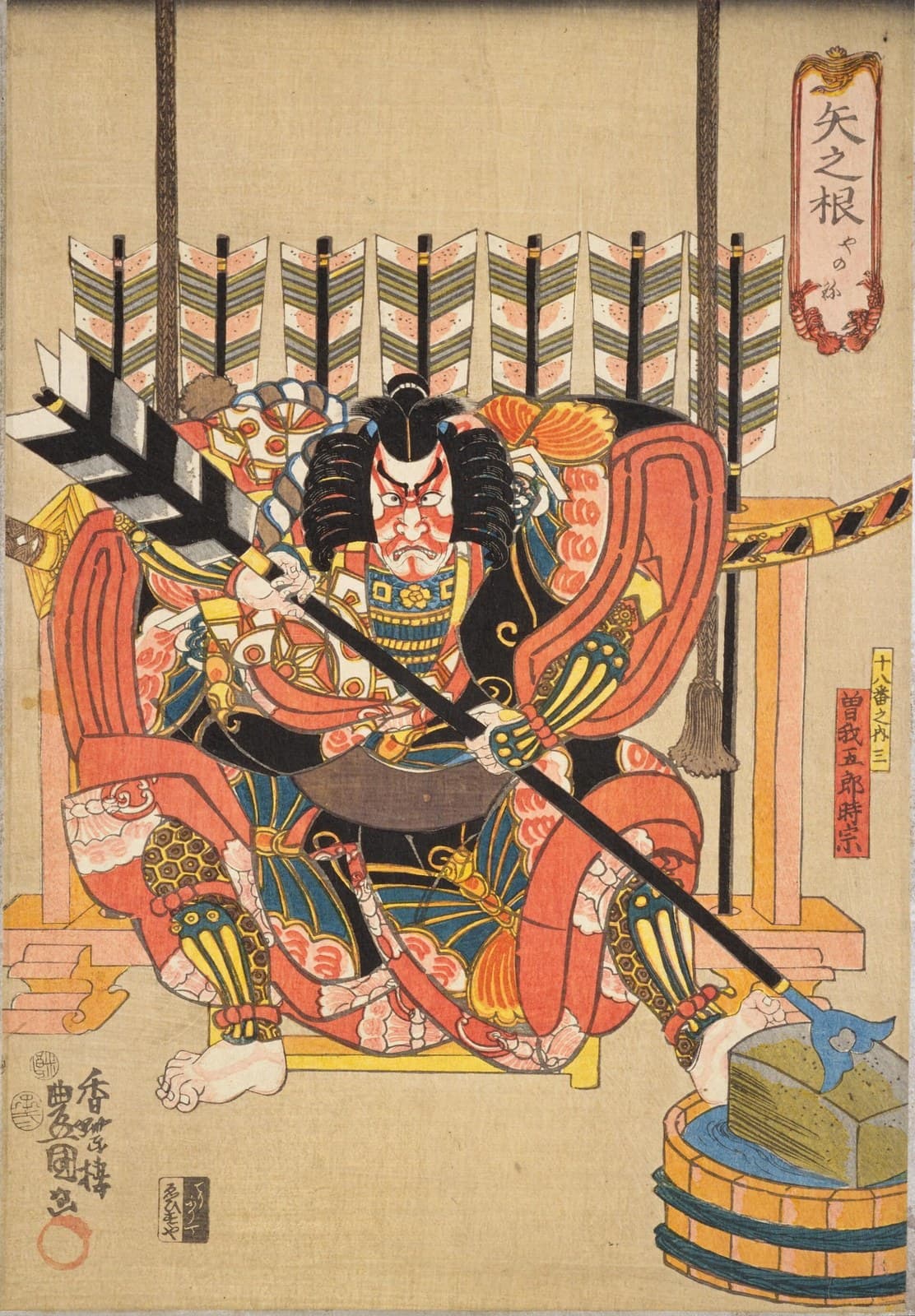
With that in place, the colours become legible. Kabuki kumadori has a grammar of colour: red carries vigour, youth and righteous strength; indigo carries resentment, the supernatural, the air of what is not quite human. That two colours are placed on Kagekiyo's face is usually explained as showing both natures inhabiting one man — the red above for the warrior's power seething within, the indigo below for an obsession beyond the ordinary.
One caution, though. The details of the kuma differ by production and by house kata. Even for the same Kagekiyo the strokes and the disposition of colour can vary, and the explanation of meaning is not settled to one account. Many kabuki kata are held to have worked first and been explained afterwards. So rather than memorising one-to-one that this colour means that, it is more useful in actual viewing to hold the grammar of colour as a loose system and read what the face in front of you is saying. Kamahige, one of the Kabuki Jūhachiban, is the play that stages Kagekiyo's prowess.
Words Used Above
- The Heike
- The clan that dominated the late Heian period, defeated and destroyed by the Genji.
- Onnen (resentment)
- A deep grievance that never lifts, commonly shown in kabuki by indigo kuma.
Words in This Answer
- 隈取の色kumadori no iroThe colours of kumadori makeup tell you who a character is: red for heroic justice, indigo blue for villains and vengeful spirits, brown for demons and the supernatural.
- 隈取kumadoriKumadori is kabuki's distinctive makeup of bold colored lines that reveals a character's nature—red for heroic passion, blue for villainy or the supernatural.
- 十八番jūhachiban / ohakoThe Jūhachiban are the eighteen plays chosen by the Ichikawa Sōke as its signature repertoire—the origin of the everyday word ohako, meaning "one's speciality."
- Kamahige — The Sickle ShaveKamahigeUnder the pretense of shaving a hero's beard with a sickle, an enemy tries to slit his throat—and the blade will not cut. An aragoto play about invulnerable strength.
- Kagekiyo — Breaking the PrisonKagekiyoAfter the fall of the Heike, the fearsome warrior Akushichibyōe Kagekiyo lies captive in a prison of the victorious Genji.
More in This Category
Sources & Method
This answer rests on widely shared, established knowledge of kabuki. Matters transmitted as custom are marked "it is said," and assertion is avoided.
- Author
- KABUKI Universe Editorial Team
- Supervision
- Ichikawa Danjūrō
- Published
- Aug 25, 2026
- Updated
- Sep 9, 2026
Supervision means Ichikawa Danjūrō has reviewed this page's intent and key points. The text is the editorial team's writing, not Ichikawa Danjūrō's own statements. Editorial responsibility rests with the team, which corrects any error. Read the editorial policy