Q&A
Production & Rehearsal
How do actors acquire kabuki's distinctive line delivery?
ANSWER
Through childhood stage debuts and word-of-mouth instruction from masters and seniors — grounded in training in gidayū, nagauta and other musical forms.
The Short Version
- Kabuki dialogue is an art of recitation; it is not the sort of thing that can be learned off the page.
- A 7-5 syllabic pulse and an interplay with the music form its skeleton.
- It is absorbed by ear and body as a child actor, then tempered through training in music and dance.
- Each house's way with a line is held to pass only by voice.
See it in a picture
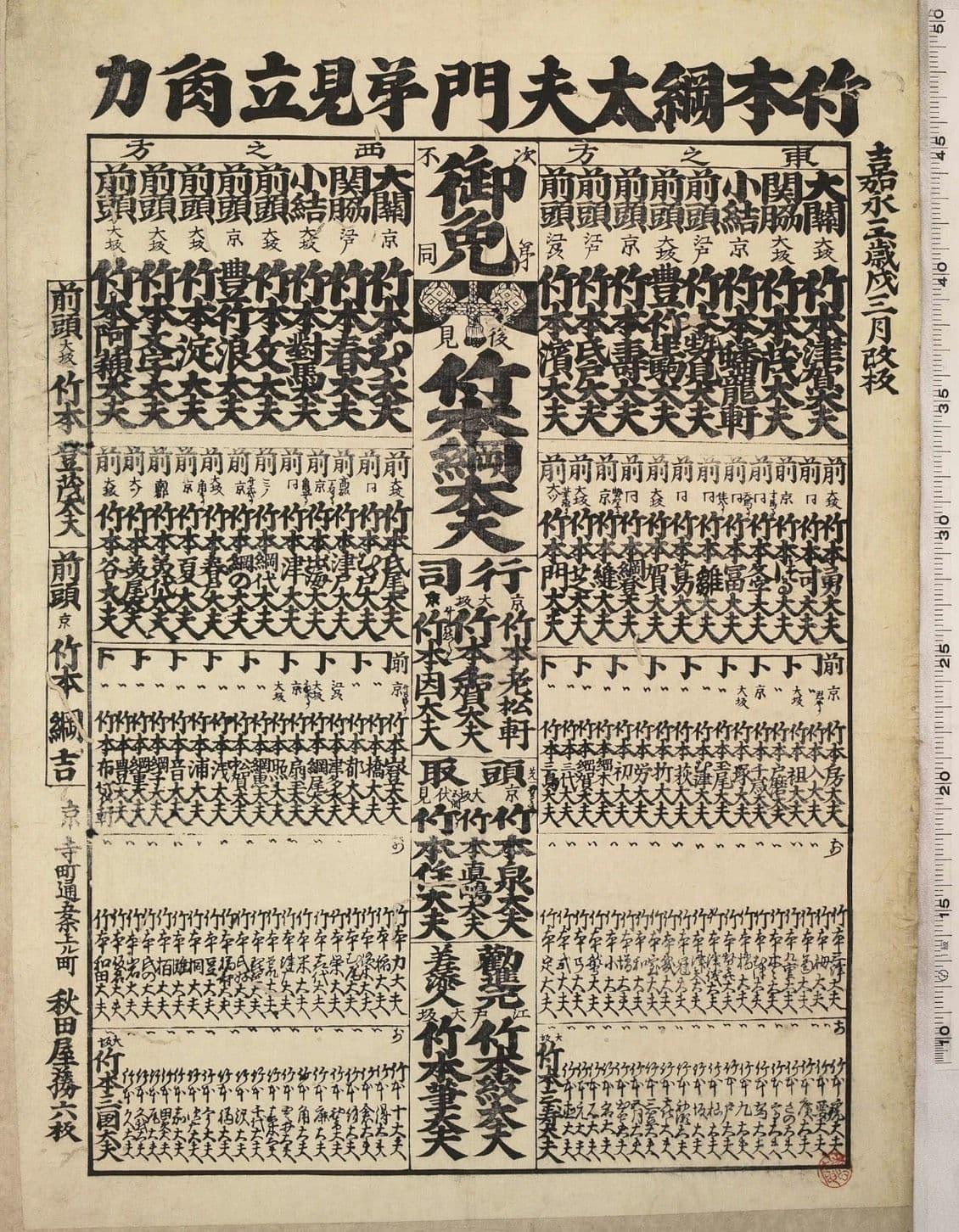
Hearing kabuki dialogue for the first time, many are struck by how far it stands from ordinary speech. This is not an actor overplaying; the lines themselves are built as an art of recitation. A pulse of seven and five syllables underlies them, and they move in exchange with the shamisen and the takemoto chanter. A line is at once a sentence that carries meaning and a part of the music.
Learning it off the page is therefore not an available route. The traditional path is to stand on stage as a child, bathed daily in the speech of the adults around, taking the pulse in through ear and body. Words whose meaning is not yet understood enter as sound first. The breathing acquired in those years is said to be beyond later conscious manufacture.
As the actor grows, training in gidayū, nagauta and classical dance becomes the ground. Studying the music oneself tempers the sense of timing, of where to draw breath, of how to ride a beat. On that ground, each house's particular way with a line is handed over by voice. In the same role and the same line, where to raise and where to let fall differs by house, and something in that difference is held to escape a recording. Which is why the time spent being corrected in the rehearsal room is necessary.
Words Used Above
- Kuden
- Transmission by mouth rather than in writing — the basic form in which kabuki's art is handed on.
- The 7-5 pulse
- A Japanese rhythm alternating seven- and five-syllable units, forming the skeleton of kabuki speech.
- Gidayū
- A narrative musical form; in kabuki it appears as takemoto, carrying scene and feeling forward.
Words in This Answer
- 竹本takemotoTakemoto is gidayū narrative music as performed in kabuki: a chanter and thick-necked shamisen carry the story in plays adapted from the puppet theatre.
- 長唄nagautaNagauta is the lyrical school of shamisen music that grew up with Edo kabuki, accompanying dance and coloring scenes throughout the play.
- 初舞台hatsubutaiHatsubutai is an actor's formal stage debut—in kabuki, the moment a young actor first performs under a professional stage name.
More in This Category
Sources & Method
This answer rests on widely shared, established knowledge of kabuki. Matters transmitted as custom are marked "it is said," and assertion is avoided.
- Author
- KABUKI Universe Editorial Team
- Supervision
- Ichikawa Danjūrō
- Published
- Aug 25, 2026
- Updated
- Sep 9, 2026
Supervision means Ichikawa Danjūrō has reviewed this page's intent and key points. The text is the editorial team's writing, not Ichikawa Danjūrō's own statements. Editorial responsibility rests with the team, which corrects any error. Read the editorial policy