Q&A
Plays, Culture & History
Did kabuki contain "riddle" elements from the beginning?
ANSWER
Edo kabuki was steeped in devices meant to be decoded — mitate allusion, wordplay, the shukō twist. Reading them was itself part of the entertainment.
The Short Version
- The very method — a known story-world overlaid with a fresh shukō — was a game of spotting what had been altered.
- Costume motifs and properties carried mitate hints of a character's hidden fate.
- The rhymed self-namings of the shiranami thieves are inseparable from the pleasure of wordplay.
- Kabuki was, from the start, a theatre that trusted its audience to decode.
See it in a picture
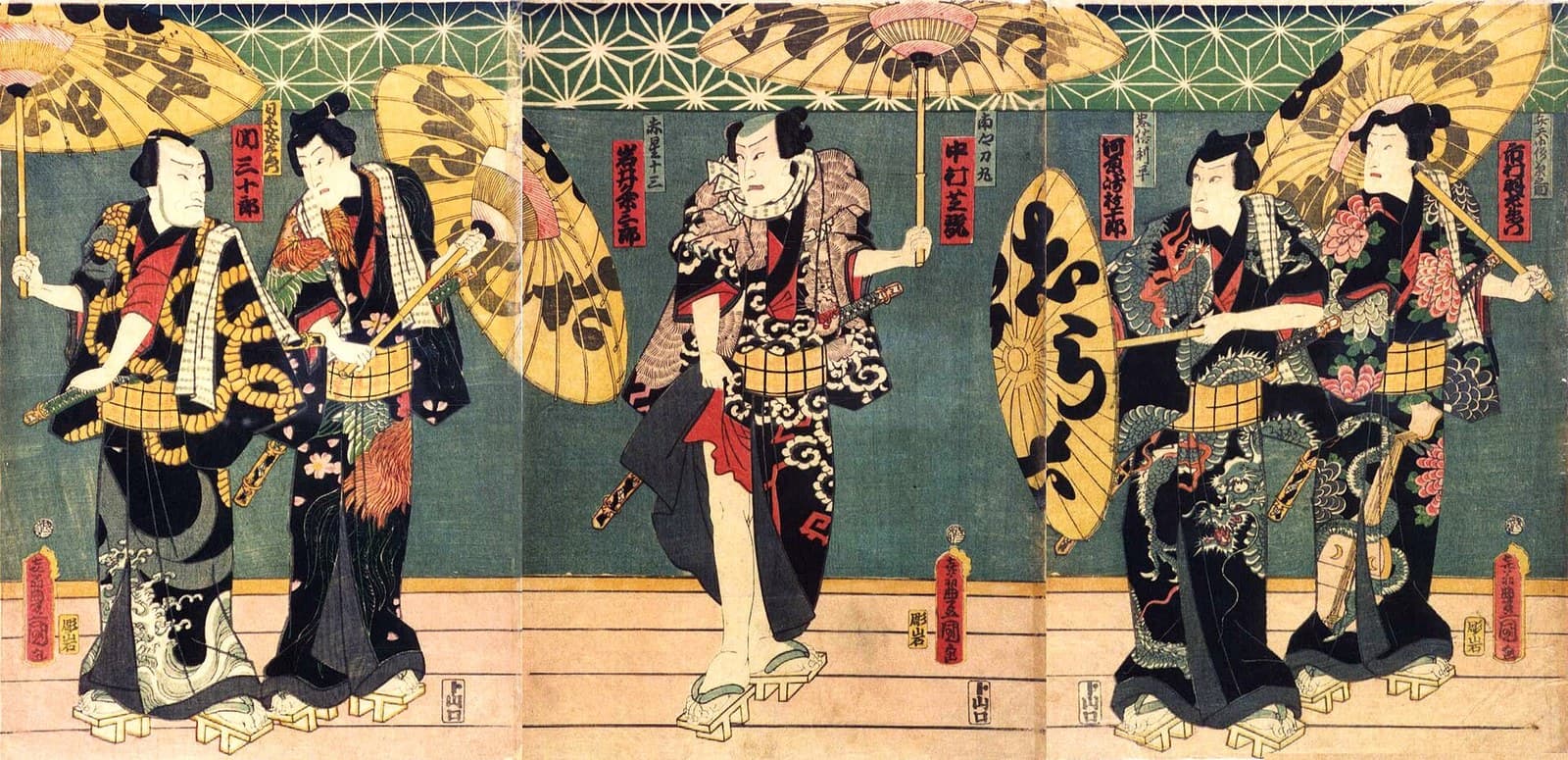
Edo audiences were masters at reading the devices laid across the stage — and this is no exaggeration: the method of playwriting presupposed it. Many kabuki works begin by choosing a sekai, a story-world everyone knows — the Soga brothers' vendetta, the tale of Yoshitsune — and then overlay a shukō, a fresh conceit. Because the audience knows the world, it sees at once where this staging has turned. The slap of the knee at a good twist was itself part of the work.
The devices are not only in the plot. Costume motifs and hand properties carried meaning too: a pattern hinting at a character's origins, an object planted as a seed for a later turn. Such mitate registers with those who catch it and passes as ornament for those who do not. The same stage reaches different depths depending on how much the viewer brings.
So too with wordplay. When the thieves of a shiranami play announce themselves, rhymed lines pile one on another, and the pleasure lies in the run of sound as much as in the sense. Jiguchi — punning play on words — is salted through the dialogue. Kabuki, in short, was from the beginning a theatre that trusted its audience to decode; it never assumed a passive viewer. That design survives intact in performance today.
Words Used Above
- Sekai (a story-world)
- The known body of narrative a work is built upon — the Soga world, the Yoshitsune world.
- Shukō
- The fresh conceit laid over a story-world — where each work's originality lies.
- Mitate
- A device likening one thing to another, planted in motifs and properties.
Words in This Answer
- 白浪物shiranami-monoShiranami-mono are kabuki's "thief plays"—dramas with charismatic robbers as their heroes, which flourished at the end of the Edo period, above all in the work of Kawatake Mokuami.
- 曽我物soga-monoSoga-mono are plays based on the Soga brothers' vendetta—a story so beloved that Edo theatres staged a Soga play every New Year.
- 捨て台詞sutezerifuA sutezerifu was originally an unscripted line improvised by a kabuki actor—today it means the parting shot flung out as someone storms off.
More in This Category
Sources & Method
This answer rests on widely shared, established knowledge of kabuki. Matters transmitted as custom are marked "it is said," and assertion is avoided.
- Author
- KABUKI Universe Editorial Team
- Supervision
- Ichikawa Danjūrō
- Published
- Aug 25, 2026
- Updated
- Sep 9, 2026
Supervision means Ichikawa Danjūrō has reviewed this page's intent and key points. The text is the editorial team's writing, not Ichikawa Danjūrō's own statements. Editorial responsibility rests with the team, which corrects any error. Read the editorial policy