Q&A
Plays, Culture & History
What does the Yachiyoza in Yamaga, Kumamoto, mean to kabuki?
ANSWER
A playhouse built in 1910 and an Important Cultural Property, it preserves the form of the pre-modern theatre — and still hosts kabuki today: a cultural asset that is alive.
The Short Version
- A playhouse built in 1910 and designated an Important Cultural Property.
- Box seating, a revolving stage, a naraku turned by human hands: the pre-modern structure survives intact.
- Fallen derelict, it was brought back to working life by local preservation and a major restoration.
- It is known for a closeness between actor and audience that the great modern theatres have lost.
See it in a picture
- 1Yagura — the licence tower
- 2Naraku — beneath stage and hanamichi
- 3Seri — the lifts
- 4Suppon — the hanamichi lift
- 5Hanamichi — the walkway
The Yachiyoza is a playhouse in Yamaga, Kumamoto Prefecture, built in 1910 with funds raised by local merchants and manufacturers. Its significance lies not only in the building but in the fact that its working structure survives largely intact: masu-seki box seating, where a few people sit together in a partitioned square of floor; a revolving stage; a naraku beneath. And the revolve and the lifts are still worked by human power rather than motors.
That such a structure survives is not a matter of course. Modern theatres were redesigned to hold larger audiences and handle more complex machinery. The Yachiyoza too fell out of use after the war and passed through a derelict period. Local preservation efforts sustained it, a major restoration followed, and it returned to working life and was designated an Important Cultural Property. What distinguishes it is that it is not a preserved building but a theatre in use.
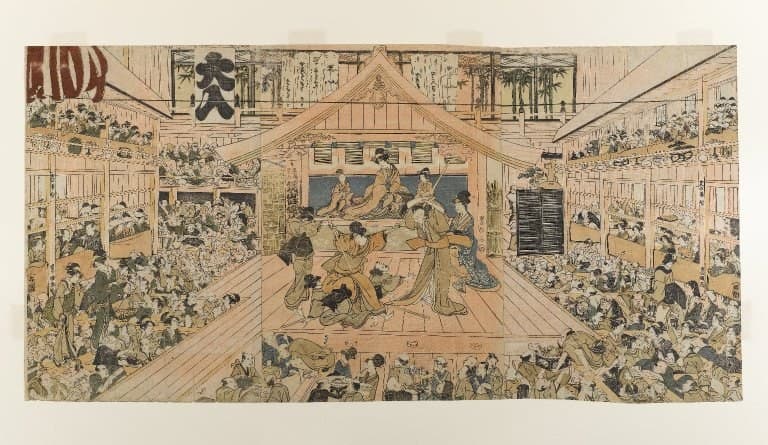
That is where its meaning for kabuki lies. Edo playhouses were far smaller than today's great theatres, and the distance between stage and seat was short — close enough for the ōmukō calls to carry, close enough to see an actor breathe. Sitting in the Yachiyoza, you experience that distance directly. It is long associated with Bandō Tamasaburō's performances, and the Ichikawa family too has played there. It is a place for understanding, not through description but through the body, the kind of room in which kabuki grew up.
Words Used Above
- Masu-seki
- Seating in partitioned squares of floor, a few people to each — the basic Edo playhouse form.
- Important Cultural Property
- A category of nationally designated cultural property, covering buildings and works of art.
Words in This Answer
- 廻り舞台mawari-butaiThe mawari-butai is kabuki's revolving stage: while one scene plays out front, the next is prepared behind, and a single rotation changes the world in moments.
- 奈落narakuNaraku—originally a Buddhist word for hell—names the space beneath the stage and hanamichi, and lives on in the everyday phrase naraku no soko, "the bottomless depths."
- 桟敷sajikiSajiki are the raised box seats along the sides of the auditorium, descended from ancient festival viewing stands and preserved at the Kabukiza today.
- こけら落としkokera-otoshiKokera-otoshi—"sweeping off the wood shavings," said to derive from clearing the roof at the end of construction—is the celebratory first performance in a newly built or renovated theatre.
More in This Category
- Why did kabuki come to be treasured as Intangible Cultural Heritage — what is its value?
- What beauty and learning can one take from kabuki?
- Are there kabuki plays that take up the society of the past thirty years?
- If the children wear wigs and makeup but the adult actor does not — is that still kabuki?
Sources & Method
- Author
- KABUKI Universe Editorial Team
- Supervision
- Ichikawa Danjūrō
- Published
- Aug 25, 2026
- Updated
- Sep 9, 2026
Supervision means Ichikawa Danjūrō has reviewed this page's intent and key points. The text is the editorial team's writing, not Ichikawa Danjūrō's own statements. Editorial responsibility rests with the team, which corrects any error. Read the editorial policy