Q&A
Plays, Culture & History
If the children wear wigs and makeup but the adult actor does not — is that still kabuki?
ANSWER
Kabuki's practice includes not only full productions but su-odori, talks and educational performances. What matters is not the costume but whether kata and art are being handed on.
The Short Version
- Doing without the full costume is a simplification, not a counterfeit.
- Su-odori — dancing in formal montsuki-hakama — is itself a dignified form of performance.
- At schools and regional venues it is common for children to try the costume while the actor teaches in plain dress.
- Kabuki as a culture includes not only the finished production but the moments where the art changes hands.
See it in a picture
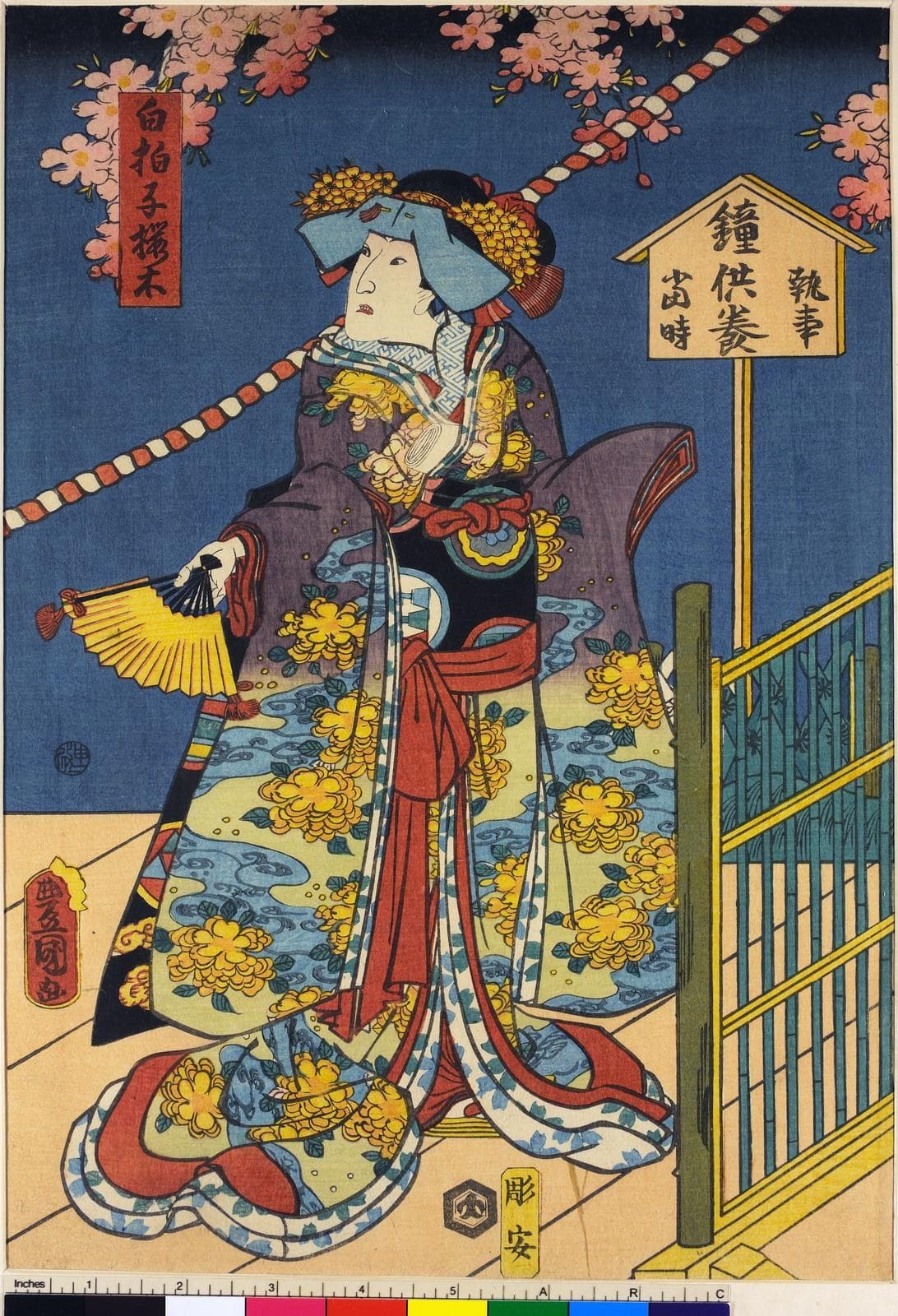
Behind this question lies a rather fundamental one: is kabuki the costume? The kumadori, the wig and the magnificent robes are its face — but is it not kabuki without them?
Look at how kabuki is actually performed and the answer is clear. Su-odori — a kabuki actor dancing in formal montsuki-hakama — omits the costume, yet is recognised as a dignified form in its own right. Indeed, since there is no help from the robes, the bodily technique stands exposed, and connoisseurs sometimes regard it as the harder form. Simplification and imitation are entirely different things.
With that in place, consider the case in the question: children in costume while the actor teaches in plain dress. This is common at school performances, regional playhouses and workshops. What is happening there is the handing on of an art. A child puts on the robes, learns what a wig weighs, and the actor beside him shows the kata. It is a different activity from presenting a finished production, but it belongs just as fully to kabuki. From the standpoint of transmission, such occasions are precisely where future audiences and future bearers are raised. If one understands kabuki as a culture to include not only the works performed but the process by which they are passed on, the answer is obvious.
Words Used Above
- Su-odori
- Dancing without costume or wig, in formal montsuki-hakama — a form that leaves technique fully visible.
- Koshirae
- The whole appearance of a role — costume, wig and makeup taken together.
Words in This Answer
- 所作事shosagotoShosagoto are kabuki's dance pieces performed to live music—an art that began with onnagata and blossomed into a rich repertoire.
- 初舞台hatsubutaiHatsubutai is an actor's formal stage debut—in kabuki, the moment a young actor first performs under a professional stage name.
- 型kataKata are the refined "forms" of acting and staging, polished over centuries and handed down within families of actors—the foundation on which kabuki is built.
More in This Category
Sources & Method
This answer rests on widely shared, established knowledge of kabuki. Matters transmitted as custom are marked "it is said," and assertion is avoided.
- Author
- KABUKI Universe Editorial Team
- Supervision
- Ichikawa Danjūrō
- Published
- Aug 25, 2026
- Updated
- Sep 9, 2026
Supervision means Ichikawa Danjūrō has reviewed this page's intent and key points. The text is the editorial team's writing, not Ichikawa Danjūrō's own statements. Editorial responsibility rests with the team, which corrects any error. Read the editorial policy