Q&A
Plays, Culture & History
Is Sukeroku's entrance — the deha — neither dance nor drama?
ANSWER
It is both at once. The entrance on the hanamichi, riding the katōbushi music, fuses the pulse of dance with the character-drawing of drama — an art that lives on the border.
The Short Version
- The deha is the set-piece in which the hero makes his entrance along the hanamichi.
- The play of the umbrella, the display of the headband, the carriage of each step: all dance vocabulary.
- And all of it is at the same time drama, drawing the greatest dandy in Edo.
- In Ichikawa stagings it rides katōbushi, so music, dance and acting overlap inseparably.
See it in a picture
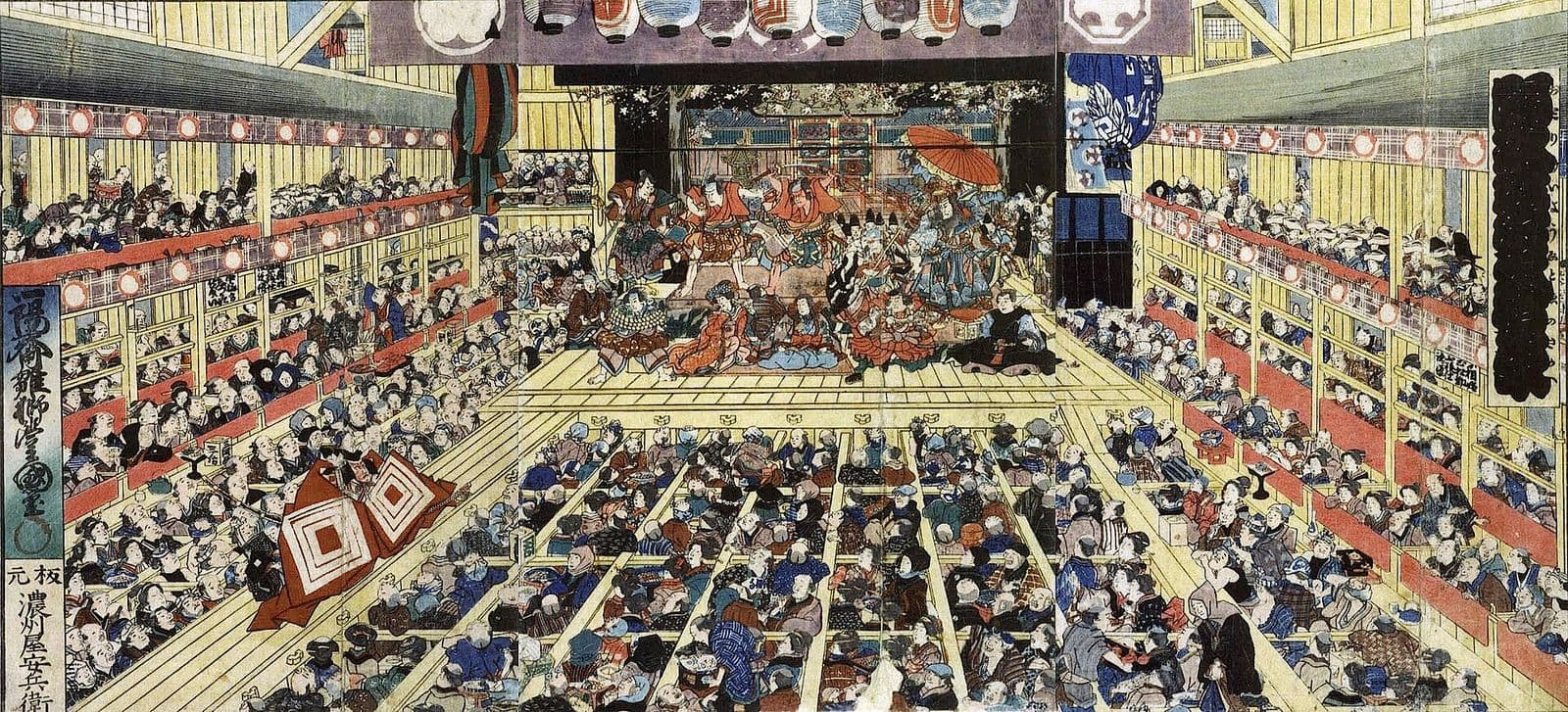
In Sukeroku Yukari no Edo-zakura, the hero makes his entrance along the hanamichi in a set-piece given generous time. This is the deha. Snake-eye umbrella in hand, purple headband bound at his brow, he moves down the walkway riding the music — and several minutes are spent on that alone.
How to classify this is the heart of the question — and in truth it does not fit the division between dance and drama. The handling of the umbrella, the display of the headband, the carriage of each step: every gesture is plainly dance vocabulary, riding the music, marking a pulse, presenting fixed forms. And yet all of it is telling us what sort of man the greatest dandy in Edo is — his style, his bravado, what he is carrying. A character rises without a word of dialogue. That is the work of drama.
In Ichikawa stagings, custom has this entrance accompanied by katōbushi, a narrative musical form born in Edo, sometimes played with the participation of amateur societies devoted to it. Music, dance and acting exist in kabuki as separate crafts — and in the best passages the seams between them vanish. Sukeroku's deha compresses that wholeness into a few minutes. The answer is not "neither" but "both."
Words Used Above
Words in This Answer
- 花道hanamichiThe hanamichi is a raised runway through the audience that turns an actor's entrances and exits into dramatic highlights of their own.
- 所作事shosagotoShosagoto are kabuki's dance pieces performed to live music—an art that began with onnagata and blossomed into a rich repertoire.
- Sukeroku, Flower of Edo (Sukeroku Yukari no Edo Zakura)Sukeroku Yukari no Edo ZakuraIn the Yoshiwara pleasure quarter of Edo, the dashing street knight Sukeroku—lover of the great courtesan Agemaki—picks fights night after night.
More in This Category
Sources & Method
This answer rests on widely shared, established knowledge of kabuki. Matters transmitted as custom are marked "it is said," and assertion is avoided.
- Author
- KABUKI Universe Editorial Team
- Supervision
- Ichikawa Danjūrō
- Published
- Aug 25, 2026
- Updated
- Sep 9, 2026
Supervision means Ichikawa Danjūrō has reviewed this page's intent and key points. The text is the editorial team's writing, not Ichikawa Danjūrō's own statements. Editorial responsibility rests with the team, which corrects any error. Read the editorial policy