Shōwa — through war into recovery
The Eleventh
Ichikawa Danjūrō XI
'Ebi-sama', and the name restored after fifty-nine years
- Life
- 1909-01-06–1965-11-10
- Bore the name Danjūrō
- 1962-04–1965-11-10
- Age at succession
- 53
- Earlier and literary names
- Horikoshi Haruo (his real name) · Matsumoto Kintarō I (his name at his stage debut) · Ichikawa Komazō IX (taken in 1929) · Ichikawa Ebizō IX (taken in 1940) · Goryū (haimyō, his poetry name) · Nikutei Tōhachi (his pen name as a playwright)
This generation in thirty seconds
Born the eldest son of Matsumoto Kōshirō VII, he was adopted by the tenth of the line and took the name Ichikawa Ebizō IX. Postwar performances of Sukeroku and Genji Monogatari made him famous as 'Ebi-sama'. After long hesitation before a name he felt was too large, he restored Danjūrō in April 1962, fifty-nine years after the death of the ninth. He died of illness three and a half years later.
What he inherited
Eldest son of Matsumoto Kōshirō VII
The Naritaya official site records that he was born on 6 January 1909, eldest son of Matsumoto Kōshirō VII, with younger brothers who became Matsumoto Kōshirō VIII (later Hakuō) and Onoe Shōroku II. The Kabuki Actor Directory calls the three the Kōraiya brothers. Their father is named by the Japan Arts Council among the great actors of Tokyo kabuki's golden age.
Adopted into the Ichikawa head house
The Kabuki Actor Directory records that he was sought as an adopted son by Ichikawa Sanshō V — son-in-law of Danjūrō IX, who had been his own father's teacher — and so became heir to the Ichikawa head house. The two official sources differ on the year: the Naritaya site gives 1939, the Kabuki Actor Directory April 1940.
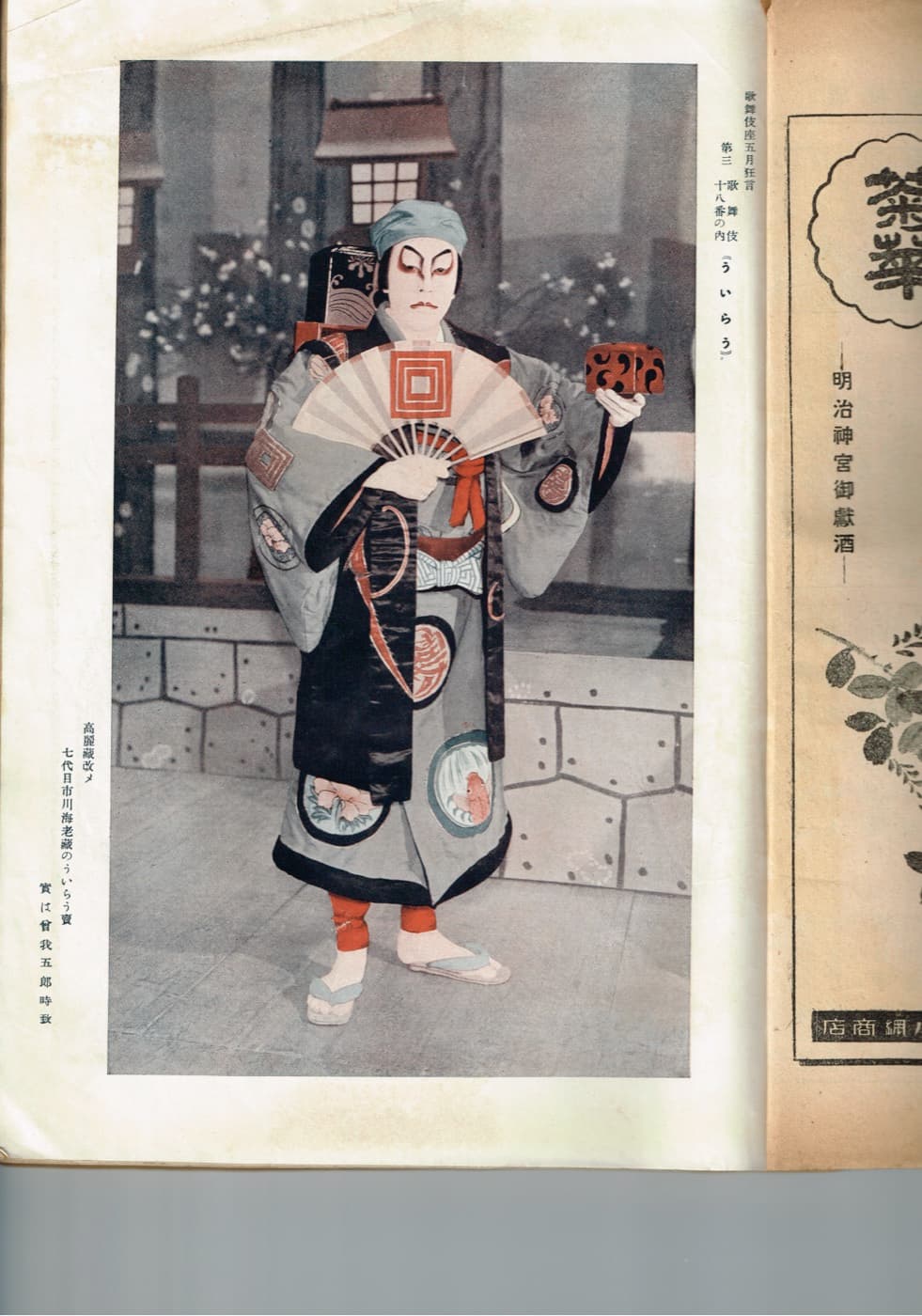
In May 1940 he took the name Ichikawa Ebizō IX at the Tokyo Kabukiza, at thirty-one. The Kabuki Actor Directory records that at the succession run he played the medicine pedlar — in truth Soga no Gorō — in the Ichikawa house's Jūhachiban play Uirō.
What he created, changed or revived
Postwar Sukeroku, and 'Ebi-sama'
The Kabuki Actor Directory records that when a Sukeroku with a young cast was staged at the Tōkyō Gekijō in 1946, Onoe Kikugorō VI put him forward for the title role and taught it to him. The Naritaya official site likewise dates his popularity from that performance. After his Hikaru Genji in Genji Monogatari in 1951 came the 'Ebi-sama' boom.
Work in newly written kabuki
The Cultural Digital Library records that in the postwar Shōwa years Danjūrō XI also left his mark in newly written kabuki and was a star of the recovery. The Kabuki Actor Directory names Fumimaro in Katō Michio's Nayotake, Oda Nobunaga in Osaragi Jirō's Wakaki Hi no Nobunaga, and Nobuyasu in Tsukiyama-dono Shimatsu.
Conferring the tenth's name on his adoptive father
In 1956 his adoptive father Sanshō died. The Naritaya official site records that on the day of the funeral his successor Ebizō conferred the name of Danjūrō X upon him; the Kabuki Actor Directory likewise states that he conferred the name when his adoptive father died. His own succession came six years later.
Araisokai, a study group for the house
The Naritaya Danjūrō Encyclopaedia carries the twelfth's recollection that it began with his father, Danjūrō XI, setting the house's pupils to study at a restaurant, and that the first formally numbered meeting was held at the Sabō Kaikan in July 1963. The series ended with its seventh meeting in 1973. The name derives from the araiso pattern originated by Danjūrō IX.
Signature roles and plays
Sukeroku Yukari no Edo Zakura — Hanakawado Sukeroku
The role in which he found fame at the Tōkyō Gekijō in June 1946. It was chosen again, with Benkei in Kanjinchō, for the plays of his succession as the eleventh in 1962.
The Kabuki Actor Directory gives the plays of his succession at the Kabukiza in April and May 1962 as Benkei in the Jūhachiban Kanjinchō and the title role in Sukeroku.
Genji Monogatari — Hikaru Genji
Kabukiza, March 1951. The Naritaya official site records that his Hikaru Genji in Funahashi Seiichi's version of The Tale of Genji was greatly acclaimed, and that the 'Ebi-sama' boom arose from about this time. The Kabuki Actor Directory calls the houses record-breaking.
Wakaki Hi no Nobunaga — Oda Nobunaga
A new play by Osaragi Jirō. The Kabuki Actor Directory records that the role brought him the fifth Mainichi Theatre Award in 1953.
Danjūrō VIII — the eighth of the line
The Kabuki Actor Directory records that in the year before his death he staged at the Kabukiza a new play he had commissioned from Gōda Isao, Ichikawa Danjūrō VIII, taking the part of the eighth — the predecessor whose style was held closest to his own.
Kabuki in his age
These were the years when theatres burned in the war were rebuilt and kabuki won back its audience. The Japan Arts Council records that recovery began with the rebuilding of the Kabukiza in 1951 and the response to Genji Monogatari, and that in 1962 the long-vanished name of Ichikawa Danjūrō returned, its succession run drawing crowds enough to be called a kabuki boom. The Cultural Digital Library introduces him as a star of the postwar recovery. The renewed emphasis on transmitting the classics would lead, the year after his death, to the opening of the National Theatre in 1966.
Meanwhile, in the world
- 1964Media
Black-and-white television reaches the home
The Ministry of Internal Affairs and Communications white paper records that black-and-white television spread rapidly through Japanese homes during the 1950s and 60s, reaching ninety per cent of households by 1964. Average daily viewing across the population rose from fifty-six minutes in 1960 to two hours fifty-two minutes by 1965.
- 1965-04Art & plays
The first designation of the Traditional Kabuki Preservation Society
The Kabuki Actor Directory records that the first designation of members of the Traditional Kabuki Preservation Society took place in April 1965 — part of a period in which the transmission of the classics was being given institutional support.
- 1966Society
The National Theatre opens
The Japan Arts Council records that in 1966 the National Theatre opened, dedicated to preserving and promoting the traditional performing arts, and began staging classical kabuki on a stage built with kabuki's own machinery. This was the year after his death.
Where the age and the actor meet
- 1941–1945Society
Wartime consolation performances
The Naritaya official site records that the Pacific War began in 1941 and that he took part in consolation performances and the like — the year after he had become Ichikawa Ebizō IX.
- 1951-03Art & plays
Genji Monogatari at the rebuilt Kabukiza
The Japan Arts Council records that the Kabukiza was rebuilt in 1951 and that kabuki began to recover, helped by the wide response to a staging of Genji Monogatari. The Naritaya official site records that in March of that year he played Hikaru Genji in Funahashi Seiichi's version at the Kabukiza to great acclaim. He was on the stage that became the emblem of the recovery.
- 1962-04Art & plays
A Danjūrō after fifty-nine years, and the kabuki boom
The Naritaya official site records that in April 1962 he took the name Danjūrō XI at the Kabukiza, and that an Ichikawa Danjūrō came into being after a gap of fifty-nine years since the death of the ninth. The Japan Arts Council records that the succession run drew such crowds that it amounted to a kabuki boom.
- 1965-03Art & plays
Three brothers side by side at the kōjō
The Naritaya Danjūrō Encyclopaedia relates that at the Kabukiza in March 1965, at a memorial run for Kōshirō VII, the three brothers appeared together in plain formal dress for the kōjō address, to much comment — and that the eleventh, thought to be a halting speaker, delivered his with humour and fluency enough to startle his younger brothers. It was the year he died.
From this generation to the next
He returned Danjūrō to the stage after fifty-nine years, but held the name for only three and a half. The Cultural Digital Library calls him a star of the postwar recovery; the Kabuki Actor Directory records that his early death was called the greatest loss of postwar kabuki. The name passed to a nineteen-year-old son.
Where the sources differ
On the following points the sources we consulted disagree. Rather than declare one correct, we set them side by side and state how we have handled each.
The year in which he was adopted by Ichikawa Sanshō, Danjūrō X
He became Ichikawa Sanshō's adopted son in 1939.
Source: 成田屋(市川團十郎家)公式サイト「家系図 十一代 市川團十郎」
He was adopted by Ichikawa Sanshō V in April 1940, and took the name Ichikawa Ebizō IX in May of the same year.
How we handle it
The two sources stand a year apart. Our text carries both and settles on neither, and will not fix a single year until a primary source can decide it.
How many years the name Danjūrō was absent from the stage
After the death of Danjūrō IX the name stood vacant for fifty-nine years.
Source: 成田屋(市川團十郎家)公式サイト「家系図 十一代 市川團十郎」
The succession came after some sixty years.
How we handle it
Our text follows the official site's fifty-nine years. Since the interval is also given as about sixty, we treat the fact of the absence — from the death of the ninth to the succession of the eleventh — as firmer than any particular figure. The Japan Arts Council gives no number at all.
What remains today
A precedent: a lapsed name can return
After fifty-nine years the name came back to the stage — showing that a succession can be an event awaited not only inside the house but by an audience and an age.
The two plays chosen for his succession have stood at the centre of the successions that followed.
Passing on to the next generation
The Kabuki Actor Directory records that his range has been securely inherited by his eldest son, Danjūrō XII, and by his grandson, the present holder of the name.