Q&A
Acting & Stage Expression
Why is the hanamichi on the left side, facing the stage?
ANSWER
It settled there with the structure of Edo playhouses, tied to the convention that shimote — the audience's left — is the side of comings and goings. No single accepted explanation exists.
The Short Version
- The hanamichi has run through shimote — the audience's left — since the Edo playhouse.
- Kabuki space carries a loose grammar: kamite (right) is the side of rank, shimote (left) of passage.
- A walkway for arrivals and departures belongs naturally to shimote under that grammar.
- But there is no settled explanation for the left specifically; a temporary second walkway is sometimes laid on the right.
See it in a picture
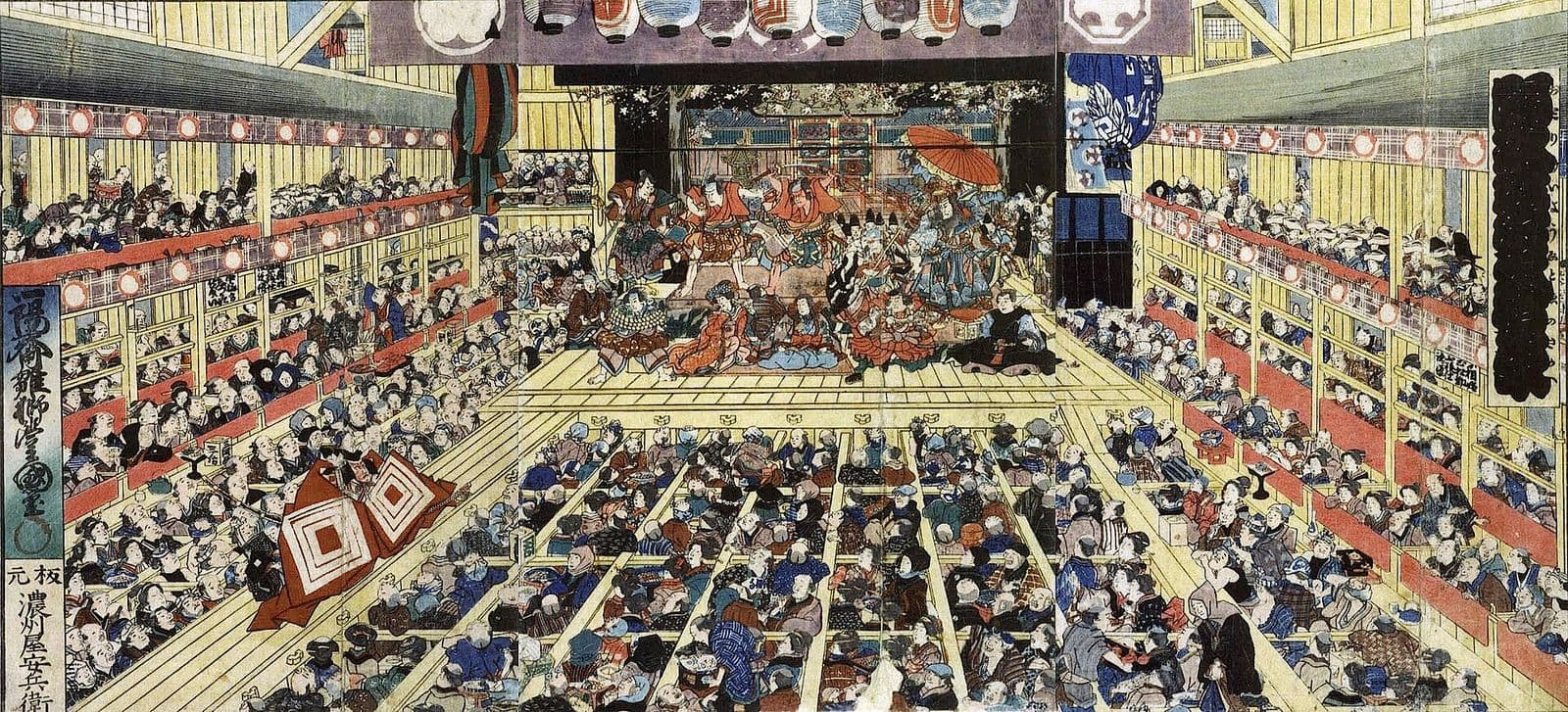
The hanamichi is a walkway running from the stage back through the audience. Actors enter along it and depart along it. With the revolving stage, it is a structure the kabuki playhouse evolved for itself and is rarely seen in other theatres. The question is why it runs through the audience's left — the side kabuki calls shimote.
To be honest, there is no established account of why the left. It was built that way in Edo playhouses and has been carried forward. That said, something can be said about it. Kabuki's stage space carries a loose grammar: kamite, the audience's right, is the side of rank, where the highest-ranking figure sits in a palace scene; shimote, the left, is the side from which people come in and out — the side of passage and movement.
The hanamichi is precisely the road by which people appear from the outside world and depart into it. Its being on shimote therefore chimes with the grammar of the space. Which way the causation runs cannot be settled — whether the walkway came first and the grammar formed around it, or the reverse — but the two are held to have grown together. Note also that a staging may call for a second walkway laid temporarily on the right. This is the karihanamichi, and when both are used the whole theatre becomes the space of the story.
Words Used Above
- Kamite and shimote
- The sides of the stage: kamite is the audience's right, shimote the left — directions that carry meaning.
- Karihanamichi
- A second walkway laid temporarily on the right when a staging needs it, narrower than the main one.
Words in This Answer
- 花道hanamichiThe hanamichi is a raised runway through the audience that turns an actor's entrances and exits into dramatic highlights of their own.
- 仮花道kari-hanamichiA kari-hanamichi is a temporary second runway built on the right side of the auditorium, used with the main hanamichi to turn the whole theatre into the stage.
- 廻り舞台mawari-butaiThe mawari-butai is kabuki's revolving stage: while one scene plays out front, the next is prepared behind, and a single rotation changes the world in moments.
More in This Category
- How is it decided whether an actor plays both male roles and onnagata, or mainly onnagata?
- Are there stages of roles — parts for the young, parts that wait for experience?
- What is the difference when an actor looks to kamite or to shimote?
- What does it mean when, after a climactic pose, the actor opens his right hand to the right and left to the left?
Sources & Method
- Author
- KABUKI Universe Editorial Team
- Supervision
- Ichikawa Danjūrō
- Published
- Aug 25, 2026
- Updated
- Sep 9, 2026
Supervision means Ichikawa Danjūrō has reviewed this page's intent and key points. The text is the editorial team's writing, not Ichikawa Danjūrō's own statements. Editorial responsibility rests with the team, which corrects any error. Read the editorial policy