Q&A
Acting & Stage Expression
What does it mean when, after a climactic pose, the actor opens his right hand to the right and left to the left?
ANSWER
It is a stylised amplification — usually explained as emotion released outward, or command over the scene made visible. The precise meaning varies with the play and its kata.
The Short Version
- It is the type of kabuki amplification: force or feeling pushed out to the body's very edge.
- In aragoto it functions as superhuman power radiating outward.
- In history plays it reads as an authority that stills and commands the scene.
- The same shape reads differently in context, so it is better watched in the flow than memorised as a picture.
See it in a picture
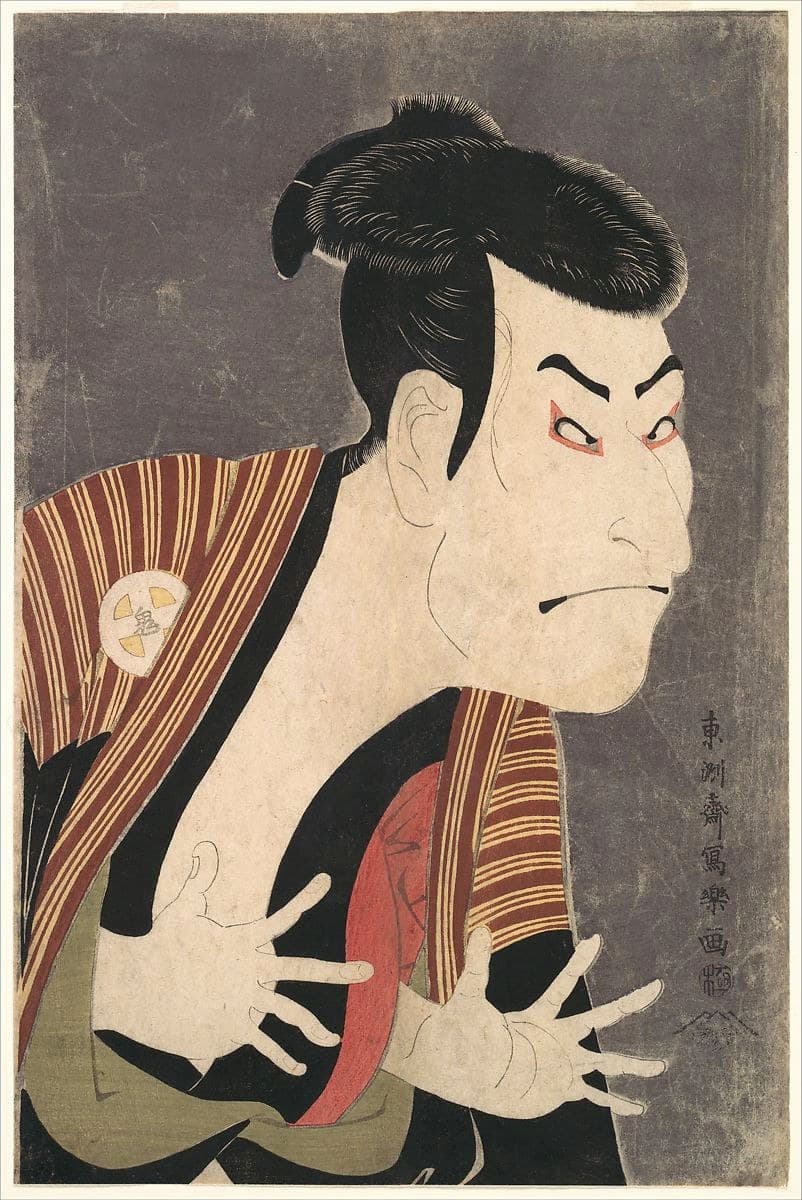
Around a mie or a decisive pose, the actor opens both hands wide to either side — a gesture you meet again and again in kabuki. As everyday movement it is unnaturally large, and that is exactly the point. Kabuki acting developed in the direction of pushing what is inside outward to be seen, and the opened hands are that principle in its clearest form.
The reading changes with the play and the character. In an aragoto role it reads as superhuman force radiating out of the body — something too large to be contained, overflowing. In a weighty history-play role it works as authority: the scene stilled, those around brought to heel. Merely spreading the hands shows that this person commands the space. Elsewhere it marks the instant a deep feeling is released all at once.
It is not, then, a sign with a one-to-one meaning. The sense of any instance is embedded in its kata, and the same shape reads differently in different contexts. Which is why this gesture is better understood watched in the flow of a play than memorised from a photograph with a caption. What has just happened, what the music is doing, how the other actor responds — only together with these does it become clear what the hands are saying.
Words Used Above
- Kimari
- Settling a movement into a hold — including stillnesses smaller than a full mie.
- Jidaimono
- History plays set among warriors and nobles, played in a weighty idiom.
Words in This Answer
- 見得mieA mie is the stylized pose in which an actor freezes at a moment of peak emotion, punctuated by the sharp crack of wooden clappers.
- 荒事aragotoAragoto is the bold, larger-than-life acting style—said to have been created by Ichikawa Danjūrō I—in which heroes express superhuman power through striking makeup, oversized costumes, and dramatic poses.
- 型kataKata are the refined "forms" of acting and staging, polished over centuries and handed down within families of actors—the foundation on which kabuki is built.
More in This Category
Sources & Method
This answer rests on widely shared, established knowledge of kabuki. Matters transmitted as custom are marked "it is said," and assertion is avoided.
- Author
- KABUKI Universe Editorial Team
- Supervision
- Ichikawa Danjūrō
- Published
- Aug 25, 2026
- Updated
- Sep 9, 2026
Supervision means Ichikawa Danjūrō has reviewed this page's intent and key points. The text is the editorial team's writing, not Ichikawa Danjūrō's own statements. Editorial responsibility rests with the team, which corrects any error. Read the editorial policy