Q&A
Acting & Stage Expression
What is the difference when an actor looks to kamite or to shimote?
ANSWER
Kamite, the audience's right, is the side of rank; shimote, the left, of the lesser and of passage. Where the gaze turns signals hierarchy and where the heart is directed.
The Short Version
- The kabuki stage is not neutral left and right but meaningful space.
- In a palace scene the high-ranking figure sits kamite, and visitors enter from shimote.
- A glance toward kamite often carries deference or a formal turn of mind.
- A glance toward shimote often carries thoughts of someone gone, or of the world outside.
See it in a picture
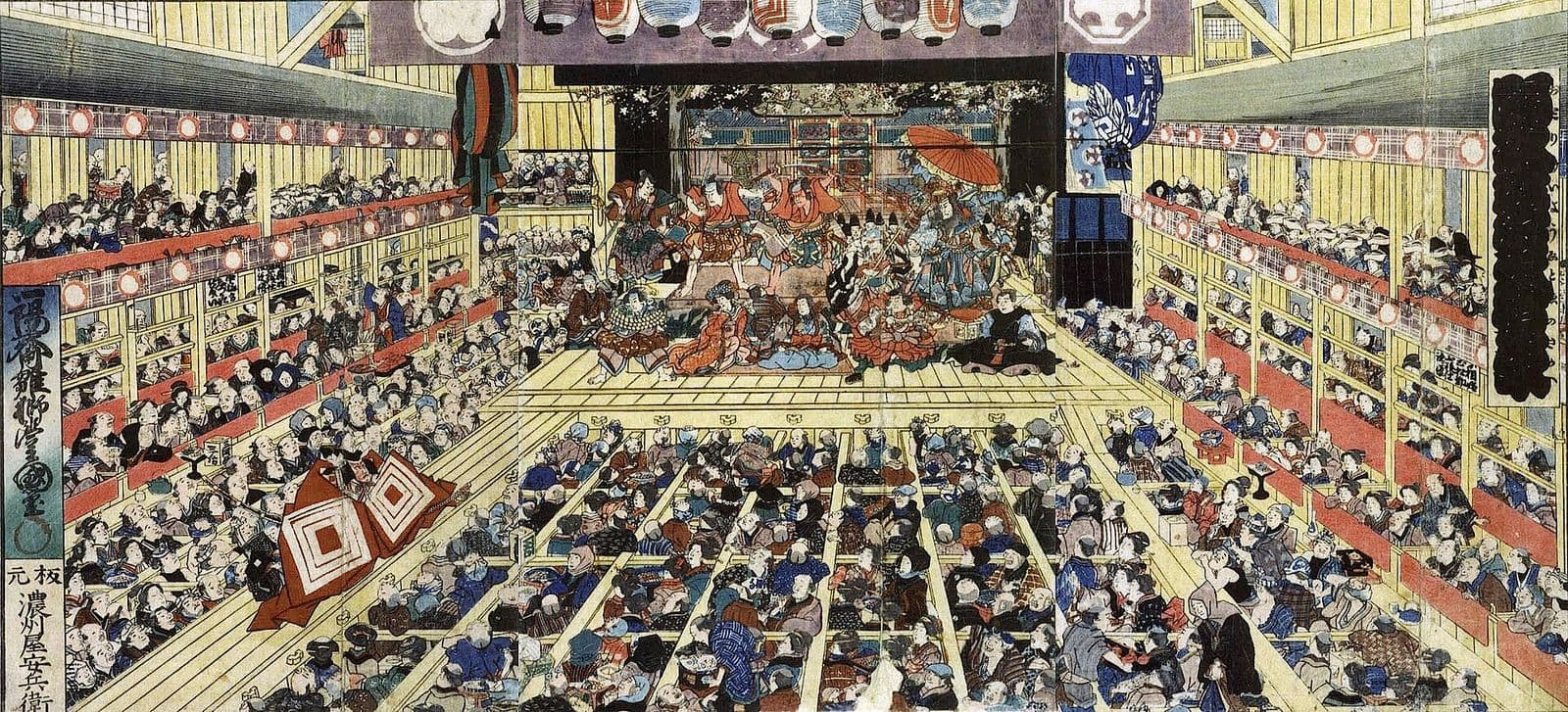
The kabuki stage assigns meaning to its sides, and knowing this changes a great deal of what you see. Kamite, the audience's right, is the side of rank: in a palace scene the high-ranking figure sits there, and memorial tablets or altars are commonly placed there too. Shimote, the left, is the side from which people enter and by which they leave — which is also why the hanamichi runs along it.
Knowing the layout, a mere turn of the head becomes legible. A look toward kamite is often held to carry consciousness of a superior, or a formal turn of mind: attention to a lord, orientation toward the divine, a posture straightened before rank. A look toward shimote reads more readily as thought of someone gone, or a heart moving toward the outside world. When someone has just left along the hanamichi and the figure remaining gazes toward shimote, that alone conveys what is passing through them.
None of this is an absolute rule: plays and scenes admit exceptions, and a staging may load the sides differently. But held as a rough grammar, it makes the acting between the lines legible. Kabuki often gives an actor stretches of standing without speech, and the meaning of the sides is a very useful handle on what is happening in them.
Words Used Above
- A palace scene
- A scene set in a noble residence, where hierarchy is expressed through the space itself.
- The gaze
- Where an actor looks. In kabuki the direction itself carries meaning.
Words in This Answer
- 花道hanamichiThe hanamichi is a raised runway through the audience that turns an actor's entrances and exits into dramatic highlights of their own.
- 型kataKata are the refined "forms" of acting and staging, polished over centuries and handed down within families of actors—the foundation on which kabuki is built.
More in This Category
- How is it decided whether an actor plays both male roles and onnagata, or mainly onnagata?
- Are there stages of roles — parts for the young, parts that wait for experience?
- Why is the hanamichi on the left side, facing the stage?
- What does it mean when, after a climactic pose, the actor opens his right hand to the right and left to the left?
Sources & Method
This answer rests on widely shared, established knowledge of kabuki. Matters transmitted as custom are marked "it is said," and assertion is avoided.
- Author
- KABUKI Universe Editorial Team
- Supervision
- Ichikawa Danjūrō
- Published
- Aug 25, 2026
- Updated
- Sep 9, 2026
Supervision means Ichikawa Danjūrō has reviewed this page's intent and key points. The text is the editorial team's writing, not Ichikawa Danjūrō's own statements. Editorial responsibility rests with the team, which corrects any error. Read the editorial policy