Q&A
Acting & Stage Expression
Umbrellas appear constantly in kabuki — are they only for rain?
ANSWER
Not only. An umbrella evokes festivals and the life of the town, makes a hero's entrance splendid, and — opened, spun, tilted — enlarges the dance itself.
The Short Version
- Rain and travel scenes are only part of what an umbrella is for.
- The flower parasols and trick hats of Musume Dōjōji have no practical use at all: they are there to make the dance splendid.
- Opening, spinning, tilting: each has a settled form, and together they become the dance.
- Stage umbrellas open wider than ordinary ones, so the face stays visible from the upper tiers.
See it in a picture
- the storeKept sorted by play.
- fitting and repairAdjusted to that theatre's width and height.
- load-inBuilt and walked through by the day before.
- the runIt has to survive daily opening and striking.
- strikeStruck after the curtain and carried on.
→ then, after maintenance, back to the store
Watch kabuki for a while and you notice how often umbrellas appear — carried on when no rain is falling, held through long stretches of dance. This is because an umbrella does several jobs at once, and shielding from rain is only one of them.
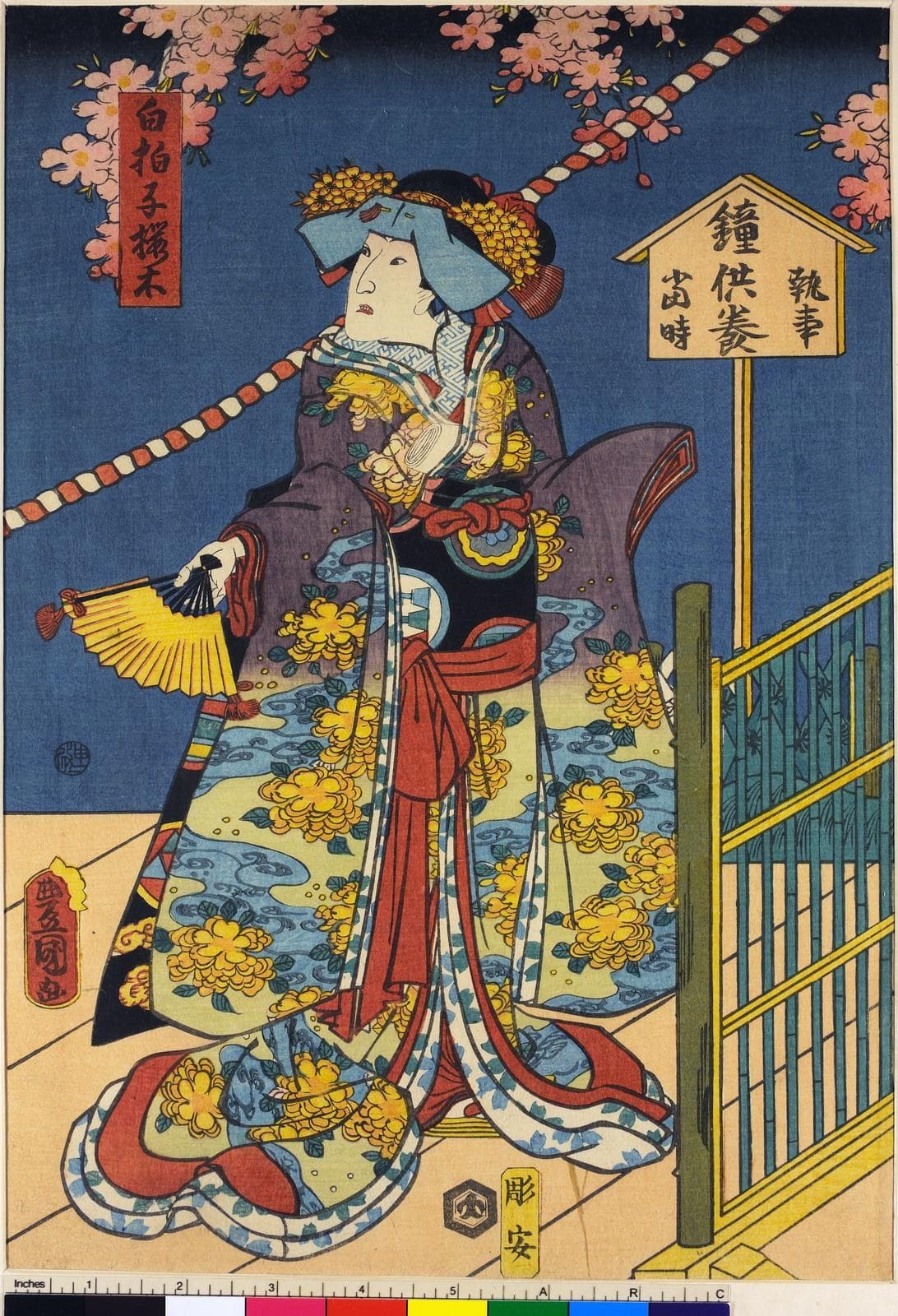
First, it renders custom and setting. Umbrellas and hats belong to scenes of going out in the rain or of travel — and they also carry the bustle of a festival onto the stage. The flower parasols the young monks hold in Musume Dōjōji are decked with blossoms and would keep off no rain at all; they exist to make the dance splendid. So too the furidashi-gasa of the same piece, three hats linked so that they spill out one after another when shaken: no use whatever, and entirely for the eye.
Second, it enlarges an entrance. The hero of Sukeroku comes down the hanamichi with a snake-eye umbrella and takes a long time over his entrance. With it, his outline grows far beyond the body alone: opened, it makes a circle; tilted, it throws light and shade across the face; spun, it multiplies the movement. Against an entrance with empty hands, a single umbrella changes the acreage of the stage.
Third, the handling is itself an art. Opening, closing, spinning, shouldering, tilting to hide the face — each has its settled form, and performed in sequence they become a dance. The umbrella is thus a place where an actor's skill shows. Note too that stage umbrellas are said to be built to open wider than ordinary ones, so that from the second and third tiers the umbrella does not come between the audience and the actor's face. The properties are made with sightlines from every seat in mind — another mark of how finely kabuki's staging is calculated.
Words Used Above
- Snake-eye umbrella
- A paper umbrella whose concentric rings suggest a snake's eye — Sukeroku's emblem.
- Flower parasol
- A parasol decked with blossoms; useless against rain, and there to brighten the dance.
- Furidashi-gasa
- Three linked hats rigged so that shaking spills them out one after another.
Words in This Answer
- 小道具kodōguKodōgu are kabuki's props—items actors carry or wear, and objects set on stage—from swords and umbrellas to hanging scrolls.
- 所作事shosagotoShosagoto are kabuki's dance pieces performed to live music—an art that began with onnagata and blossomed into a rich repertoire.
- 花道hanamichiThe hanamichi is a raised runway through the audience that turns an actor's entrances and exits into dramatic highlights of their own.
- Sukeroku, Flower of Edo (Sukeroku Yukari no Edo Zakura)Sukeroku Yukari no Edo ZakuraIn the Yoshiwara pleasure quarter of Edo, the dashing street knight Sukeroku—lover of the great courtesan Agemaki—picks fights night after night.
More in This Category
Sources & Method
- Author
- KABUKI Universe Editorial Team
- Supervision
- Ichikawa Danjūrō
- Published
- Aug 25, 2026
- Updated
- Sep 9, 2026
Supervision means Ichikawa Danjūrō has reviewed this page's intent and key points. The text is the editorial team's writing, not Ichikawa Danjūrō's own statements. Editorial responsibility rests with the team, which corrects any error. Read the editorial policy