Q&A
Going to the Theatre
Is there a difference between tsuke one may applaud and tsuke better left alone?
ANSWER
The tsuke is not an applause cue but an accent on movement. Applause rises naturally at the battari of a mie; during the running bata-bata the scene is still moving, so hold back.
The Short Version
- The tsuke is not an applause cue. It is sound used to outline an actor's movement.
- The battari that locks a mie is the summit of a scene; applause there is woven into its breathing.
- The bata-bata under a run is sound in mid-motion; clapping there treads on what follows.
- One rule covers nearly everything: when the sound locks and the actor stills, applaud.
See it in a picture
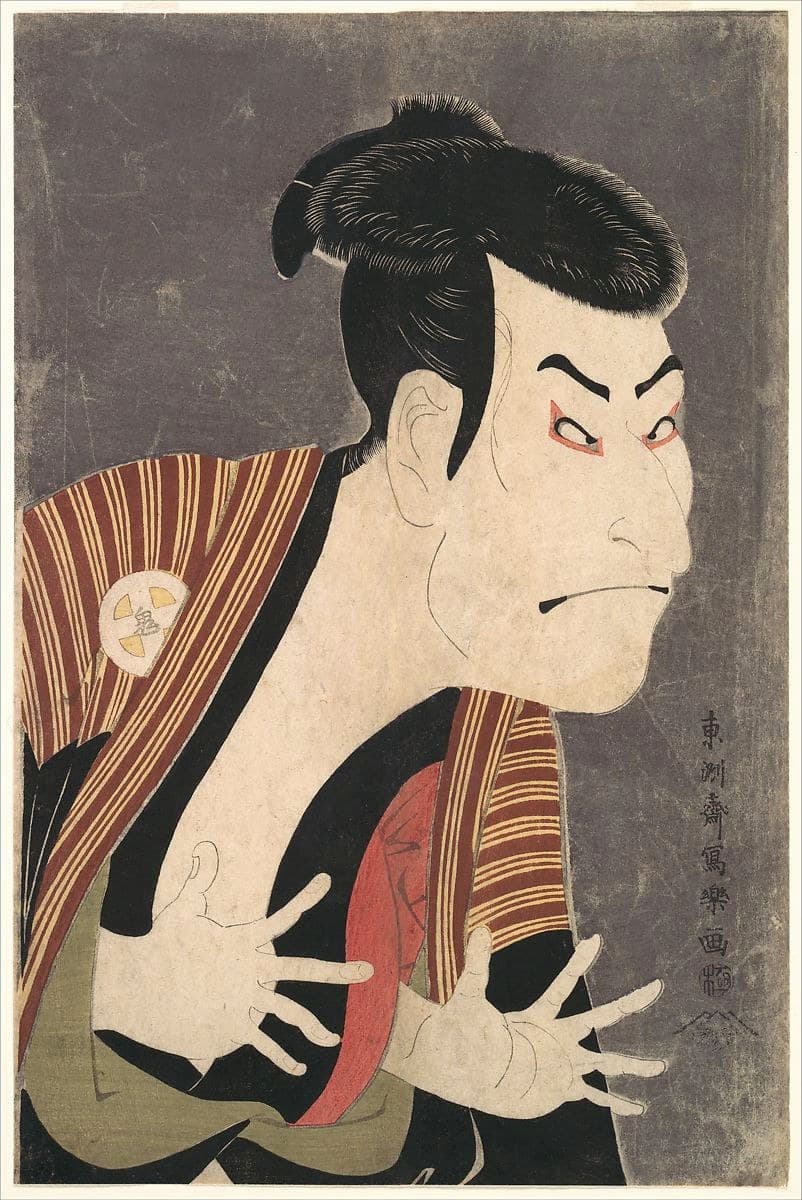
The tsuke is the sound made by striking a board laid on the floor on the audience's right (the kamite side) with wooden clappers. The player is the tsuke-uchi — a duty of the scenery crew in Tokyo and of the kyōgen-kata in Kansai, so that the same sound has been handed down along two different lines. The first thing to know is that the tsuke is not a signal to applaud. It is sound that gives an outline to an actor's movement, and it sounds for a purpose quite separate from applause.
Within that, the tsuke is struck in different ways, and the difference is your guide. The battari that locks a mie is two strong decisive beats at the summit of a scene. The actor freezes; an instant opens in which time appears to stop. The applause and ōmukō calls that come here were built into the play's breathing from the start — one could say the moment is completed by them.
The bata-bata under a run, by contrast, is a rapid roll that lends impetus to motion. It is sound in mid-movement, and the scene is still going. Applause here treads on the line that follows or on the next turn of events. The same instrument, entirely different offices. If in doubt, hold to one thing: when the sound locks and the actor stills, applaud. It will almost never mislead you.
Words Used Above
Words in This Answer
- ツケtsukeTsuke are the sharp beats of wooden clappers struck against a board at the side of the stage, accenting footsteps and landing exactly on the frozen mie poses.
- 見得mieA mie is the stylized pose in which an actor freezes at a moment of peak emotion, punctuated by the sharp crack of wooden clappers.
- 大向うōmukōŌmukō are the well-timed shouts of an actor's house name—"Naritaya!"—from the back of the theatre, and the aficionados who make them.
More in This Category
Sources & Method
This answer rests on widely shared, established knowledge of kabuki. Matters transmitted as custom are marked "it is said," and assertion is avoided.
- Author
- KABUKI Universe Editorial Team
- Supervision
- Ichikawa Danjūrō
- Published
- Aug 25, 2026
- Updated
- Sep 9, 2026
Supervision means Ichikawa Danjūrō has reviewed this page's intent and key points. The text is the editorial team's writing, not Ichikawa Danjūrō's own statements. Editorial responsibility rests with the team, which corrects any error. Read the editorial policy