Q&A
Going to the Theatre
Is the tsuke ever struck simply to heighten excitement?
ANSWER
Its essence is to accent movement — and that accent itself generates excitement. It is never struck loose for atmosphere; every beat rides the actor's motion and breath.
The Short Version
- The tsuke exists to outline an actor's movement in sound, not to manufacture atmosphere.
- A run, a mie, a falling object: every beat answers a specific event on stage.
- The player reads the actor's feet, eyes and breath as he strikes; he is not following a fixed score.
- The house does stir — but as a result of the movement's outline being honed by sound.
See it in a picture
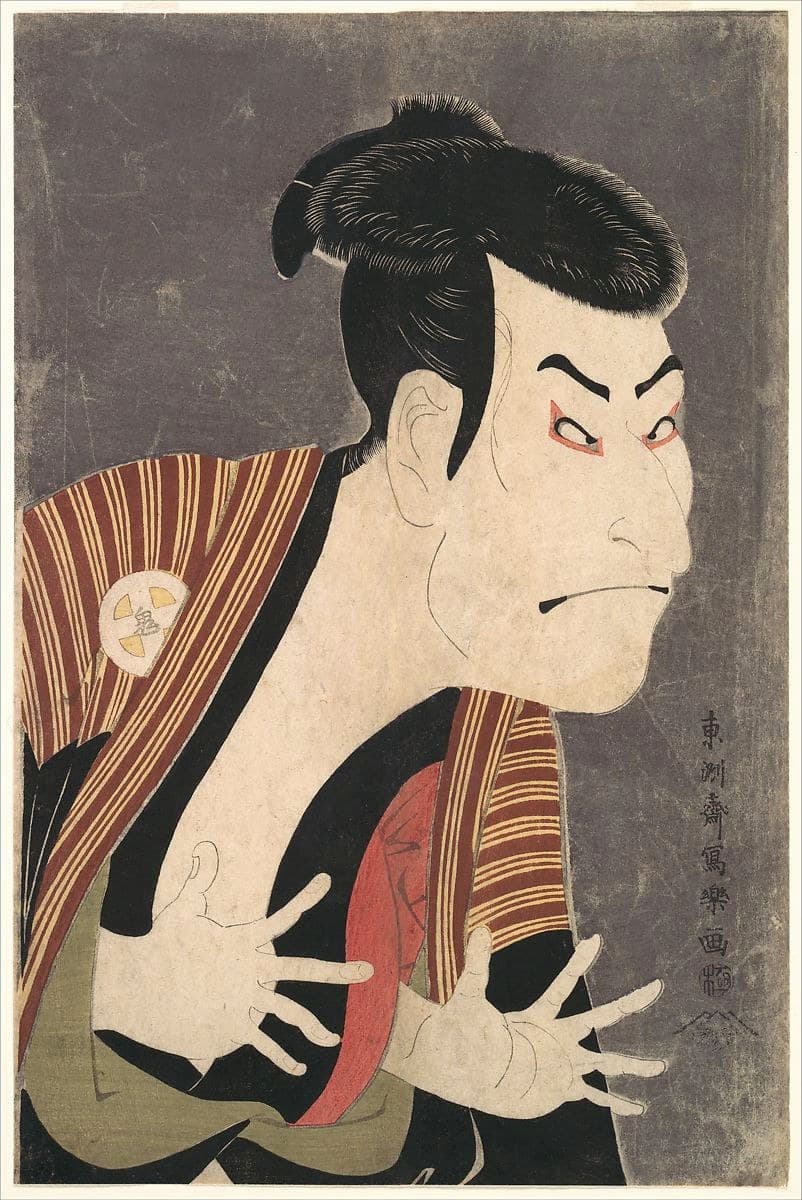
"Isn't it just sound effects whipping things up?" is a common first impression, and it is true that the temperature of the house visibly rises when the tsuke sounds. But the order is the other way round. The tsuke does not sound in order to excite; excitement follows from its having outlined a movement.
The tsuke-uchi is not playing from a score fixed in advance. He strikes while watching the actor's footwork, his eyes, his breath. Running has its sound, the mie has its sound, a falling object has its own — every beat answers a concrete event on stage. So even in the same play, a change of actor changes the striking slightly. In the sense of matching another's breathing, this too is a kind of ensemble playing.
It is fair to say there is no loose striking merely for effect. Were there, the sound would detach from the movement and the play would in fact slacken. This is why a good tsuke is said to tighten a play: the sound hones the outline of the motion, and the actor's body becomes more clearly visible. The house stirs not because it has been goaded but because what it should be seeing has come sharply into view.
Words Used Above
- Tsuke board
- The wooden board laid on the floor on the audience's right (kamite), struck to make the sound.
- Ensemble
- Playing in time by reading one another's breath — which is close to what the tsuke does with an actor.
Words in This Answer
- ツケtsukeTsuke are the sharp beats of wooden clappers struck against a board at the side of the stage, accenting footsteps and landing exactly on the frozen mie poses.
- 見得mieA mie is the stylized pose in which an actor freezes at a moment of peak emotion, punctuated by the sharp crack of wooden clappers.
- 立廻りtachimawariTachimawari are kabuki's stylized fight scenes—group combat choreographed like dance to offstage music, punctuated by mie poses.
More in This Category
Sources & Method
This answer rests on widely shared, established knowledge of kabuki. Matters transmitted as custom are marked "it is said," and assertion is avoided.
- Author
- KABUKI Universe Editorial Team
- Supervision
- Ichikawa Danjūrō
- Published
- Aug 25, 2026
- Updated
- Sep 9, 2026
Supervision means Ichikawa Danjūrō has reviewed this page's intent and key points. The text is the editorial team's writing, not Ichikawa Danjūrō's own statements. Editorial responsibility rests with the team, which corrects any error. Read the editorial policy