Q&A
Going to the Theatre
If I wait a beat after the tsuke, is applause acceptable at any scene?
ANSWER
No rule makes a one-beat pause always safe. The test is whether the moment has settled and closed — in quiet scenes, silence can honour the stage more than applause.
The Short Version
- The measure is not how long you wait but whether the play has reached a break.
- Where a moment has sealed itself — a mie, an exit, the curtain — even instant applause belongs to the play.
- In the middle of a hushed domestic scene, no length of pause makes applause safe.
- When unsure, move with the house. That shared response is the etiquette of the theatre as a community.
See it in a picture
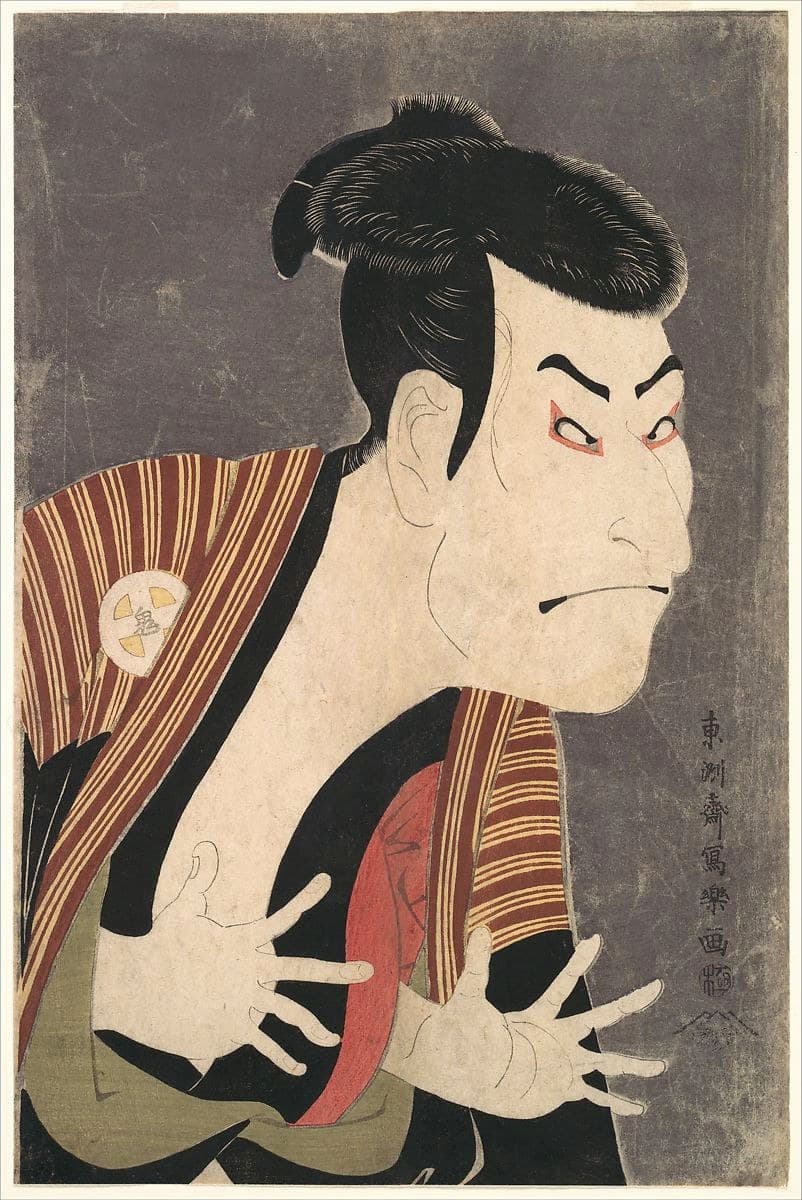
"Wait one beat" sounds plausible but measures the wrong thing. What decides whether to applaud is not elapsed time but whether the play has reached a break there. A tsuke can sound while the scene continues; a scene can close cleanly with no tsuke at all.
You can see when a moment has closed. The actor freezes in a mie. He withdraws along the hanamichi. The striped curtain is drawn across at the end of an act. At such moments even immediate applause is received as part of the play — indeed, a silent house at those points leaves the stage feeling rather alone.
There are also moments that have not closed: the hushed passages of a kizewamono, the descent of feeling mid-scene, the air drawn taut toward a line still to come. Here, applause breaks something no matter how long you have waited. There are scenes where continuing to listen in silence is the greater respect — true of theatre generally, but the contrast is unusually sharp in kabuki. When unsure, move with the house; that, in the end, is the etiquette of the theatre as a shared space.
Words Used Above
- Makugire
- The instant an act ends. The moment is closed, so applause enters naturally.
- Sewaba
- A scene of ordinary life. These often move quietly, and call for judgment about applause.
Words in This Answer
- 見得mieA mie is the stylized pose in which an actor freezes at a moment of peak emotion, punctuated by the sharp crack of wooden clappers.
- 幕切れmakugireMakugire is the closing of the curtain on an act—and, by extension, the way anything comes to an end.
- 生世話物kizewamonoKizewamono are the most sharply realistic of kabuki's domestic plays, depicting the raw life and lower depths of the Edo townsman's world.
More in This Category
Sources & Method
This answer rests on widely shared, established knowledge of kabuki. Matters transmitted as custom are marked "it is said," and assertion is avoided.
- Author
- KABUKI Universe Editorial Team
- Supervision
- Ichikawa Danjūrō
- Published
- Aug 25, 2026
- Updated
- Sep 9, 2026
Supervision means Ichikawa Danjūrō has reviewed this page's intent and key points. The text is the editorial team's writing, not Ichikawa Danjūrō's own statements. Editorial responsibility rests with the team, which corrects any error. Read the editorial policy