Q&A
Going to the Theatre
At a Japanese dance recital, may one clap briefly in a rest in the music? Are there rules?
ANSWER
There are no strict rules. A rest is part of the music, so hold back mid-piece; the safe custom is to applaud at the dancer's exit or the end of the number.
The Short Version
- There is no prescribed number and no written rule; no etiquette says "just once."
- A rest inside a piece is part of the music; applause there cuts the shared breath of dancer and musicians.
- The safe moments are after the music has fully ended, or at the dancer's exit.
- Applause that rises naturally at a highlight needs no suppressing. Breathing with the room is the point.
See it in a picture
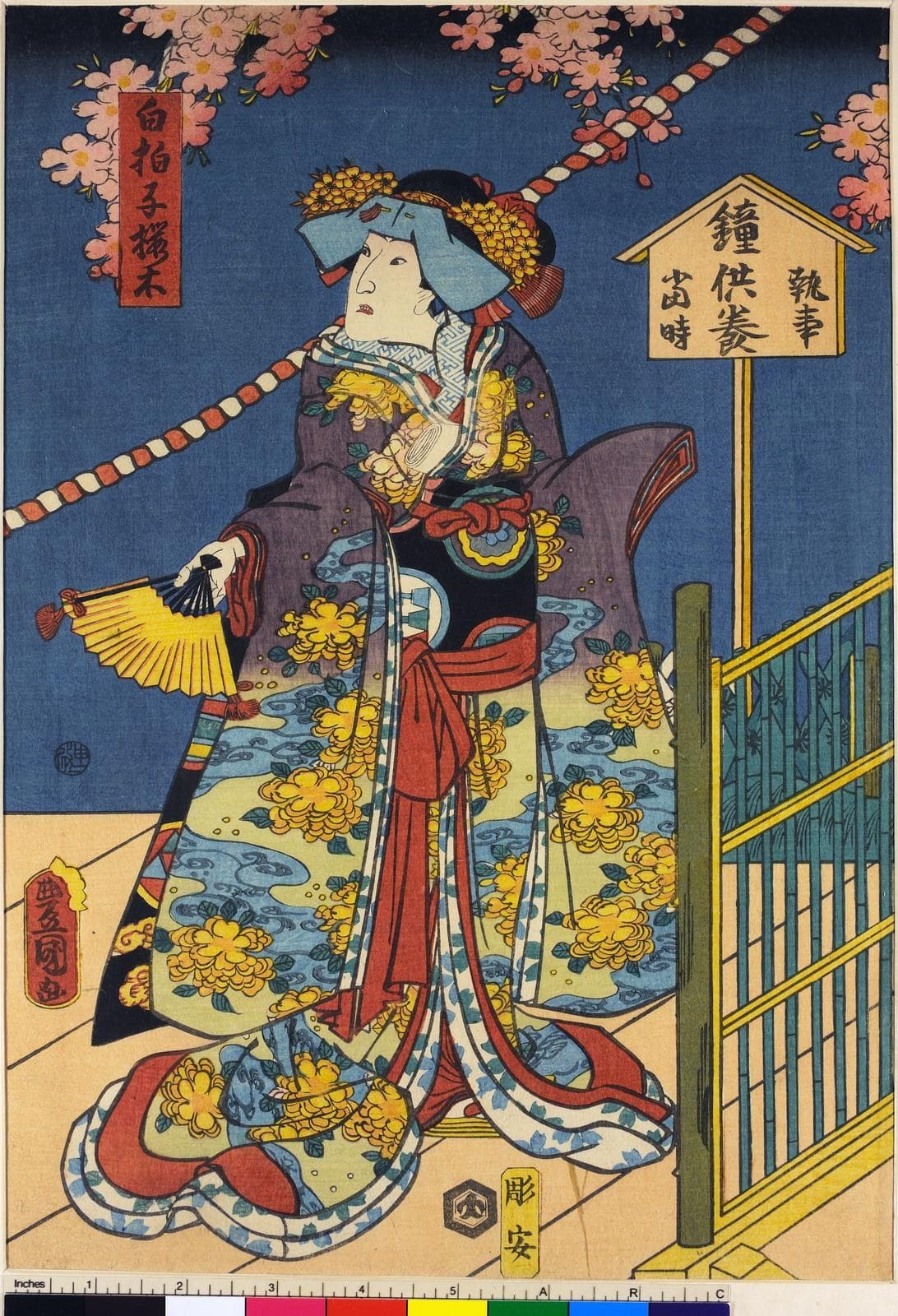
The reassuring part first: neither Japanese dance nor kabuki has any written rule about how many times to clap. There is nothing as sharply prohibitive as the between-movements convention in classical music. There is, however, one place best avoided: a rest in the middle of a piece.
In Japanese and kabuki dance, the moment when sound stops is itself composed as ma. The silence is not a pause for rest: within it the dancer may be gathering a movement, or the air may be being drawn taut toward the next note. Applause here severs the breath held between the dancer and the jikata — the nagauta singers and shamisen players. A rest is not a signal that something has ended; it is part of the music.
When, then? Two markers are enough. One: when a number has completely finished. Two: when the dancer withdraws, along the hanamichi or otherwise. Both make it unmistakable that a moment has closed, so you cannot go wrong. Beyond these, applause sometimes rises of itself at a great highlight, and there is no need to hold it back. Kabuki applause is not a rule about counts; it is a form of respect for the stage. Breathing with the people around you turns out to be the surest etiquette there is.
Words Used Above
- Ma
- The interval between sounds or movements — not emptiness but time deliberately placed.
- Hikkomi (the exit)
- The moment a performer leaves the stage — applause here is entirely at home.
Words in This Answer
- 所作事shosagotoShosagoto are kabuki's dance pieces performed to live music—an art that began with onnagata and blossomed into a rich repertoire.
- 長唄nagautaNagauta is the lyrical school of shamisen music that grew up with Edo kabuki, accompanying dance and coloring scenes throughout the play.
- 三味線shamisenThe shamisen is the three-stringed, plectrum-struck instrument at the heart of kabuki music, built in thin-, middle-, and thick-necked types for different musical styles.
More in This Category
Sources & Method
This answer rests on widely shared, established knowledge of kabuki. Matters transmitted as custom are marked "it is said," and assertion is avoided.
- Author
- KABUKI Universe Editorial Team
- Supervision
- Ichikawa Danjūrō
- Published
- Aug 25, 2026
- Updated
- Sep 9, 2026
Supervision means Ichikawa Danjūrō has reviewed this page's intent and key points. The text is the editorial team's writing, not Ichikawa Danjūrō's own statements. Editorial responsibility rests with the team, which corrects any error. Read the editorial policy