Q&A
Going to the Theatre
What should I wear to see kabuki?
ANSWER
Dress is free. Ordinary going-out clothes are perfectly fine; there is no dress code. Many wear kimono — but it is never required.
The Short Version
- There is no dress code. Ordinary going-out clothes are fine; jeans included.
- You will be seated for hours, so comfortable clothes are the practical choice.
- The only real code is consideration for your neighbours: no tall hats or hairstyles, no heavy scent.
- On opening days, senshūraku and succession runs, kimono multiply and the house itself turns festive.
See it in a picture
The month
Roughly a month of the same bill, most days — with dark days in between.
Your day
Plays of thirty to ninety minutes, separated by intervals long enough to eat. Three to four hours in all.
This question comes up constantly, and the answer is simple: dress as you like. Neither the Kabukiza nor other theatres impose a dress code, and ordinary going-out clothes are entirely fine. People come in jeans as a matter of course. There is no need to brace yourself for the formality one might imagine at an opera house.
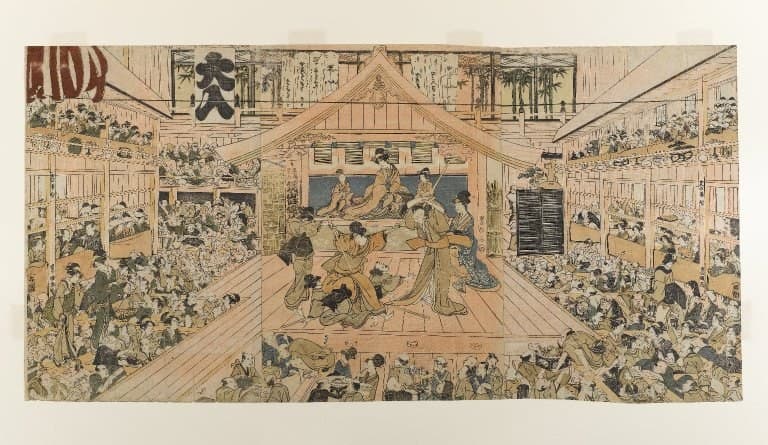
Historically, too, kabuki was popular entertainment. Edo playhouses drew audiences of every rank and every purse — some installed grandly in the boxes, others standing at the back for a single act. That temper survives. Practically speaking, since a part runs three to four hours in a seat, unrestrictive clothing is more comfortable; and as air conditioning reaches some seats more than others, a layer to put on is worth carrying.
If one must name an etiquette, it concerns not clothing but your neighbours. Avoid tall hats and hairstyles that block the view behind you. Go easy on strong perfume. That, in practice, is the whole of the dress code. Note that on opening days, on senshūraku and during name-succession runs, kimono noticeably multiply, and the house itself becomes part of the spectacle — good days to choose if you would like to wear one. It is never required.
Words Used Above
- Playhouse (shibai-goya)
- An Edo-period theatre, where audiences of every rank and purse gathered in one room.
- The celebratory run
- The run presenting a name-succession. The festive mood brings out kimono in the audience.
Words in This Answer
- 千穐楽senshūrakuSenshūraku is the closing day of a theatrical run; in kabuki it is traditionally written with a character that avoids the element for "fire."
- 襲名shūmeiShūmei is the succession to a historic stage name—not a mere renaming, but the acceptance of an artistic lineage, its history, and its responsibilities.
- 桟敷sajikiSajiki are the raised box seats along the sides of the auditorium, descended from ancient festival viewing stands and preserved at the Kabukiza today.
More in This Category
Sources & Method
This answer rests on widely shared, established knowledge of kabuki. Matters transmitted as custom are marked "it is said," and assertion is avoided.
- Author
- KABUKI Universe Editorial Team
- Supervision
- Ichikawa Danjūrō
- Published
- Aug 25, 2026
- Updated
- Sep 9, 2026
Supervision means Ichikawa Danjūrō has reviewed this page's intent and key points. The text is the editorial team's writing, not Ichikawa Danjūrō's own statements. Editorial responsibility rests with the team, which corrects any error. Read the editorial policy