Q&A
Acting & Stage Expression
What is the meaning and role of the mie?
ANSWER
The mie carves the peak of emotion or force into stillness — kabuki's greatest device. By stopping movement it cuts a frame out of time and burns it into the audience's eye.
The Short Version
- At the play's crest the actor stops, wheels his head and locks his glare.
- Often likened to a cinematic close-up: a device that freezes flowing time at a single point.
- The tsuke's battari strikes and a call flies from the ōmukō — the whole theatre converges on the instant.
- The Ichikawa line's aragoto is held to have raised this aesthetic to its grandest scale.
See it in a picture
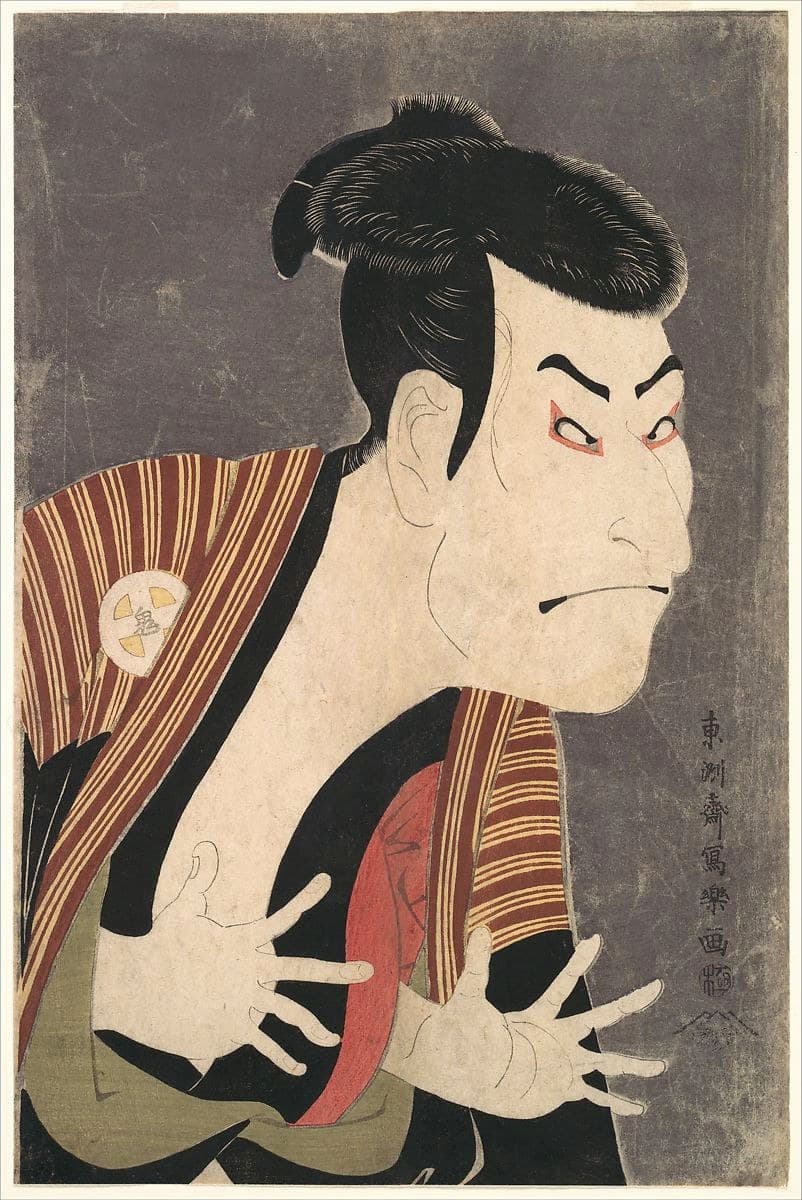
The mie is the device that most makes kabuki kabuki. At the crest of a scene the actor stops. He wheels his head, draws one eye toward the other into a locked glare, and hardens his whole body like a statue. For a few seconds time appears to halt. Even a first-time viewer knows that something particular is happening — it is designed with exactly that clarity.
Why stop? The most-used explanation is an analogy with the cinematic close-up: as a camera moves in on a face to concentrate attention, the mie freezes flowing time at a point and hands the audience the character's force at full output. It is as though a single painted image were inserted into a moving stage — and indeed it is the mie that actor prints have depicted again and again.
Everything in the theatre is designed to converge on that instant. The tsuke strikes its two hard battari beats. The geza music comes to its peak. A cry of the house name flies from the ōmukō. Applause rises from the seats. It is not one actor's gesture but a moment made by stage and audience together. And it is the Ichikawa line's aragoto that is held to have raised this aesthetic furthest. Being a style that stages more-than-human strength, its mie are extreme in size and extreme in length — the hero of Shibaraku locking his mie at centre stage is the summit of it.
Words Used Above
- Nirami (the glare)
- Drawing the eyes together into a fixed stare. In the Ichikawa house it is held to avert misfortune.
- Statue
- A figure for the stillness of a mie — though it is not dead stillness: force is held taut within.
Words in This Answer
- 見得mieA mie is the stylized pose in which an actor freezes at a moment of peak emotion, punctuated by the sharp crack of wooden clappers.
- ツケtsukeTsuke are the sharp beats of wooden clappers struck against a board at the side of the stage, accenting footsteps and landing exactly on the frozen mie poses.
- 大向うōmukōŌmukō are the well-timed shouts of an actor's house name—"Naritaya!"—from the back of the theatre, and the aficionados who make them.
- 睨みniramiThe nirami is a ceremonial glare said to be reserved for the Ichikawa Danjūrō line—and to grant a year of good health to all who receive it.
- Shibaraku — Just a Moment!ShibarakuThe tyrant Kiyohara no Takehira has seized power and is about to execute a group of innocents who refuse to bow to him.
More in This Category
Sources & Method
This answer rests on widely shared, established knowledge of kabuki. Matters transmitted as custom are marked "it is said," and assertion is avoided.
- Author
- KABUKI Universe Editorial Team
- Supervision
- Ichikawa Danjūrō
- Published
- Aug 25, 2026
- Updated
- Sep 9, 2026
Supervision means Ichikawa Danjūrō has reviewed this page's intent and key points. The text is the editorial team's writing, not Ichikawa Danjūrō's own statements. Editorial responsibility rests with the team, which corrects any error. Read the editorial policy