Q&A
Acting & Stage Expression
Why does a samurai or yakko raise only the big toe when striking a mie?
ANSWER
It is held to be a stylised exaggeration showing force filled to the very tips. Some read it further: the shape matches a primitive reflex seen only in newborn infants — the untouched vitality aragoto reaches for.
The Short Version
- A mie is not dead stillness but stillness under pressure, with force held taut within.
- The upturned toe is explained as that force made visible, filling the body to its farthest point.
- The same shape is known in medicine as a primitive reflex seen only in newborns — the Babinski response.
- That reflex was reported in 1896; aragoto had taken shape more than two centuries earlier.
See it in a picture
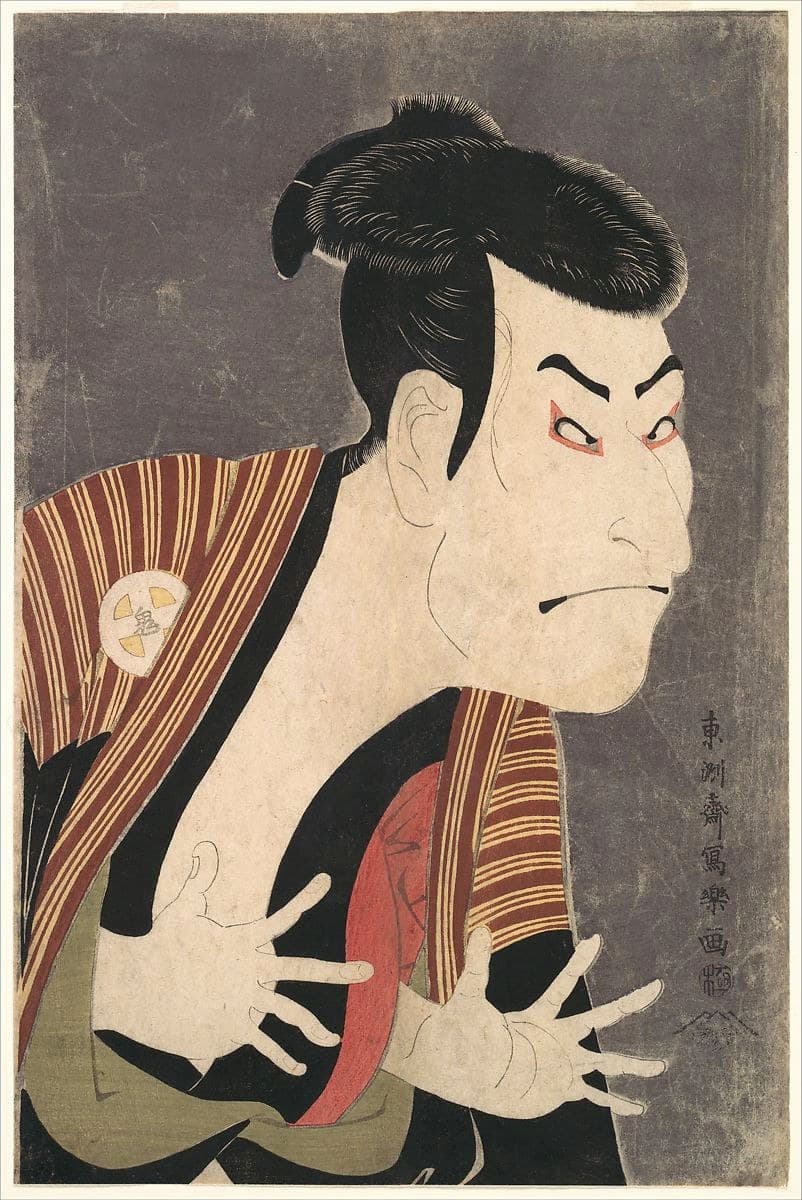
This question notices something fine. When a mie is struck, the big toe of the planted foot curls sharply upward — and this is indeed a feature common to many kata.
Start with the most common explanation. A mie is not complete stillness. The actor appears fixed like a statue, but inside, the musculature of the whole body is drawn taut — not movement stopped, but the force that wants to move being held in. Stillness under pressure. That tension is what lets a mie hold the air of the house for several seconds, and the upturned toe is explained as making it visible at the body's farthest point: force filled to the toes and spilling over.
Here it becomes interesting, for another reading is transmitted alongside. Stroke the sole of a foot and the big toe bends back toward the shin while the other toes fan out — a response that appears normally only in newborn infants. Medicine calls it the Babinski response, and it fades by around the age of two. The shape of the aragoto toe is exactly this.
The sequence is worth fixing. The reflex was reported by the French neurologist Joseph Babinski in 1896, in a note said to run to only twenty-eight lines. Aragoto, by contrast, is held to have been created by Danjūrō I in 1673 — more than two centuries earlier. Before medicine had named it as a reflex peculiar to infants, the kabuki stage had already taken the shape into its art.
How to take the coincidence is a question of keeping fact and interpretation apart. That the reflex was reported in 1896 is a matter of record, and the beginning of aragoto is traditionally placed in 1673 (with some variation among accounts). That the kata reproduces the reflex is an interpretation: no record says an Edo actor studied an infant's foot and decided upon it. And yet, remembering that the aragoto hero is so often shaped as a childlike innocent charged with more-than-human power, the reading holds together well. Many details of kabuki kata are said to have worked before they were explained, with meaning supplied afterwards — and this is the exemplary case. The raised toe, it should be added, is said to be transmitted as an art of the Danjūrō house.
Words Used Above
- Primitive reflex
- A reflex present only in newborns, fading as the child grows.
- The Babinski response
- Stroking the sole makes the big toe bend back and the others fan out. Reported in 1896.
- Yakko
- A manservant in a warrior household — a role marked by spirited movement and large mie.
- Stillness under pressure
- Appearing stopped while force is held taut inside — the essence of a mie.
Words in This Answer
- 見得mieA mie is the stylized pose in which an actor freezes at a moment of peak emotion, punctuated by the sharp crack of wooden clappers.
- 荒事aragotoAragoto is the bold, larger-than-life acting style—said to have been created by Ichikawa Danjūrō I—in which heroes express superhuman power through striking makeup, oversized costumes, and dramatic poses.
- 型kataKata are the refined "forms" of acting and staging, polished over centuries and handed down within families of actors—the foundation on which kabuki is built.
- 市川宗家Ichikawa SōkeIchikawa Sōke is the customary name for Naritaya, the head family of the Ichikawa Danjūrō lineage — the house that has inherited aragoto, the Kabuki Jūhachiban, and the Danjūrō name.
More in This Category
Sources & Method
- Babinski Reflex (Plantar Reflex) — Cleveland Clinic
- History of the extensor plantar response: Babinski and Chaddock signs (PubMed)
- Author
- KABUKI Universe Editorial Team
- Supervision
- Ichikawa Danjūrō
- Published
- Aug 25, 2026
- Updated
- Sep 9, 2026
Supervision means Ichikawa Danjūrō has reviewed this page's intent and key points. The text is the editorial team's writing, not Ichikawa Danjūrō's own statements. Editorial responsibility rests with the team, which corrects any error. Read the editorial policy