Q&A
Acting & Stage Expression
What do the ways of walking and moving on stage mean?
ANSWER
The walk itself speaks the role: the gliding suri-ashi carries rank and bearing, the roppō superhuman force, the onnagata's gait a soft inner nature — all movement is stylised.
The Short Version
- The kabuki body never imports everyday movement; even walking is stylised.
- The grounded gliding step comes from noh; rank and inner tension translate into stride and speed.
- Sometimes the walk is itself the spectacle, as in the roppō of aragoto.
- The turn of a fan, the handling of a sleeve: each is a word in a vocabulary of feeling.
See it in a picture
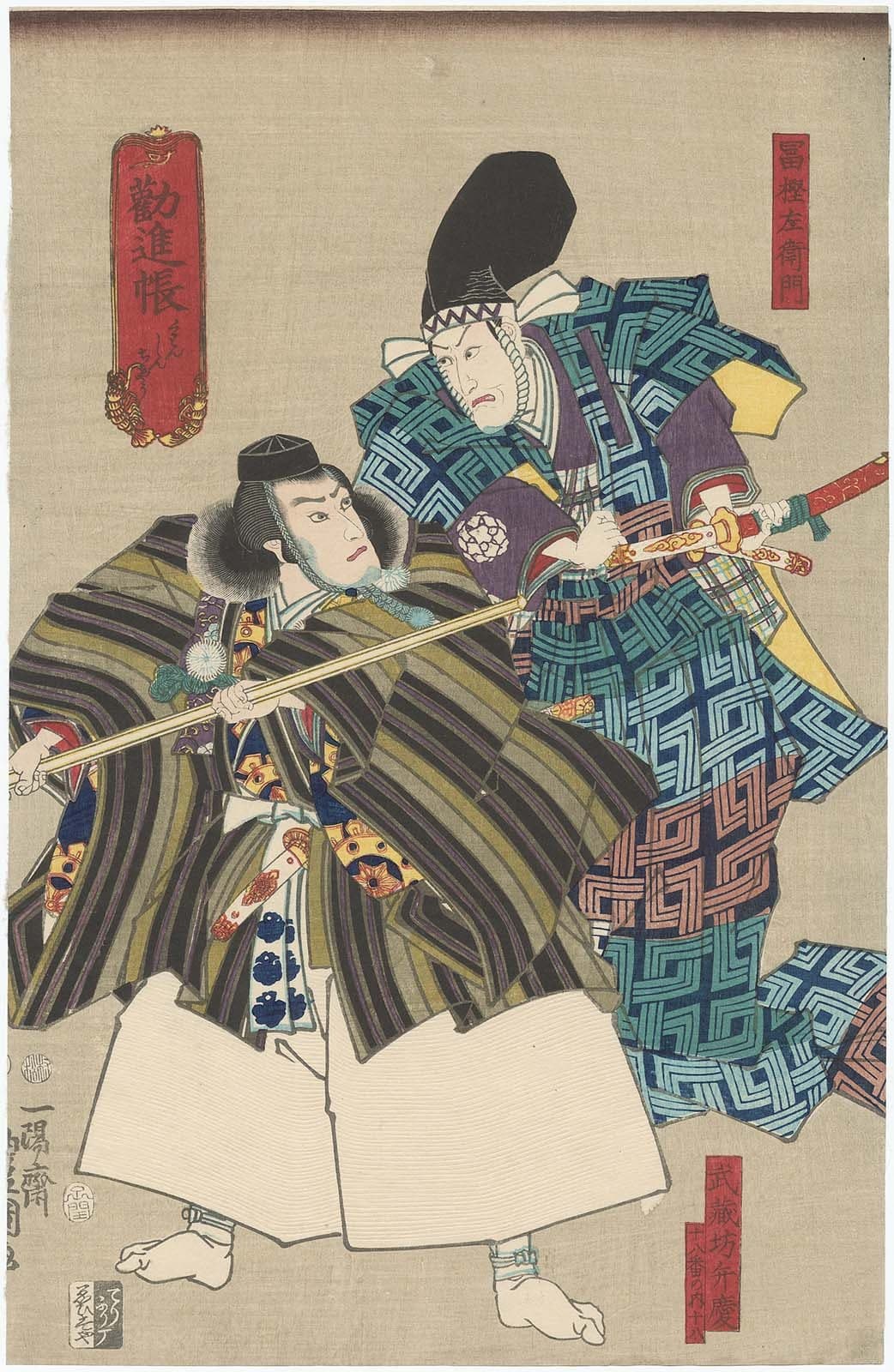
One of the first things a viewer notices is that nobody walks normally. This is not excess in the acting: the walk itself is a means of speaking the role. The kabuki body does not carry everyday movement onto the stage. Every kind of locomotion is designed as style.
The foundation is suri-ashi. Hips lowered and settled, the soles never leaving the floor, the upper body free of bobbing — a basis inherited from noh. On that stable ground the differences of role are laid: a high-ranking figure moves broadly and unhurriedly, an agitated one in small quick steps, an old man with slackened knees. Stride, speed and the placement of weight become information about the person. Inner tension shows too: the walk of someone resolved differs visibly from the walk of someone in doubt.
Sometimes the walk is the spectacle. The roppō of aragoto — the great stamping withdrawal along the hanamichi — is watched as an independent art in itself. The onnagata's carriage is another system again: the feet placed slightly inward, the body's axis drawn a little in, giving form to softness and reserve. Gesture follows the same principle: the turn of a fan, the handling of a sleeve, each a word in a vocabulary of feeling. Once you can read movement, kabuki becomes several times more interesting.
Words Used Above
- Suri-ashi
- A gliding step that never lifts the soles, keeping the upper body still — the foundation of the style.
- Centre of weight
- Where a body's mass gathers. Its placement changes the impression of a character considerably.
Words in This Answer
- 六方roppōRoppō is a bravura stylized walk with sweeping arms and stamping feet—most famous as Benkei's "flying roppō" exit down the hanamichi in Kanjinchō.
- 型kataKata are the refined "forms" of acting and staging, polished over centuries and handed down within families of actors—the foundation on which kabuki is built.
- 所作事shosagotoShosagoto are kabuki's dance pieces performed to live music—an art that began with onnagata and blossomed into a rich repertoire.
More in This Category
Sources & Method
This answer rests on widely shared, established knowledge of kabuki. Matters transmitted as custom are marked "it is said," and assertion is avoided.
- Author
- KABUKI Universe Editorial Team
- Supervision
- Ichikawa Danjūrō
- Published
- Aug 25, 2026
- Updated
- Sep 9, 2026
Supervision means Ichikawa Danjūrō has reviewed this page's intent and key points. The text is the editorial team's writing, not Ichikawa Danjūrō's own statements. Editorial responsibility rests with the team, which corrects any error. Read the editorial policy