Q&A
Acting & Stage Expression
Is there a conductor within the hayashi ensemble?
ANSWER
No baton, but leadership exists: the principal singer and principal shamisen in nagauta, and the lead players in the hayashi, bind the ensemble by cue and breath.
The Short Version
- There is no conductor holding a baton and imposing a tempo on the whole.
- In nagauta the principal singer and shamisen lead; in gidayū the chanter and shamisen do, by shared breath.
- The players' calls function as spoken cues.
- It is not that nobody conducts; conducting is distributed to everyone, in the form of breath.
See it in a picture
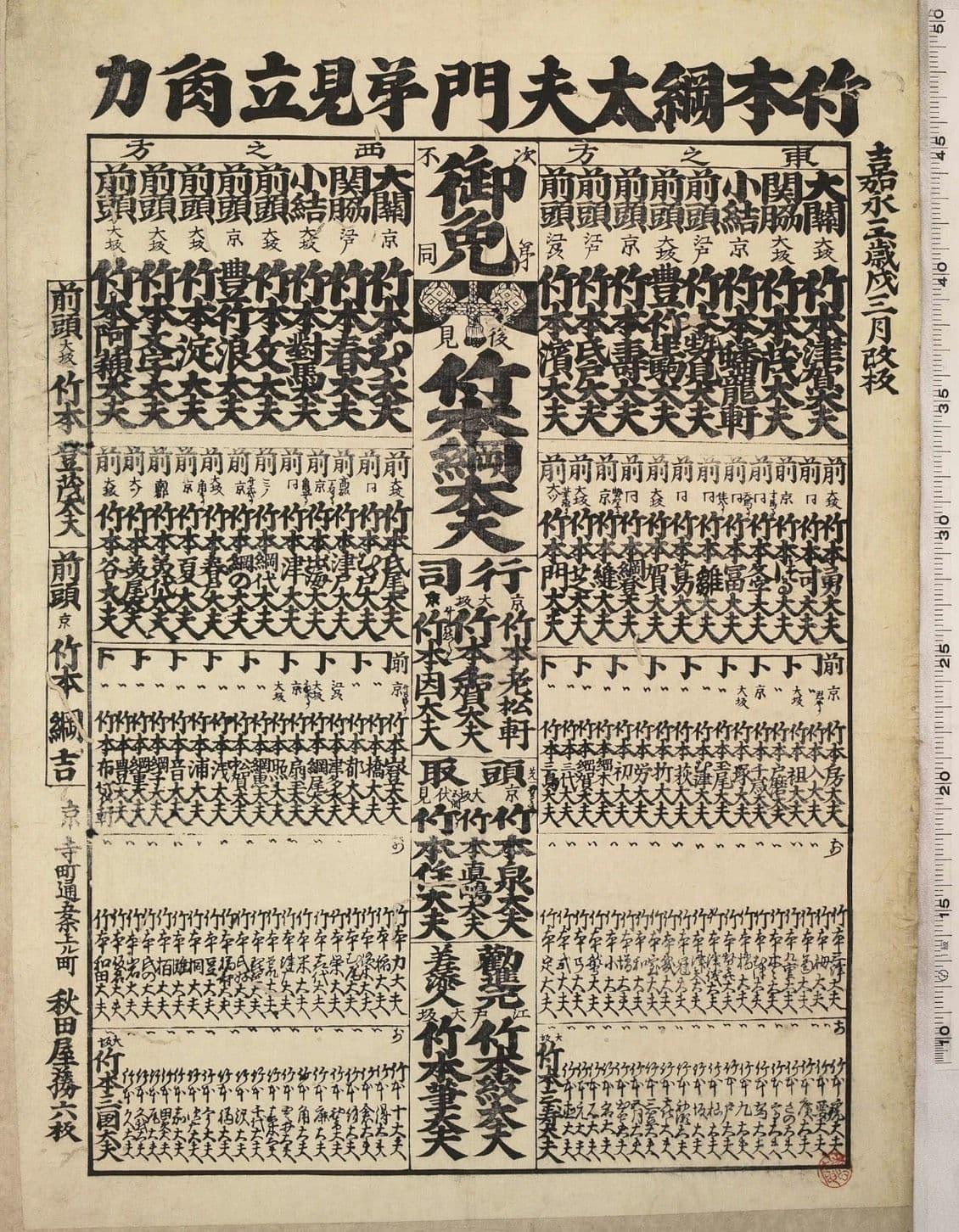
Picture a Western orchestra and the absence of a conductor seems strange. But kabuki music is built so as not to need one — because its tempo is not fixed.
Kabuki music stretches and contracts with the breathing of the actors on stage. If an actor holds a mie a beat longer, the music extends to meet him. If the dialogue runs quick, it follows. The music, in other words, is continually responding to what the stage is doing. Place a conductor imposing tempo from outside and that responsiveness stops working.
That does not mean nobody leads. In nagauta the tate-uta and tate-jamisen — the principal singer and principal shamisen — draw the ensemble along by shared breath. In gidayū the chanter and shamisen lead as a pair. Cues are given by the players' own calls, which serve in practice as words of instruction. It is not, then, that there is no conductor; conducting is distributed to everyone, in the form of breath. Everyone is watching the stage and everyone is listening to everyone else. Without that arrangement, the music could not stretch to meet the actors at all.
Words Used Above
Words in This Answer
- 長唄nagautaNagauta is the lyrical school of shamisen music that grew up with Edo kabuki, accompanying dance and coloring scenes throughout the play.
- 竹本takemotoTakemoto is gidayū narrative music as performed in kabuki: a chanter and thick-necked shamisen carry the story in plays adapted from the puppet theatre.
- 黒御簾kuromisuThe kuromisu is the black-latticed room at the side of the kabuki stage where unseen musicians perform geza music live, in step with the drama.
- 三味線shamisenThe shamisen is the three-stringed, plectrum-struck instrument at the heart of kabuki music, built in thin-, middle-, and thick-necked types for different musical styles.
More in This Category
Sources & Method
This answer rests on widely shared, established knowledge of kabuki. Matters transmitted as custom are marked "it is said," and assertion is avoided.
- Author
- KABUKI Universe Editorial Team
- Supervision
- Ichikawa Danjūrō
- Published
- Aug 25, 2026
- Updated
- Sep 9, 2026
Supervision means Ichikawa Danjūrō has reviewed this page's intent and key points. The text is the editorial team's writing, not Ichikawa Danjūrō's own statements. Editorial responsibility rests with the team, which corrects any error. Read the editorial policy