Q&A
Acting & Stage Expression
Are there plays where the tsuke clappers are not used?
ANSWER
Yes. The tsuke accents movement, so quiet domestic scenes, the formal matsubame pieces and shin-kabuki may use it sparingly or not at all.
The Short Version
- The tsuke punctuates peaks of movement — running, fights, the mie — and does not sound throughout.
- In matsubame pieces modelled on noh, the whole staging is restrained to match its formality.
- Shin-kabuki and quiet domestic scenes often forgo the tsuke to protect their realism.
- Its absence, too, is a staging choice.
See it in a picture
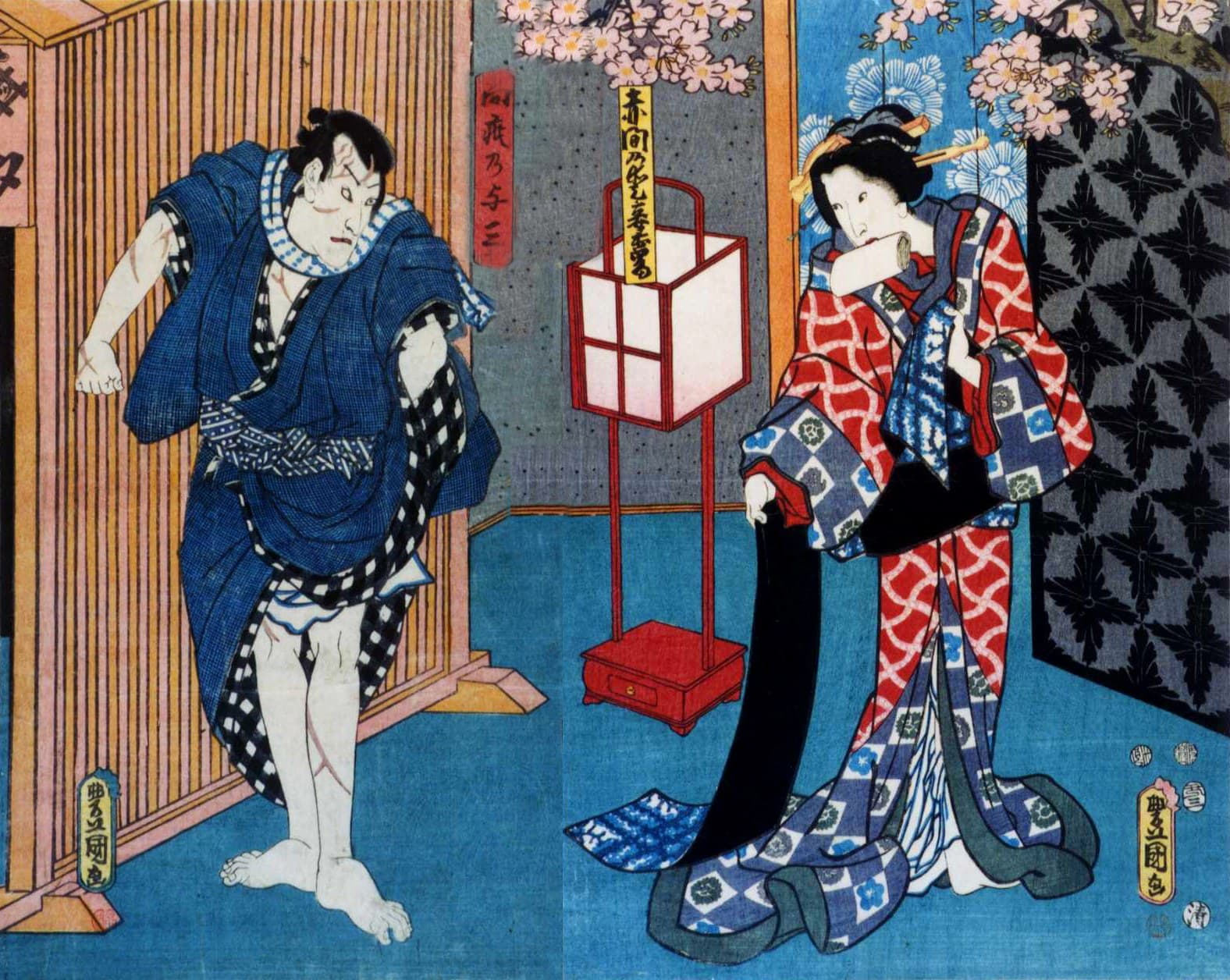
The tsuke is a sound emblematic of kabuki, but it does not sound continuously in every play. To restate its office: it exists to punctuate peaks of movement — running, fighting, the mie. Where there are no such peaks, or where emphasis by sound would be wrong, it simply has no work to do.
Some cases where it is dropped or heavily restrained. One is the matsubame pieces: drawn from noh and kyōgen and played against an imitation noh stage, they restrain the whole staging to match noh's formality, and a showy sound effect does not belong to that idiom. Another is shin-kabuki, written from Meiji onward. Composed as dramatic literature, these works often aim at realistic acting, and many of their scenes forgo stylised sound effects.
And the quiet domestic scenes. Depicting ordinary life, they often proceed with feeling held down, and a hard wooden crack would break them. This is truer still of the kizewamono, the works closest to realism. The absence of the tsuke, in other words, is itself a choice of staging: the quality of a scene changes by its not sounding. As a viewer, attending to when it does not sound, as well as when it does, brings each play's design into view.
Words Used Above
- Tachimawari
- The stylised fight scene — one of the places the tsuke works hardest.
- Kizewamono
- The domestic plays closest to realism, drawing the life of Edo's commoners in fine detail.
Words in This Answer
- ツケtsukeTsuke are the sharp beats of wooden clappers struck against a board at the side of the stage, accenting footsteps and landing exactly on the frozen mie poses.
- 松羽目物matsubamemonoMatsubamemono are dignified pieces adapted from Noh and Kyōgen, performed before a pine-panel set modeled on the Noh stage—a genre said to begin with Kanjinchō.
- 新歌舞伎shin-kabukiShin-kabuki ("new kabuki") names the plays written for the kabuki stage by independent literary authors from late Meiji to early Shōwa, joining modern drama to kabuki technique.
- 生世話物kizewamonoKizewamono are the most sharply realistic of kabuki's domestic plays, depicting the raw life and lower depths of the Edo townsman's world.
More in This Category
Sources & Method
This answer rests on widely shared, established knowledge of kabuki. Matters transmitted as custom are marked "it is said," and assertion is avoided.
- Author
- KABUKI Universe Editorial Team
- Supervision
- Ichikawa Danjūrō
- Published
- Aug 25, 2026
- Updated
- Sep 9, 2026
Supervision means Ichikawa Danjūrō has reviewed this page's intent and key points. The text is the editorial team's writing, not Ichikawa Danjūrō's own statements. Editorial responsibility rests with the team, which corrects any error. Read the editorial policy