Q&A
Acting & Stage Expression
From the stage, can actors see individual faces in the audience?
ANSWER
Stage lights are far brighter than the house, so faces are hard to make out — but the audience's presence, reactions and the ōmukō calls certainly reach the stage.
The Short Version
- Looking from strong light into a dark house, one senses shapes but can hardly read faces.
- Yet laughter, a held breath and the warmth of applause certainly reach the stage.
- The ōmukō calls arrive clearly enough to be built into the play's timing.
- The hanamichi runs through the audience, so there the distance collapses entirely.
See it in a picture
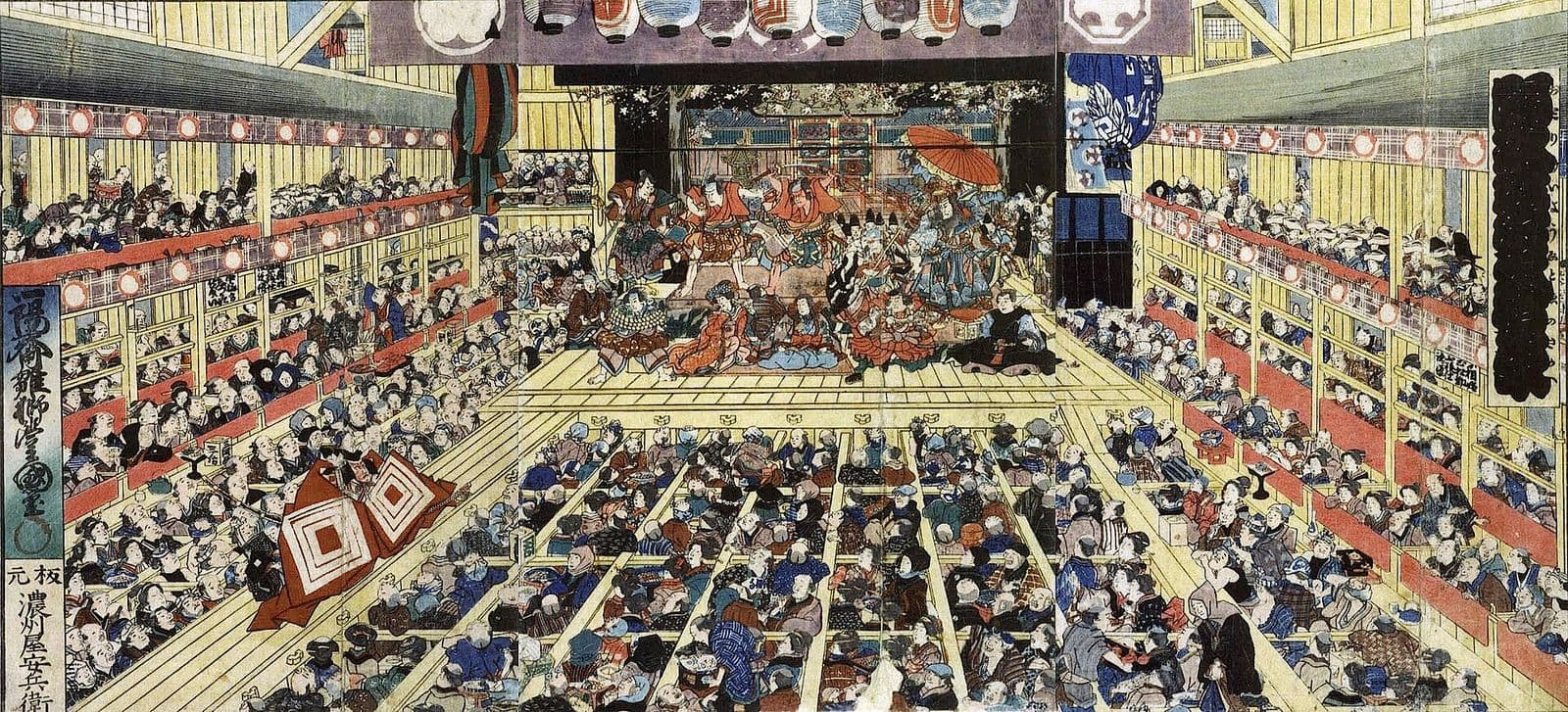
This follows from a condition common to stages everywhere. Stage lighting is set far brighter than the house. Standing in strong light and looking into a dark auditorium, one can make out the shapes of seated people and how full the room is, but reading individual expressions is hard. The eye is adapted to the brightness, so the dark side becomes difficult to see — a plainly physiological matter.
But not seeing and not sensing are different things. Kabuki actors are said to steer a performance while receiving the house's responses in detail. Whether laughter comes, whether a hush of held breath opens, at what temperature the applause arrives — all of this transmits clearly as sound and atmosphere. The quality of a house differs from day to day even in the same play, and the timing is said to shift in response.
What reaches the stage most surely of all is the ōmukō call. The short cry thrown at the locking of a mie or at an entrance arrives clearly enough to be built into the play's timing. And the hanamichi itself changes the distance altogether. It runs through the audience, so when an actor walks it the gap narrows to a matter of centimetres, and the lighting conditions differ from those on stage. On the hanamichi, one may take it that the faces are genuinely visible.
Words Used Above
- The temperature of a house
- How engaged a given audience is — sensed from the stage as sound and atmosphere.
Words in This Answer
- 大向うōmukōŌmukō are the well-timed shouts of an actor's house name—"Naritaya!"—from the back of the theatre, and the aficionados who make them.
- 花道hanamichiThe hanamichi is a raised runway through the audience that turns an actor's entrances and exits into dramatic highlights of their own.
- 桟敷sajikiSajiki are the raised box seats along the sides of the auditorium, descended from ancient festival viewing stands and preserved at the Kabukiza today.
More in This Category
Sources & Method
This answer rests on widely shared, established knowledge of kabuki. Matters transmitted as custom are marked "it is said," and assertion is avoided.
- Author
- KABUKI Universe Editorial Team
- Supervision
- Ichikawa Danjūrō
- Published
- Aug 25, 2026
- Updated
- Sep 9, 2026
Supervision means Ichikawa Danjūrō has reviewed this page's intent and key points. The text is the editorial team's writing, not Ichikawa Danjūrō's own statements. Editorial responsibility rests with the team, which corrects any error. Read the editorial policy