Q&A
Going to the Theatre
What should I focus on when watching kabuki?
ANSWER
First time, trust your senses over the plot: colour and sound, the instant of the mie, entrances on the hanamichi. Collect what amazes you, not what puzzles you.
The Short Version
- Kabuki is built to work even when you do not follow the whole story.
- Costume colour speaks a character's nature: red for righteousness and strength, indigo for the villain.
- The geza music from behind the black bamboo blind announces a scene's air and season.
- The stillness of a mie and entrances on the hanamichi reach the body with no preparation at all.
See it in a picture
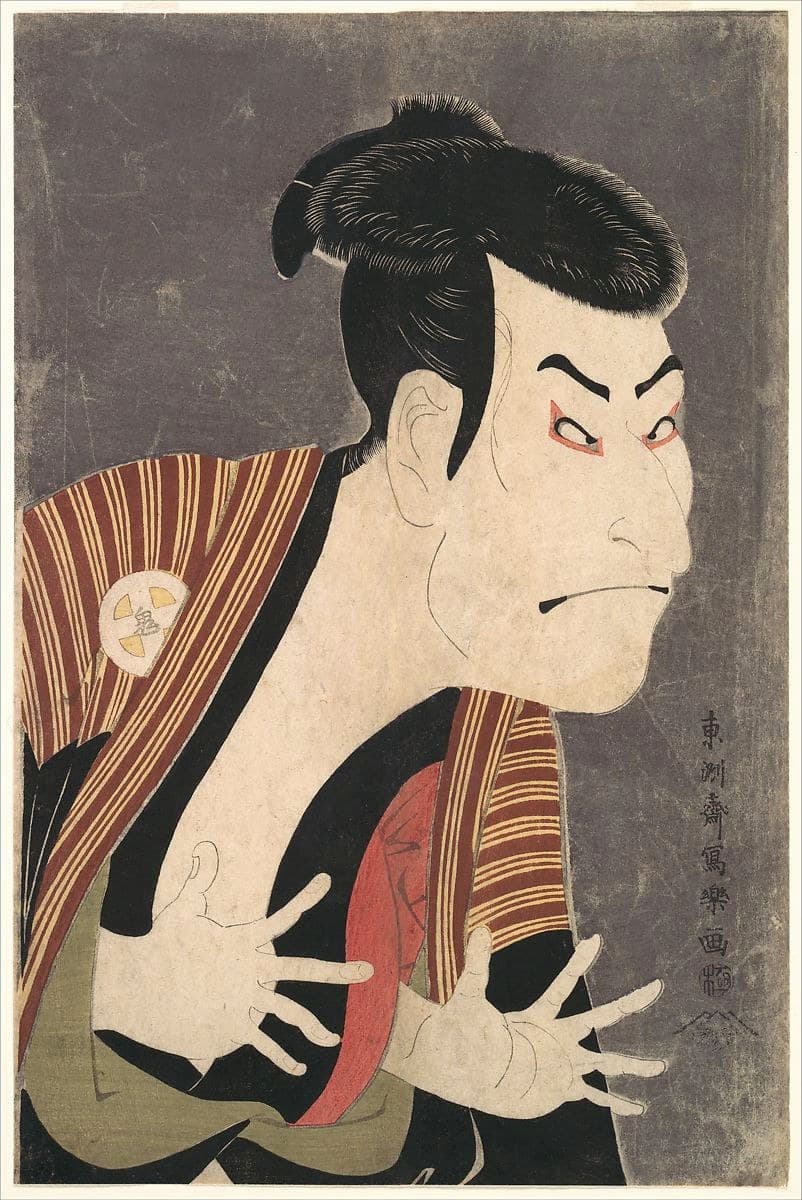
The greatest waste on a first visit is to panic about not following the story and so miss what is happening in front of you. Kabuki is built to work even when the plot escapes you. Edo audiences came in partway, watched a single act and left. So begin by trusting your senses.
What to look at, concretely. First, colour. Kabuki's costume and makeup colours carry meaning: the red of kumadori is held to signify righteousness and strength, indigo the villain or the supernatural. Face and costume alone will tell you a good deal about which side someone is on. Then sound. From the kuromisu, the black-blinded room on the audience's left (the shimote side), comes the geza music that announces a scene's air, its season, its hour, the shape of what is about to happen. The sound of rain, of snow, of a ghost's approach — you need not identify them for them to reach you.
And two great set-pieces. First, the mie: the actor stops, draws his eyes together, and the tsuke locks. The stage is declaring that this is the summit, so it cannot be missed. Second, the hanamichi: the walkway running through the audience along which actors arrive and depart. Having a performer pass at arm's length is something few other theatres offer. From the second visit, know the plot and start collecting the devices. Not everything at once, but more each time — that is how this theatre is designed.
Words Used Above
- Geza music
- The music and sound effects played inside the kuromisu, conveying scene, weather and mood.
- Shōne (a character's nature)
- The fundamental nature of a character — shown from the outside by the colours of costume and makeup.
Words in This Answer
- 見得mieA mie is the stylized pose in which an actor freezes at a moment of peak emotion, punctuated by the sharp crack of wooden clappers.
- 花道hanamichiThe hanamichi is a raised runway through the audience that turns an actor's entrances and exits into dramatic highlights of their own.
- 黒御簾kuromisuThe kuromisu is the black-latticed room at the side of the kabuki stage where unseen musicians perform geza music live, in step with the drama.
- 隈取の色kumadori no iroThe colours of kumadori makeup tell you who a character is: red for heroic justice, indigo blue for villains and vengeful spirits, brown for demons and the supernatural.
More in This Category
Sources & Method
This answer rests on widely shared, established knowledge of kabuki. Matters transmitted as custom are marked "it is said," and assertion is avoided.
- Author
- KABUKI Universe Editorial Team
- Supervision
- Ichikawa Danjūrō
- Published
- Aug 25, 2026
- Updated
- Sep 9, 2026
Supervision means Ichikawa Danjūrō has reviewed this page's intent and key points. The text is the editorial team's writing, not Ichikawa Danjūrō's own statements. Editorial responsibility rests with the team, which corrects any error. Read the editorial policy